Record Information
Version1.0
Creation Date2009-06-22 16:08:28 UTC
Update Date2026-04-14 20:05:40 UTC
Accession NumberCHEM001462
Identification
Common NameOctyl cyanoacrylate
ClassSmall Molecule
DescriptionOctyl cyanoacrylate is a chemical compound of cyanide. It is the main component of medical cyanoacrylate glues, which are used as adhesives for lacerations of the skin, and in the treatment of bleeding from vascular structures. (3)
Contaminant Sources
  • T3DB toxins
Contaminant Type
  • Cyanide Compound
  • Ether
  • Industrial/Workplace Toxin
  • Nitrile
  • Organic Compound
  • Synthetic Compound
Chemical Structure
Thumb
Synonyms
ValueSource
Octyl cyanoacrylic acidGenerator
OcrilateChEMBL
Ocrilic acidGenerator
2-Octyl cyanoacrylateMeSH
2-OctylcyanoacrylateMeSH
DermabondMeSH
N-Octyl-cyanoacrylateMeSH
Octyl 2-cyanoacrylateMeSH
2-Propenoic acid, 2-cyano-, octyl esterMeSH
OcrylateMeSH
Chemical FormulaC12H19NO2
Average Molecular Mass209.285 g/mol
Monoisotopic Mass209.142 g/mol
CAS Registry Number6701-17-3
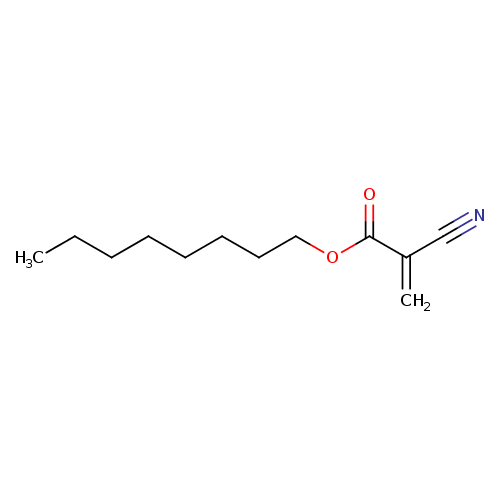
IUPAC Nameoctyl 2-cyanoprop-2-enoate
Traditional Namedermabond
SMILESCCCCCCCCOC(=O)C(=C)C#N
InChI IdentifierInChI=1S/C12H19NO2/c1-3-4-5-6-7-8-9-15-12(14)11(2)10-13/h2-9H2,1H3
InChI KeyRPQUGMLCZLGZTG-UHFFFAOYSA-N
Chemical Taxonomy
Description belongs to the class of organic compounds known as cyanoacrylates. These are organonitrogen compounds containing an acrylic acid ester, which carries a nitrile group. They have the general structure ROC(=O)C(=C)C#N, where R is an organic group.
KingdomOrganic compounds
Super ClassOrganic acids and derivatives
ClassCarboxylic acids and derivatives
Sub ClassCarboxylic acid derivatives
Direct ParentCyanoacrylates
Alternative Parents
Substituents
  • Cyanoacrylic acid ester
  • Nitrile
  • Carbonitrile
  • Monocarboxylic acid or derivatives
  • Organic nitrogen compound
  • Organic oxygen compound
  • Organopnictogen compound
  • Organic oxide
  • Hydrocarbon derivative
  • Organooxygen compound
  • Organonitrogen compound
  • Carbonyl group
  • Aliphatic acyclic compound
Molecular FrameworkAliphatic acyclic compounds
External DescriptorsNot Available
Biological Properties
StatusDetected and Not Quantified
OriginExogenous
Cellular Locations
  • Membrane
Biofluid LocationsNot Available
Tissue LocationsNot Available
PathwaysNot Available
ApplicationsNot Available
Biological RolesNot Available
Chemical RolesNot Available
Physical Properties
StateLiquid
AppearanceColorless liquid.
Experimental Properties
PropertyValue
Melting PointNot Available
Boiling PointNot Available
SolubilityNot Available
Predicted Properties
PropertyValueSource
Water Solubility0.02 g/LALOGPS
logP4.14ALOGPS
logP3.83ChemAxon
logS-4ALOGPS
pKa (Strongest Basic)-7.2ChemAxon
Physiological Charge0ChemAxon
Hydrogen Acceptor Count2ChemAxon
Hydrogen Donor Count0ChemAxon
Polar Surface Area50.09 ŲChemAxon
Rotatable Bond Count9ChemAxon
Refractivity59.39 m³·mol⁻¹ChemAxon
Polarizability24.58 ųChemAxon
Number of Rings0ChemAxon
Bioavailability1ChemAxon
Rule of FiveYesChemAxon
Ghose FilterYesChemAxon
Veber's RuleNoChemAxon
MDDR-like RuleNoChemAxon
Spectra
Spectra
Spectrum TypeDescriptionSplash KeyView
Predicted LC-MS/MSPredicted LC-MS/MS Spectrum - 10V, Positivesplash10-03di-5590000000-71a222c7b64c9c431953Spectrum
Predicted LC-MS/MSPredicted LC-MS/MS Spectrum - 20V, Positivesplash10-0w29-9600000000-425de2cee4da5c5612d8Spectrum
Predicted LC-MS/MSPredicted LC-MS/MS Spectrum - 40V, Positivesplash10-0udi-9000000000-e5df365ca9b772dcc012Spectrum
Predicted LC-MS/MSPredicted LC-MS/MS Spectrum - 10V, Negativesplash10-0a4i-2190000000-2cc52eb2da5485ba02d1Spectrum
Predicted LC-MS/MSPredicted LC-MS/MS Spectrum - 20V, Negativesplash10-0f6t-9120000000-c0bf8cbac5bb2cbba58dSpectrum
Predicted LC-MS/MSPredicted LC-MS/MS Spectrum - 40V, Negativesplash10-0udi-9000000000-8c374adc0c616706ff87Spectrum
Toxicity Profile
Route of ExposureOral (1) ; inhalation (1) ; dermal (1)
Mechanism of ToxicityOrganic nitriles decompose into cyanide ions both in vivo and in vitro. Consequently the primary mechanism of toxicity for organic nitriles is their production of toxic cyanide ions or hydrogen cyanide. Cyanide is an inhibitor of cytochrome c oxidase in the fourth complex of the electron transport chain (found in the membrane of the mitochondria of eukaryotic cells). It complexes with the ferric iron atom in this enzyme. The binding of cyanide to this cytochrome prevents transport of electrons from cytochrome c oxidase to oxygen. As a result, the electron transport chain is disrupted and the cell can no longer aerobically produce ATP for energy. Tissues that mainly depend on aerobic respiration, such as the central nervous system and the heart, are particularly affected. Cyanide is also known produce some of its toxic effects by binding to catalase, glutathione peroxidase, methemoglobin, hydroxocobalamin, phosphatase, tyrosinase, ascorbic acid oxidase, xanthine oxidase, succinic dehydrogenase, and Cu/Zn superoxide dismutase. Cyanide binds to the ferric ion of methemoglobin to form inactive cyanmethemoglobin. (2)
MetabolismOrganic nitriles are converted into cyanide ions through the action of cytochrome P450 enzymes in the liver. Cyanide is rapidly absorbed and distributed throughout the body. Cyanide is mainly metabolized into thiocyanate by either rhodanese or 3-mercaptopyruvate sulfur transferase. Cyanide metabolites are excreted in the urine. (1)
Toxicity ValuesNot Available
Lethal Dose223 to 300 milligrams for an adult human (cyanide salts). (4)
Carcinogenicity (IARC Classification)No indication of carcinogenicity to humans (not listed by IARC).
Uses/SourcesOctyl cyanoacrylate is the main component of medical cyanoacrylate glues, which are used as adhesives for lacerations of the skin, and in the treatment of bleeding from vascular structures. (3)
Minimum Risk LevelNot Available
Health EffectsExposure to high levels of cyanide for a short time harms the brain and heart and can even cause coma, seizures, apnea, cardiac arrest and death. Chronic inhalation of cyanide causes breathing difficulties, chest pain, vomiting, blood changes, headaches, and enlargement of the thyroid gland. Skin contact with cyanide salts can irritate and produce sores. (1, 2)
SymptomsCyanide poisoning is identified by rapid, deep breathing and shortness of breath, general weakness, giddiness, headaches, vertigo, confusion, convulsions/seizures and eventually loss of consciousness. (1, 2)
TreatmentAntidotes to cyanide poisoning include hydroxocobalamin and sodium nitrite, which release the cyanide from the cytochrome system, and rhodanase, which is an enzyme occurring naturally in mammals that combines serum cyanide with thiosulfate, producing comparatively harmless thiocyanate. Oxygen therapy can also be administered. (2)

Concentrations
Not Available
DrugBank IDNot Available
HMDB IDNot Available
FooDB IDNot Available
Phenol Explorer IDNot Available
KNApSAcK IDNot Available
BiGG IDNot Available
BioCyc IDNot Available
METLIN IDNot Available
PDB IDNot Available
Wikipedia LinkOctyl cyanoacrylate
Chemspider IDNot Available
ChEBI IDNot Available
PubChem Compound ID23167
Kegg Compound IDNot Available
YMDB IDNot Available
ECMDB IDNot Available
References
Synthesis ReferenceNot Available
MSDSNot Available
General ReferencesNot Available