Record Information
Version1.0
Creation Date2009-06-22 16:08:28 UTC
Update Date2026-03-26 22:58:35 UTC
Accession NumberCHEM001460
Identification
Common NameMalononitrile
ClassSmall Molecule
DescriptionMalononitrile is a chemical compound of cyanide.
Contaminant Sources
  • Clean Air Act Chemicals
  • HPV EPA Chemicals
  • STOFF IDENT Compounds
  • T3DB toxins
  • ToxCast & Tox21 Chemicals
Contaminant Type
  • Cyanide Compound
  • Industrial/Workplace Toxin
  • Nitrile
  • Organic Compound
  • Synthetic Compound
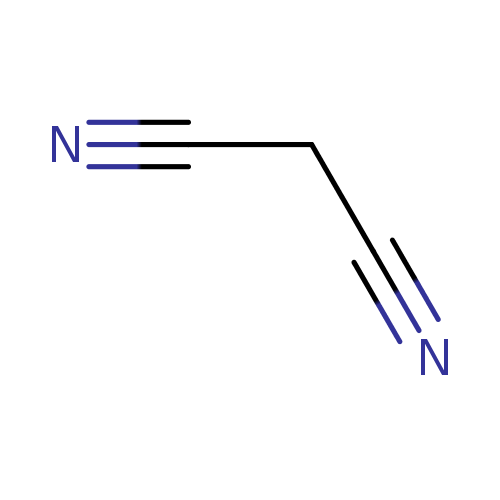
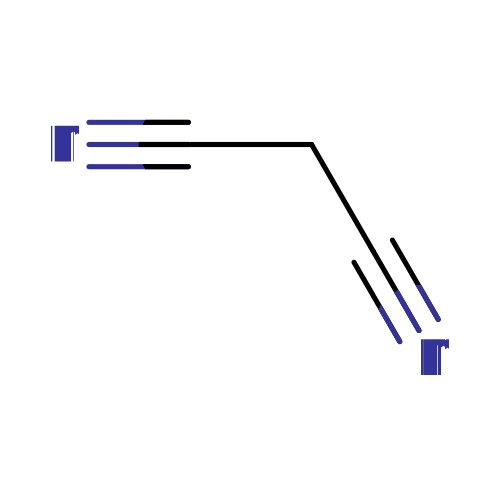
Chemical Structure
Thumb
Synonyms
ValueSource
DicyanmethaneChEBI
DicyanomethaneChEBI
MalonsaeuredinitrilChEBI
PropanedinitrileChEBI
MalonodinitrileMeSH
MalonitrileMeSH
Chemical FormulaC3H2N2
Average Molecular Mass66.061 g/mol
Monoisotopic Mass66.022 g/mol
CAS Registry Number109-77-3
IUPAC Namepropanedinitrile
Traditional Namemalononitrile
SMILESN#CCC#N
InChI IdentifierInChI=1S/C3H2N2/c4-2-1-3-5/h1H2
InChI KeyCUONGYYJJVDODC-UHFFFAOYSA-N
Chemical Taxonomy
Description belongs to the class of organic compounds known as nitriles. Nitriles are compounds having the structure RC#N; thus C-substituted derivatives of hydrocyanic acid, HC#N.
KingdomOrganic compounds
Super ClassOrganic nitrogen compounds
ClassOrganonitrogen compounds
Sub ClassOrganic cyanides
Direct ParentNitriles
Alternative Parents
Substituents
  • Nitrile
  • Carbonitrile
  • Organopnictogen compound
  • Hydrocarbon derivative
  • Aliphatic acyclic compound
Molecular FrameworkAliphatic acyclic compounds
External Descriptors
Biological Properties
StatusDetected and Not Quantified
OriginExogenous
Cellular Locations
  • Cytoplasm
  • Extracellular
Biofluid LocationsNot Available
Tissue LocationsNot Available
PathwaysNot Available
ApplicationsNot Available
Biological RolesNot Available
Chemical RolesNot Available
Physical Properties
StateSolid
AppearanceColorless crystals.
Experimental Properties
PropertyValue
Melting Point32°C
Boiling PointNot Available
Solubility133 mg/mL at 25°C [KIRK-OTHMER; 4th ed, 15:941 (1995)]
Predicted Properties
PropertyValueSource
Water Solubility9.65 g/LALOGPS
logP-0.84ALOGPS
logP-0.22ChemAxon
logS-0.84ALOGPS
pKa (Strongest Acidic)8.52ChemAxon
Physiological Charge0ChemAxon
Hydrogen Acceptor Count2ChemAxon
Hydrogen Donor Count0ChemAxon
Polar Surface Area47.58 ŲChemAxon
Rotatable Bond Count0ChemAxon
Refractivity16.95 m³·mol⁻¹ChemAxon
Polarizability6.02 ųChemAxon
Number of Rings0ChemAxon
Bioavailability1ChemAxon
Rule of FiveYesChemAxon
Ghose FilterNoChemAxon
Veber's RuleNoChemAxon
MDDR-like RuleNoChemAxon
Spectra
Spectra
Spectrum TypeDescriptionSplash KeyView
Predicted GC-MSPredicted GC-MS Spectrum - GC-MS (Non-derivatized) - 70eV, Positivesplash10-014i-9000000000-4cc7a3f6016abf074b35Spectrum
Predicted GC-MSPredicted GC-MS Spectrum - GC-MS (Non-derivatized) - 70eV, PositiveNot AvailableSpectrum
Predicted LC-MS/MSPredicted LC-MS/MS Spectrum - 10V, Positivesplash10-014i-9000000000-efbb3e110ec5399b1112Spectrum
Predicted LC-MS/MSPredicted LC-MS/MS Spectrum - 20V, Positivesplash10-014i-9000000000-efbb3e110ec5399b1112Spectrum
Predicted LC-MS/MSPredicted LC-MS/MS Spectrum - 40V, Positivesplash10-014i-9000000000-efbb3e110ec5399b1112Spectrum
Predicted LC-MS/MSPredicted LC-MS/MS Spectrum - 10V, Negativesplash10-014i-9000000000-8ac5279924c670259352Spectrum
Predicted LC-MS/MSPredicted LC-MS/MS Spectrum - 20V, Negativesplash10-014i-9000000000-8ac5279924c670259352Spectrum
Predicted LC-MS/MSPredicted LC-MS/MS Spectrum - 40V, Negativesplash10-014i-9000000000-8ac5279924c670259352Spectrum
Predicted LC-MS/MSPredicted LC-MS/MS Spectrum - 10V, Positivesplash10-0006-9000000000-042ab9174696882de89dSpectrum
Predicted LC-MS/MSPredicted LC-MS/MS Spectrum - 20V, Positivesplash10-0006-9000000000-042ab9174696882de89dSpectrum
Predicted LC-MS/MSPredicted LC-MS/MS Spectrum - 40V, Positivesplash10-0006-9000000000-59ddeaf8d4c17a5de5fcSpectrum
Predicted LC-MS/MSPredicted LC-MS/MS Spectrum - 10V, Negativesplash10-014i-9000000000-673b735ba50fadb2df73Spectrum
Predicted LC-MS/MSPredicted LC-MS/MS Spectrum - 20V, Negativesplash10-014i-9000000000-673b735ba50fadb2df73Spectrum
Predicted LC-MS/MSPredicted LC-MS/MS Spectrum - 40V, Negativesplash10-014i-9000000000-673b735ba50fadb2df73Spectrum
MSMass Spectrum (Electron Ionization)splash10-014i-9000000000-a0656821d8c78c4517faSpectrum
1D NMR1H NMR SpectrumNot AvailableSpectrum
1D NMR13C NMR SpectrumNot AvailableSpectrum
1D NMR1H NMR SpectrumNot AvailableSpectrum
1D NMR13C NMR SpectrumNot AvailableSpectrum
1D NMR1H NMR SpectrumNot AvailableSpectrum
1D NMR13C NMR SpectrumNot AvailableSpectrum
1D NMR1H NMR SpectrumNot AvailableSpectrum
1D NMR13C NMR SpectrumNot AvailableSpectrum
1D NMR1H NMR SpectrumNot AvailableSpectrum
1D NMR13C NMR SpectrumNot AvailableSpectrum
1D NMR1H NMR SpectrumNot AvailableSpectrum
1D NMR13C NMR SpectrumNot AvailableSpectrum
1D NMR1H NMR SpectrumNot AvailableSpectrum
1D NMR13C NMR SpectrumNot AvailableSpectrum
1D NMR1H NMR SpectrumNot AvailableSpectrum
1D NMR13C NMR SpectrumNot AvailableSpectrum
1D NMR1H NMR SpectrumNot AvailableSpectrum
1D NMR13C NMR SpectrumNot AvailableSpectrum
1D NMR1H NMR SpectrumNot AvailableSpectrum
Toxicity Profile
Route of ExposureOral (1) ; inhalation (1) ; dermal (1)
Mechanism of ToxicityOrganic nitriles decompose into cyanide ions both in vivo and in vitro. Consequently the primary mechanism of toxicity for organic nitriles is their production of toxic cyanide ions or hydrogen cyanide. Cyanide is an inhibitor of cytochrome c oxidase in the fourth complex of the electron transport chain (found in the membrane of the mitochondria of eukaryotic cells). It complexes with the ferric iron atom in this enzyme. The binding of cyanide to this cytochrome prevents transport of electrons from cytochrome c oxidase to oxygen. As a result, the electron transport chain is disrupted and the cell can no longer aerobically produce ATP for energy. Tissues that mainly depend on aerobic respiration, such as the central nervous system and the heart, are particularly affected. Cyanide is also known produce some of its toxic effects by binding to catalase, glutathione peroxidase, methemoglobin, hydroxocobalamin, phosphatase, tyrosinase, ascorbic acid oxidase, xanthine oxidase, succinic dehydrogenase, and Cu/Zn superoxide dismutase. Cyanide binds to the ferric ion of methemoglobin to form inactive cyanmethemoglobin. (2)
MetabolismOrganic nitriles are converted into cyanide ions through the action of cytochrome P450 enzymes in the liver. Cyanide is rapidly absorbed and distributed throughout the body. Cyanide is mainly metabolized into thiocyanate by either rhodanese or 3-mercaptopyruvate sulfur transferase. Cyanide metabolites are excreted in the urine. (1)
Toxicity ValuesLD50: 12.9 mg/kg (Intraperitoneal, Mouse) (5) LD50: 19 mg/kg (Oral, Mouse) (4) LD50: 350 mg/kg (Dermal, Rat) (3) LD50: 32 mg/kg (Intravenous, Mouse) (3)
Lethal Dose221 to 300 milligrams for an adult human (cyanide salts). (6)
Carcinogenicity (IARC Classification)No indication of carcinogenicity to humans (not listed by IARC).
Uses/SourcesNot Available
Minimum Risk LevelNot Available
Health EffectsExposure to high levels of cyanide for a short time harms the brain and heart and can even cause coma, seizures, apnea, cardiac arrest and death. Chronic inhalation of cyanide causes breathing difficulties, chest pain, vomiting, blood changes, headaches, and enlargement of the thyroid gland. Skin contact with cyanide salts can irritate and produce sores. (1, 2)
SymptomsCyanide poisoning is identified by rapid, deep breathing and shortness of breath, general weakness, giddiness, headaches, vertigo, confusion, convulsions/seizures and eventually loss of consciousness. (1, 2)
TreatmentAntidotes to cyanide poisoning include hydroxocobalamin and sodium nitrite, which release the cyanide from the cytochrome system, and rhodanase, which is an enzyme occurring naturally in mammals that combines serum cyanide with thiosulfate, producing comparatively harmless thiocyanate. Oxygen therapy can also be administered. (2)
Concentrations
Not Available
DrugBank IDNot Available
HMDB IDHMDB0254315
FooDB IDNot Available
Phenol Explorer IDNot Available
KNApSAcK IDNot Available
BiGG IDNot Available
BioCyc IDNot Available
METLIN IDNot Available
PDB IDNot Available
Wikipedia LinkMalononitrile
Chemspider ID13884495
ChEBI ID33186
PubChem Compound IDNot Available
Kegg Compound IDNot Available
YMDB IDNot Available
ECMDB IDNot Available
References
Synthesis ReferenceNot Available
MSDSNot Available
General References
1. https://www.ncbi.nlm.nih.gov/pubmed/?term=24683341