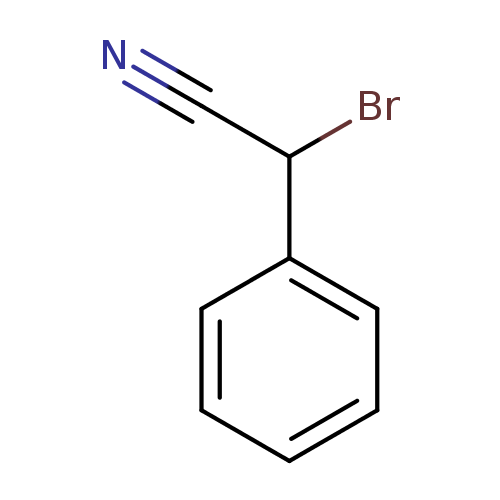
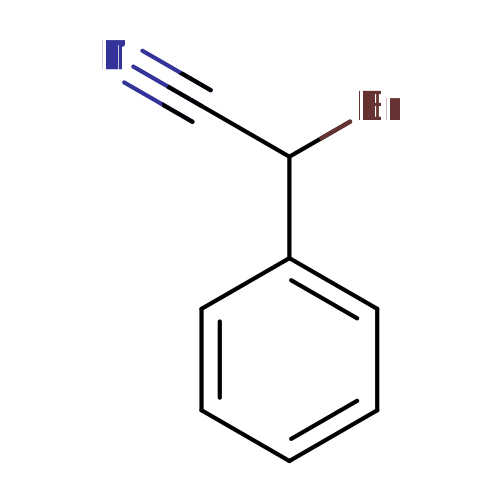
Bromobenzyl cyanide is a colorless organobromide compound. It is slightly soluble in water but readily soluble in organic solvents. Bromobenzyl cyanide is resistant to the action of water and oxidizers; it decomposes upon heating above 120° C and also when exposed to the action of a number of metals, which are thereby intensely corroded. Bromobenzyl cyanide is obtained by the action of sodium cyanide or potassium cyanide on benzyl chloride with subsequent bromination of the benzyl cyanide that has been formed. Bromobenzyl cyanide acts powerfully on the mucous membranes of the eye, causing irritation and heavy lachrymation. It was proposed as a toxic lachrymatory agent at the end of World War I and an irritant gas for law enforcement. It is chemically and biologically similar to Benzyl cyanide. Benzyl cyanide and its derivatives are used in organic synthesis for dyes, perfumes, pesticides, pharmaceuticals, especially penicillin precursors.
belongs to the class of organic compounds known as benzene and substituted derivatives. These are aromatic compounds containing one monocyclic ring system consisting of benzene.
Organic nitriles decompose into cyanide ions both in vivo and in vitro. Consequently the primary mechanism of toxicity for organic nitriles is their production of toxic cyanide ions or hydrogen cyanide. Cyanide is an inhibitor of cytochrome c oxidase in the fourth complex of the electron transport chain (found in the membrane of the mitochondria of eukaryotic cells). It complexes with the ferric iron atom in this enzyme. The binding of cyanide to this cytochrome prevents transport of electrons from cytochrome c oxidase to oxygen. As a result, the electron transport chain is disrupted and the cell can no longer aerobically produce ATP for energy. Tissues that mainly depend on aerobic respiration, such as the central nervous system and the heart, are particularly affected. Cyanide is also known produce some of its toxic effects by binding to catalase, glutathione peroxidase, methemoglobin, hydroxocobalamin, phosphatase, tyrosinase, ascorbic acid oxidase, xanthine oxidase, succinic dehydrogenase, and Cu/Zn superoxide dismutase. Cyanide binds to the ferric ion of methemoglobin to form inactive cyanmethemoglobin. (2)
Metabolism
Bromobenzyl cyanide is metabolized into bromobenzoic acid and thiocyanate, probably via hydroxylation to mandelonitrile. Hydrolysis of the cyanide group to give phenylacetic acid or bromophenylacetic occurs as minor pathway. Any liberated cyanide is mainly metabolized into thiocyanate by either rhodanese or 3-mercaptopyruvate sulfur transferase. Cyanide metabolites are excreted in the urine. Organic nitriles are converted into cyanide ions through the action of cytochrome P450 enzymes in the liver. Cyanide is rapidly absorbed and distributed throughout the body. Cyanide is mainly metabolized into thiocyanate by either rhodanese or 3-mercaptopyruvate sulfur transferase. Cyanide metabolites are excreted in the urine. (1)
Toxicity Values
Insupportable at 5 mg/m3.
Lethal Dose
109 ppm is lethal to humans in 5 hours; or 0.9 mg/L for 30 minutes.
No indication of carcinogenicity (not listed by IARC). (3)
Uses/Sources
Bromobenzyl cyanide is an industrial and laboratory chemical. Occupational exposure to Bromobenzyl cyanide may occur through inhalation and dermal contact with this compound at workplaces where Bromobenzyl cyanide is produced or used.
Minimum Risk Level
Minimal Effective Concentration: 0.2 mg/m3
Health Effects
Strong lachrymator. On exposure to eyes, corneal corpuscles become swollen and brownish during first 24 hr. This is followed by infiltration of cornea by macrophages, loss of normal endothelial reflex and appearance of fine irregularity in endothelium. Harmful if inhaled, swallowed or absorbed through skin. Target organs: central nervous system, blood, lungs, cardiovascular system, thyroid.
Symptoms
Causes severe eye and skin burns. Irritating to eyes, skin, and respiratory system. Acute exposure (ingestion or inhalation) can lead to coma, seizures, palpitations, dilated pupils, hypoventilation, shock, cyanosis, initial tachycardia and hypertension, and hypotension may be seen. Nausea, vomiting, and metabolic acidosis may occur.
Treatment
EYES: irrigate opened eyes for several minutes under running water.
INGESTION: do not induce vomiting. Rinse mouth with water (never give anything by mouth to an unconscious person). Seek immediate medical advice.
SKIN: should be treated immediately by rinsing the affected parts in cold running water for at least 15 minutes, followed by thorough washing with soap and water. If necessary, the person should shower and change contaminated clothing and shoes, and then must seek medical attention.
INHALATION: supply fresh air. If required provide artificial respiration.