Record Information
Version1.0
Creation Date2009-06-22 16:08:27 UTC
Update Date2026-03-31 18:10:08 UTC
Accession NumberCHEM001448
Identification
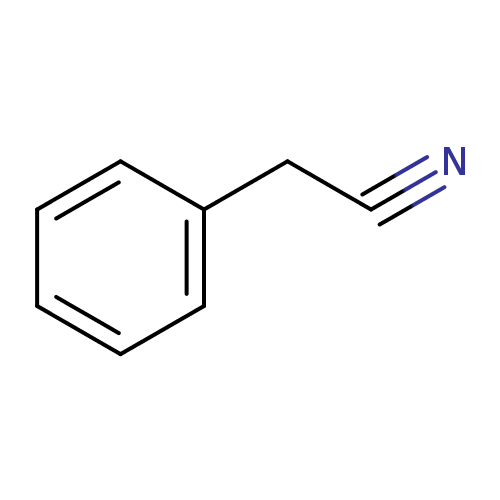
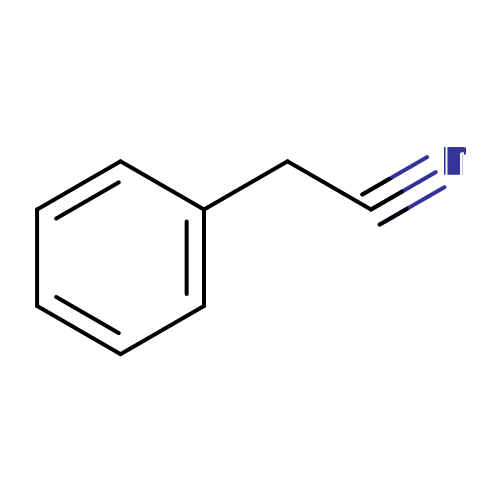
Common NameBenzeneacetonitrile
ClassSmall Molecule
DescriptionBenzeneacetonitrile is found in garden cress. Benzeneacetonitrile is isolated from oil of garden cress (Lepidium sativum) and other plant oils.
Contaminant Sources
  • Clean Air Act Chemicals
  • DEA Chemicals
  • FooDB Chemicals
  • STOFF IDENT Compounds
  • T3DB toxins
  • ToxCast & Tox21 Chemicals
Contaminant Type
  • Aromatic Hydrocarbon
  • Cyanide Compound
  • Food Toxin
  • Industrial/Workplace Toxin
  • Metabolite
  • Nitrile
  • Organic Compound
  • Synthetic Compound
Chemical Structure
Thumb
Synonyms
ValueSource
(Cyanomethyl)benzeneChEBI
2-PhenylacetonitrileChEBI
alpha-CyanotolueneChEBI
alpha-TolunitrileChEBI
Benzyl cyanideChEBI
Benzyl nitrileChEBI
a-CyanotolueneGenerator
Α-cyanotolueneGenerator
a-TolunitrileGenerator
Α-tolunitrileGenerator
.omega.-cyanotolueneHMDB
Acetic acid, phenyl-nitrileHMDB
alpha -CyanotolueneHMDB
alpha -TolunitrileHMDB
alpha-cyano-TolueneHMDB
Benzeneacetonitrile, 9ciHMDB
BenzylkyanidHMDB
BenzylnitrileHMDB
CyanophenylmethaneHMDB
EnzylcyanideHMDB
laquo omegaraquo -CyanotolueneHMDB
Omega-cyanotolueneHMDB
PhenacetonitrileHMDB
Phenyl acetyl nitrileHMDB
Phenyl-acetonitrileHMDB
PhenylacetonitrileHMDB
Phenylacetonitrile, liquidHMDB
BenzeneacetonitrileChEBI
Chemical FormulaC8H7N
Average Molecular Mass117.148 g/mol
Monoisotopic Mass117.058 g/mol
CAS Registry Number140-29-4
IUPAC Name2-phenylacetonitrile
Traditional Namephenylacetonitrile
SMILESN#CCC1=CC=CC=C1
InChI IdentifierInChI=1S/C8H7N/c9-7-6-8-4-2-1-3-5-8/h1-5H,6H2
InChI KeySUSQOBVLVYHIEX-UHFFFAOYSA-N
Chemical Taxonomy
Description belongs to the class of organic compounds known as benzyl cyanides. These are organic compounds containing an acetonitrile with one hydrogen replaced by a phenyl group.
KingdomOrganic compounds
Super ClassBenzenoids
ClassBenzene and substituted derivatives
Sub ClassBenzyl cyanides
Direct ParentBenzyl cyanides
Alternative Parents
Substituents
  • Benzyl-cyanide
  • Nitrile
  • Carbonitrile
  • Organic nitrogen compound
  • Organopnictogen compound
  • Hydrocarbon derivative
  • Organonitrogen compound
  • Aromatic homomonocyclic compound
Molecular FrameworkAromatic homomonocyclic compounds
External Descriptors
Biological Properties
StatusDetected and Not Quantified
OriginExogenous
Cellular Locations
  • Cytoplasm
  • Extracellular
Biofluid LocationsNot Available
Tissue LocationsNot Available
PathwaysNot Available
ApplicationsNot Available
Biological Roles
Chemical RolesNot Available
Physical Properties
StateLiquid
AppearanceColorless liquid.
Experimental Properties
PropertyValue
Melting Point-23.8°C
Boiling PointNot Available
Solubility0.1 mg/mL at 25°C
Predicted Properties
PropertyValueSource
Water Solubility6.85 g/LALOGPS
logP1.42ALOGPS
logP1.67ChemAxon
logS-1.2ALOGPS
pKa (Strongest Acidic)14.33ChemAxon
Physiological Charge0ChemAxon
Hydrogen Acceptor Count1ChemAxon
Hydrogen Donor Count0ChemAxon
Polar Surface Area23.79 ŲChemAxon
Rotatable Bond Count1ChemAxon
Refractivity36.34 m³·mol⁻¹ChemAxon
Polarizability12.75 ųChemAxon
Number of Rings1ChemAxon
Bioavailability1ChemAxon
Rule of FiveYesChemAxon
Ghose FilterNoChemAxon
Veber's RuleYesChemAxon
MDDR-like RuleNoChemAxon
Spectra
Spectra
Spectrum TypeDescriptionSplash KeyView
GC-MSGC-MS Spectrum - EI-B (Non-derivatized)splash10-014i-9700000000-aa951610ae3086079fc3Spectrum
GC-MSGC-MS Spectrum - EI-B (Non-derivatized)splash10-014i-6900000000-9fa568274538519d6221Spectrum
GC-MSGC-MS Spectrum - EI-B (Non-derivatized)splash10-014i-4900000000-7fb420e2a4693843bcc6Spectrum
GC-MSGC-MS Spectrum - EI-B (Non-derivatized)splash10-014i-9700000000-44dc07c52f713661d49dSpectrum
GC-MSGC-MS Spectrum - EI-B (Non-derivatized)splash10-014i-9700000000-aa951610ae3086079fc3Spectrum
GC-MSGC-MS Spectrum - EI-B (Non-derivatized)splash10-014i-6900000000-9fa568274538519d6221Spectrum
GC-MSGC-MS Spectrum - EI-B (Non-derivatized)splash10-014i-4900000000-7fb420e2a4693843bcc6Spectrum
GC-MSGC-MS Spectrum - EI-B (Non-derivatized)splash10-014i-9700000000-44dc07c52f713661d49dSpectrum
Predicted GC-MSPredicted GC-MS Spectrum - GC-MS (Non-derivatized) - 70eV, Positivesplash10-014i-9600000000-3ff8c2a019af8041ccf5Spectrum
Predicted GC-MSPredicted GC-MS Spectrum - GC-MS (Non-derivatized) - 70eV, PositiveNot AvailableSpectrum
Predicted LC-MS/MSPredicted LC-MS/MS Spectrum - 10V, Positivesplash10-014i-0900000000-26618186da25d2fb36a3Spectrum
Predicted LC-MS/MSPredicted LC-MS/MS Spectrum - 20V, Positivesplash10-014i-2900000000-36bcc9666d8d6f02be93Spectrum
Predicted LC-MS/MSPredicted LC-MS/MS Spectrum - 40V, Positivesplash10-0006-9100000000-e64aaf4670bfdd42e5ecSpectrum
Predicted LC-MS/MSPredicted LC-MS/MS Spectrum - 10V, Negativesplash10-014i-0900000000-c300e5c9a5a8fd9efed7Spectrum
Predicted LC-MS/MSPredicted LC-MS/MS Spectrum - 20V, Negativesplash10-014i-1900000000-62ae29742c669f0cbb48Spectrum
Predicted LC-MS/MSPredicted LC-MS/MS Spectrum - 40V, Negativesplash10-00kr-9400000000-a31fa80a0b41e8872dfdSpectrum
Predicted LC-MS/MSPredicted LC-MS/MS Spectrum - 10V, Negativesplash10-014i-0900000000-89c3f30c8225ba6d5d62Spectrum
Predicted LC-MS/MSPredicted LC-MS/MS Spectrum - 20V, Negativesplash10-014i-0900000000-89c3f30c8225ba6d5d62Spectrum
Predicted LC-MS/MSPredicted LC-MS/MS Spectrum - 40V, Negativesplash10-014i-7900000000-a5d53547c4ff1f8c5b08Spectrum
Predicted LC-MS/MSPredicted LC-MS/MS Spectrum - 10V, Positivesplash10-00kf-9600000000-37eae74477faef6aa26eSpectrum
Predicted LC-MS/MSPredicted LC-MS/MS Spectrum - 20V, Positivesplash10-0006-9200000000-0ed055b02df43a8a2055Spectrum
Predicted LC-MS/MSPredicted LC-MS/MS Spectrum - 40V, Positivesplash10-00kf-9000000000-c6037f271472539420c4Spectrum
MSMass Spectrum (Electron Ionization)splash10-014i-9600000000-bacbbfee69800587e876Spectrum
1D NMR1H NMR SpectrumNot AvailableSpectrum
1D NMR13C NMR SpectrumNot AvailableSpectrum
1D NMR1H NMR SpectrumNot AvailableSpectrum
1D NMR13C NMR SpectrumNot AvailableSpectrum
1D NMR1H NMR SpectrumNot AvailableSpectrum
1D NMR13C NMR SpectrumNot AvailableSpectrum
1D NMR1H NMR SpectrumNot AvailableSpectrum
1D NMR13C NMR SpectrumNot AvailableSpectrum
1D NMR1H NMR SpectrumNot AvailableSpectrum
1D NMR13C NMR SpectrumNot AvailableSpectrum
1D NMR1H NMR SpectrumNot AvailableSpectrum
1D NMR13C NMR SpectrumNot AvailableSpectrum
1D NMR1H NMR SpectrumNot AvailableSpectrum
1D NMR13C NMR SpectrumNot AvailableSpectrum
1D NMR1H NMR SpectrumNot AvailableSpectrum
1D NMR13C NMR SpectrumNot AvailableSpectrum
1D NMR1H NMR SpectrumNot AvailableSpectrum
1D NMR13C NMR SpectrumNot AvailableSpectrum
1D NMR1H NMR SpectrumNot AvailableSpectrum
1D NMR13C NMR SpectrumNot AvailableSpectrum
Toxicity Profile
Route of ExposureOral (10) ; inhalation (10) ; dermal (10)
Mechanism of ToxicityOrganic nitriles decompose into cyanide ions both in vivo and in vitro. Consequently the primary mechanism of toxicity for organic nitriles is their production of toxic cyanide ions or hydrogen cyanide. Cyanide is an inhibitor of cytochrome c oxidase in the fourth complex of the electron transport chain (found in the membrane of the mitochondria of eukaryotic cells). It complexes with the ferric iron atom in this enzyme. The binding of cyanide to this cytochrome prevents transport of electrons from cytochrome c oxidase to oxygen. As a result, the electron transport chain is disrupted and the cell can no longer aerobically produce ATP for energy. Tissues that mainly depend on aerobic respiration, such as the central nervous system and the heart, are particularly affected. Cyanide is also known produce some of its toxic effects by binding to catalase, glutathione peroxidase, methemoglobin, hydroxocobalamin, phosphatase, tyrosinase, ascorbic acid oxidase, xanthine oxidase, succinic dehydrogenase, and Cu/Zn superoxide dismutase. Cyanide binds to the ferric ion of methemoglobin to form inactive cyanmethemoglobin. (11)
MetabolismOrganic nitriles are converted into cyanide ions through the action of cytochrome P450 enzymes in the liver. Cyanide is rapidly absorbed and distributed throughout the body. Cyanide is mainly metabolized into thiocyanate by either rhodanese or 3-mercaptopyruvate sulfur transferase. Cyanide metabolites are excreted in the urine. (10)
Toxicity ValuesLD50: 270 mg/kg (Dermal, Rabbit) (15) LD50: 10 mg/kg (Intraperitoneal, Mouse) (13) LD50: 45.5 mg/kg (Oral, Mouse) (13) LD50: 0.05 mg/L over 4 hours (Inhalation, Mouse) (15)
Lethal Dose208 to 300 milligrams for an adult human (cyanide salts). (14)
Carcinogenicity (IARC Classification)No indication of carcinogenicity to humans (not listed by IARC).
Uses/SourcesBenzyl cyanide is an intermediate to the production of phenobarbital, methylphenidate, and many amphetamines. (12)
Minimum Risk LevelNot Available
Health EffectsExposure to high levels of cyanide for a short time harms the brain and heart and can even cause coma, seizures, apnea, cardiac arrest and death. Chronic inhalation of cyanide causes breathing difficulties, chest pain, vomiting, blood changes, headaches, and enlargement of the thyroid gland. Skin contact with cyanide salts can irritate and produce sores. (10, 11)
SymptomsCyanide poisoning is identified by rapid, deep breathing and shortness of breath, general weakness, giddiness, headaches, vertigo, confusion, convulsions/seizures and eventually loss of consciousness. (10, 11)
TreatmentAntidotes to cyanide poisoning include hydroxocobalamin and sodium nitrite, which release the cyanide from the cytochrome system, and rhodanase, which is an enzyme occurring naturally in mammals that combines serum cyanide with thiosulfate, producing comparatively harmless thiocyanate. Oxygen therapy can also be administered. (11)
Concentrations
Not Available
DrugBank IDNot Available
HMDB IDHMDB0034171
FooDB IDFDB012457
Phenol Explorer IDNot Available
KNApSAcK IDC00007674
BiGG IDNot Available
BioCyc IDNot Available
METLIN IDNot Available
PDB IDNot Available
Wikipedia LinkNot Available
Chemspider ID13839308
ChEBI ID25979
PubChem Compound ID8794
Kegg Compound IDC16074
YMDB IDNot Available
ECMDB IDM2MDB004421
References
Synthesis ReferenceNot Available
MSDSNot Available
General References
1. https://www.ncbi.nlm.nih.gov/pubmed/?term=12770022
2. https://www.ncbi.nlm.nih.gov/pubmed/?term=19215138
3. https://www.ncbi.nlm.nih.gov/pubmed/?term=20411403
4. https://www.ncbi.nlm.nih.gov/pubmed/?term=20490899
5. https://www.ncbi.nlm.nih.gov/pubmed/?term=20882316
6. https://www.ncbi.nlm.nih.gov/pubmed/?term=21377400
7. https://www.ncbi.nlm.nih.gov/pubmed/?term=21452001
8. Huang L, Liu Y, Xie F, Hu Y: An organic molecule modulated chemoselective cyclization of alkynyl nitriles tethered to 2-alkyl substituted chromones with multireactive sites. Org Lett. 2012 Dec 21;14(24):6122-5. doi: 10.1021/ol302964x. Epub 2012 Dec 4.
9. Rao CN, Hoz S: Photostimulated reduction of nitriles by SmI2. J Org Chem. 2012 Apr 20;77(8):4029-34. doi: 10.1021/jo300383r. Epub 2012 Apr 11.
10. Petrickova A, Vesela AB, Kaplan O, Kubac D, Uhnakova B, Malandra A, Felsberg J, Rinagelova A, Weyrauch P, Kren V, Bezouska K, Martinkova L: Purification and characterization of heterologously expressed nitrilases from filamentous fungi. Appl Microbiol Biotechnol. 2012 Feb;93(4):1553-61. doi: 10.1007/s00253-011-3525-7. Epub 2011 Sep 3.
11. Amwayi PW, Masiga DK, Govender P, Teal PE, Torto B: Mass spectral determination of phenylacetonitrile (PAN) levels in body tissues of adult desert locust, Schistocerca gregaria. J Insect Physiol. 2012 Aug;58(8):1037-41. doi: 10.1016/j.jinsphys.2012.03.012. Epub 2012 May 17.
12. Noge K, Abe M, Tamogami S: Phenylacetonitrile from the giant knotweed, Fallopia sachalinensis, infested by the Japanese beetle, Popillia japonica, is induced by exogenous methyl jasmonate. Molecules. 2011 Aug 3;16(8):6481-8. doi: 10.3390/molecules16086481.
13. Strzalko T, Wartski L, Corset J, Castella-Ventura M, Froment F: Study of the lithiated phenylacetonitrile monoanions and dianions formed according to the lithiated base used (LHMDS, LDA, or n-BuLi). 2. Alkylation and deuteriation mechanism study by vibrational and NMR spectroscopy and quantum chemistry calculations. J Org Chem. 2012 Aug 3;77(15):6431-42. doi: 10.1021/jo300758g. Epub 2012 Jul 23.
14. Tang YB, Zhang CM, Fang C, Hu C, Huang L, Chen CH, Xiao ZY: [Design, synthesis and evaluation of novel 2H-1, 4-benzodiazepine-2-ones as inhibitors of HIV-1 transcription]. Yao Xue Xue Bao. 2011 Jun;46(6):688-94.
15. Mei L, Hai ZJ, Jie S, Ming ZS, Hao Y, Liang HK: Modular synthesis of oxazolines and their derivatives. J Comb Chem. 2009 Mar 9;11(2):220-7. doi: 10.1021/cc8001537.
16. de Oliveira JR, Mizuno CM, Seleghim MH, Javaroti DC, Rezende MO, Landgraf MD, Sette LD, Porto AL: Biotransformation of phenylacetonitrile to 2-hydroxyphenylacetic acid by marine fungi. Mar Biotechnol (NY). 2013 Feb;15(1):97-103. doi: 10.1007/s10126-012-9464-1. Epub 2012 Jul 12.
17. Yannai, Shmuel. (2004) Dictionary of food compounds with CD-ROM: Additives, flavors, and ingredients. Boca Raton: Chapman & Hall/CRC.