Record Information
Version1.0
Creation Date2009-06-22 16:08:26 UTC
Update Date2026-04-15 17:11:20 UTC
Accession NumberCHEM001437
Identification
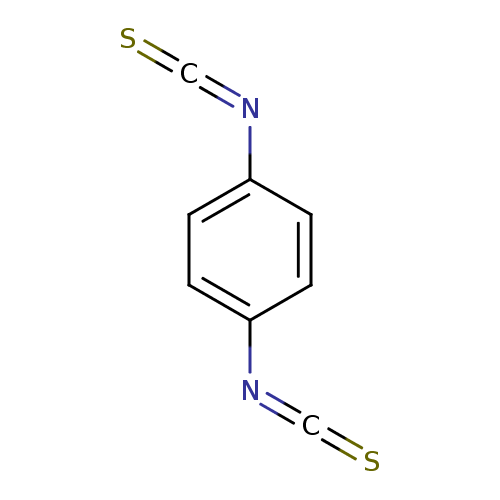
Common NamePhenylene-1,4-diisothiocyanate
ClassSmall Molecule
DescriptionPhenylene-1,4-diisothiocyanate is a chemical compound of cyanide.
Contaminant Sources
  • Clean Air Act Chemicals
  • T3DB toxins
  • ToxCast & Tox21 Chemicals
Contaminant Type
  • Aromatic Hydrocarbon
  • Cyanide Compound
  • Industrial/Workplace Toxin
  • Organic Compound
  • Pollutant
  • Synthetic Compound
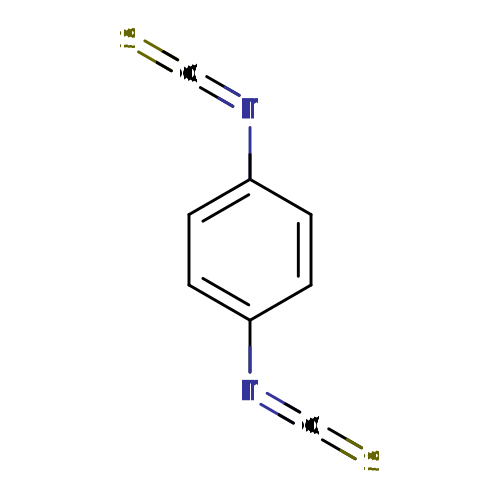
Chemical Structure
Thumb
Synonyms
ValueSource
Phenylene-1,4-diisothiocyanic acidGenerator
16842BitoscanateChEMBL
16842Bitoscanic acidGenerator
Phenylene diisothiocyanateMeSH
1,4-PhenylenediisothiocyanateMeSH
JonitMeSH
Chemical FormulaC8H4N2S2
Average Molecular Mass192.261 g/mol
Monoisotopic Mass191.982 g/mol
CAS Registry Number4044-65-9
IUPAC Name1,4-diisothiocyanatobenzene
Traditional Namebitoscanate
SMILESS=C=NC1=CC=C(C=C1)N=C=S
InChI IdentifierInChI=1S/C8H4N2S2/c11-5-9-7-1-2-8(4-3-7)10-6-12/h1-4H
InChI KeyOMWQUXGVXQELIX-UHFFFAOYSA-N
Chemical Taxonomy
Description belongs to the class of organic compounds known as benzene and substituted derivatives. These are aromatic compounds containing one monocyclic ring system consisting of benzene.
KingdomOrganic compounds
Super ClassBenzenoids
ClassBenzene and substituted derivatives
Sub ClassNot Available
Direct ParentBenzene and substituted derivatives
Alternative Parents
Substituents
  • Monocyclic benzene moiety
  • Isothiocyanate
  • Organic 1,3-dipolar compound
  • Propargyl-type 1,3-dipolar organic compound
  • Organic nitrogen compound
  • Organopnictogen compound
  • Hydrocarbon derivative
  • Organosulfur compound
  • Organonitrogen compound
  • Aromatic homomonocyclic compound
Molecular FrameworkAromatic homomonocyclic compounds
External DescriptorsNot Available
Biological Properties
StatusDetected and Not Quantified
OriginExogenous
Cellular Locations
  • Membrane
Biofluid LocationsNot Available
Tissue LocationsNot Available
PathwaysNot Available
ApplicationsNot Available
Biological RolesNot Available
Chemical RolesNot Available
Physical Properties
StateSolid
AppearanceColorless crystals.
Experimental Properties
PropertyValue
Melting Point132°C
Boiling PointNot Available
SolubilityNot Available
Predicted Properties
PropertyValueSource
Water Solubility0.011 g/LALOGPS
logP3.96ALOGPS
logP4.02ChemAxon
logS-4.2ALOGPS
pKa (Strongest Basic)0.23ChemAxon
Physiological Charge0ChemAxon
Hydrogen Acceptor Count2ChemAxon
Hydrogen Donor Count0ChemAxon
Polar Surface Area24.72 ŲChemAxon
Rotatable Bond Count2ChemAxon
Refractivity60.18 m³·mol⁻¹ChemAxon
Polarizability19.27 ųChemAxon
Number of Rings1ChemAxon
Bioavailability1ChemAxon
Rule of FiveYesChemAxon
Ghose FilterNoChemAxon
Veber's RuleYesChemAxon
MDDR-like RuleNoChemAxon
Spectra
Spectra
Spectrum TypeDescriptionSplash KeyView
Predicted LC-MS/MSPredicted LC-MS/MS Spectrum - 10V, Positivesplash10-0006-0900000000-2c71aaa0874869159315Spectrum
Predicted LC-MS/MSPredicted LC-MS/MS Spectrum - 20V, Positivesplash10-0006-0900000000-2c71aaa0874869159315Spectrum
Predicted LC-MS/MSPredicted LC-MS/MS Spectrum - 40V, Positivesplash10-01ox-0900000000-fa2a6b67620e85698c4eSpectrum
Predicted LC-MS/MSPredicted LC-MS/MS Spectrum - 10V, Negativesplash10-0006-0900000000-367145d2db0cb739642cSpectrum
Predicted LC-MS/MSPredicted LC-MS/MS Spectrum - 20V, Negativesplash10-0006-0900000000-367145d2db0cb739642cSpectrum
Predicted LC-MS/MSPredicted LC-MS/MS Spectrum - 40V, Negativesplash10-0006-0900000000-aeaaf3416958ba179d65Spectrum
MSMass Spectrum (Electron Ionization)splash10-0006-4900000000-0c920e0ccffba82d1639Spectrum
1D NMR1H NMR SpectrumNot AvailableSpectrum
1D NMR13C NMR SpectrumNot AvailableSpectrum
Toxicity Profile
Route of ExposureOral (1) ; inhalation (1) ; dermal (1)
Mechanism of ToxicityCyanide is an inhibitor of cytochrome c oxidase in the fourth complex of the electron transport chain (found in the membrane of the mitochondria of eukaryotic cells). It complexes with the ferric iron atom in this enzyme. The binding of cyanide to this cytochrome prevents transport of electrons from cytochrome c oxidase to oxygen. As a result, the electron transport chain is disrupted and the cell can no longer aerobically produce ATP for energy. Tissues that mainly depend on aerobic respiration, such as the central nervous system and the heart, are particularly affected. Cyanide is also known produce some of its toxic effects by binding to catalase, glutathione peroxidase, methemoglobin, hydroxocobalamin, phosphatase, tyrosinase, ascorbic acid oxidase, xanthine oxidase, succinic dehydrogenase, and Cu/Zn superoxide dismutase. Cyanide binds to the ferric ion of methemoglobin to form inactive cyanmethemoglobin. (2)
MetabolismCyanide is rapidly alsorbed through oral, inhalation, and dermal routes and distributed throughout the body. Cyanide is mainly metabolized into thiocyanate by either rhodanese or 3-mercaptopyruvate sulfur transferase. Cyanide metabolites are excreted in the urine. (1)
Toxicity ValuesLD50: 21 mg/kg (Intraperitoneal, Mouse) (3) LD50: 230 mg/kg (Oral, Mouse) (3)
Lethal Dose200 to 300 milligrams for an adult human (cyanide salts). (4)
Carcinogenicity (IARC Classification)No indication of carcinogenicity to humans (not listed by IARC).
Uses/SourcesNot Available
Minimum Risk LevelNot Available
Health EffectsExposure to high levels of cyanide for a short time harms the brain and heart and can even cause coma, seizures, apnea, cardiac arrest and death. Chronic inhalation of cyanide causes breathing difficulties, chest pain, vomiting, blood changes, headaches, and enlargement of the thyroid gland. Skin contact with cyanide salts can irritate and produce sores. (1, 2)
SymptomsCyanide poisoning is identified by rapid, deep breathing and shortness of breath, general weakness, giddiness, headaches, vertigo, confusion, convulsions/seizures and eventually loss of consciousness. (1, 2)
TreatmentEYES: irrigate opened eyes for several minutes under running water. INGESTION: do not induce vomiting. Rinse mouth with water (never give anything by mouth to an unconscious person). Seek immediate medical advice. SKIN: should be treated immediately by rinsing the affected parts in cold running water for at least 15 minutes, followed by thorough washing with soap and water. If necessary, the person should shower and change contaminated clothing and shoes, and then must seek medical attention. INHALATION: supply fresh air. If required provide artificial respiration.

Concentrations
Not Available
DrugBank IDNot Available
HMDB IDNot Available
FooDB IDNot Available
Phenol Explorer IDNot Available
KNApSAcK IDNot Available
BiGG IDNot Available
BioCyc IDNot Available
METLIN IDNot Available
PDB IDNot Available
Wikipedia LinkNot Available
Chemspider IDNot Available
ChEBI IDNot Available
PubChem Compound ID19958
Kegg Compound IDNot Available
YMDB IDNot Available
ECMDB IDNot Available
References
Synthesis ReferenceNot Available
MSDSNot Available
General ReferencesNot Available