Record Information
Version1.0
Creation Date2009-06-19 21:59:03 UTC
Update Date2016-11-09 01:08:31 UTC
Accession NumberCHEM001384
Identification
Common NameSilver(II) fluoride
ClassSmall Molecule
DescriptionSilver(I) fluoride is a fluoride of silver. It is a strong fluorinating and oxidation agent. Silver is a metallic element with the chemical symbol Ag and atomic number 47. It occurs naturally in its pure, free form, as an alloy with gold and other metals, and in minerals such as argentite and chlorargyrite. (5, 6, 8)
Contaminant Sources
  • T3DB toxins
Contaminant Type
  • Fluoride Compound
  • Industrial/Workplace Toxin
  • Inorganic Compound
  • Silver Compound
  • Synthetic Compound
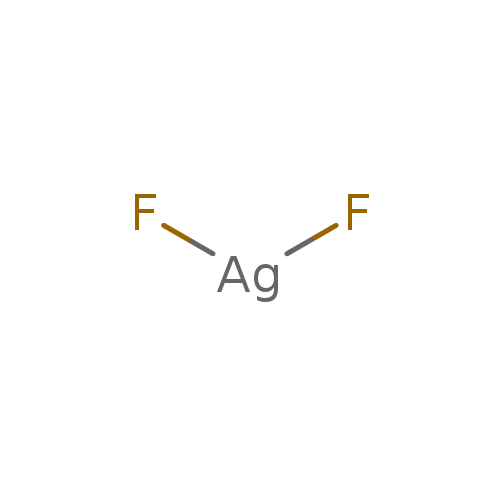
Chemical Structure
Thumb
SynonymsNot Available
Chemical FormulaAgF2
Average Molecular Mass145.865 g/mol
Monoisotopic Mass144.902 g/mol
CAS Registry Number7775-41-9
IUPAC Namedifluorosilver
Traditional Namedifluorosilver
SMILESF[Ag]F
InChI IdentifierInChI=1S/Ag.2FH/h;2*1H/q+2;;/p-2
InChI KeyKWVVTSALYXIJSS-UHFFFAOYSA-L
Chemical Taxonomy
Description belongs to the class of inorganic compounds known as transition metal fluorides. These are inorganic compounds in which the largest halogen atom is fluorine, and the heaviest metal atom is a transition metal.
KingdomInorganic compounds
Super ClassMixed metal/non-metal compounds
ClassTransition metal salts
Sub ClassTransition metal fluorides
Direct ParentTransition metal fluorides
Alternative Parents
Substituents
  • Transition metal fluoride
  • Inorganic silver salt
  • Inorganic salt
Molecular FrameworkNot Available
External DescriptorsNot Available
Biological Properties
StatusDetected and Not Quantified
OriginExogenous
Cellular Locations
  • Cytoplasm
  • Extracellular
Biofluid LocationsNot Available
Tissue LocationsNot Available
PathwaysNot Available
ApplicationsNot Available
Biological RolesNot Available
Chemical RolesNot Available
Physical Properties
StateSolid
AppearanceWhite or grey crystals.
Experimental Properties
PropertyValue
Melting Point690°C
Boiling PointNot Available
SolubilityNot Available
Predicted Properties
PropertyValueSource
logP-0.045ChemAxon
Physiological Charge0ChemAxon
Hydrogen Acceptor Count0ChemAxon
Hydrogen Donor Count0ChemAxon
Polar Surface Area0 ŲChemAxon
Rotatable Bond Count0ChemAxon
Refractivity3 m³·mol⁻¹ChemAxon
Polarizability2.77 ųChemAxon
Number of Rings0ChemAxon
Bioavailability1ChemAxon
Rule of FiveYesChemAxon
Ghose FilterNoChemAxon
Veber's RuleYesChemAxon
MDDR-like RuleNoChemAxon
Spectra
Spectra
Spectrum TypeDescriptionSplash KeyView
Predicted LC-MS/MSPredicted LC-MS/MS Spectrum - 10V, Positivesplash10-0002-0900000000-197e23e4e2af19da9052Spectrum
Predicted LC-MS/MSPredicted LC-MS/MS Spectrum - 20V, Positivesplash10-0002-0900000000-197e23e4e2af19da9052Spectrum
Predicted LC-MS/MSPredicted LC-MS/MS Spectrum - 40V, Positivesplash10-0002-0900000000-197e23e4e2af19da9052Spectrum
Predicted LC-MS/MSPredicted LC-MS/MS Spectrum - 10V, Negativesplash10-0006-0900000000-c33f2e5e05ab23b1d904Spectrum
Predicted LC-MS/MSPredicted LC-MS/MS Spectrum - 20V, Negativesplash10-0006-0900000000-c33f2e5e05ab23b1d904Spectrum
Predicted LC-MS/MSPredicted LC-MS/MS Spectrum - 40V, Negativesplash10-0006-0900000000-c33f2e5e05ab23b1d904Spectrum
Toxicity Profile
Route of ExposureOral (5) ; inhalation (5) ; dermal (5)
Mechanism of ToxicityMetallic silver is oxidized and may deposit in the tissues, causing arygria. The silver ion is known to inhibit glutathione peroxidase and NA+,K+-ATPase activity, disrupting selenium-catalyzed sulfhydryl oxidation-reduction reactions and intracellular ion concentrations, respectively. Silver nanoparticles are believed to disrupt the mitochondrial respiratory chain, causing oxidative stress, reduced ATP synthesis, and DNA damage. (5, 1, 2, 3, 4)
MetabolismSilver and its compounds can be absorbed via inhalation, while silver compounds can also be absorbed orally and dermally. It distributes throughout the body in the blood, particularily to the liver. Insoluble silver salts are transformed into soluble silver sulfide albuminates, bind to amino or carboxyl groups in RNA, DNA, and proteins, or are reduced to metallic silver by ascorbic acid or catecholamines. Metallic silver is oxidized and may deposit in the tissues, causing arygria. Silver is eliminated primarily in the faeces. (5)
Toxicity ValuesNot Available
Lethal DoseNot Available
Carcinogenicity (IARC Classification)No indication of carcinogenicity to humans (not listed by IARC).
Uses/SourcesSilver(I) fluoride is a strong fluorinating and oxidation agent. (8)
Minimum Risk LevelNot Available
Health EffectsSilver itself is not toxic to humans, but most silver salts are. In large doses, silver and compounds containing it can be absorbed into the circulatory system and become deposited in various body tissues, leading to argyria, which results in a blue-grayish pigmentation of the skin, eyes, and mucous membranes. Argyria is rare, and although, so far as known, this condition does not otherwise harm a person's health, it is disfiguring and usually permanent. Mild forms of argyria are sometimes mistaken for cyanosis. (6)
SymptomsExposure to high levels of silver for a long period of time may result in a condition called arygria, a blue-gray discoloration of the skin and other body tissues. Argyria is a permanent effect but does not appear to be harmful to health. Exposure to high levels of silver in the air has resulted in breathing problems, lung and throat irritation, and stomach pains. Skin contact with silver can cause mild allergic reactions such as rash, swelling, and inflammation in some people. (5)
TreatmentEYES: irrigate opened eyes for several minutes under running water. INGESTION: do not induce vomiting. Rinse mouth with water (never give anything by mouth to an unconscious person). Seek immediate medical advice. SKIN: should be treated immediately by rinsing the affected parts in cold running water for at least 15 minutes, followed by thorough washing with soap and water. If necessary, the person should shower and change contaminated clothing and shoes, and then must seek medical attention. INHALATION: supply fresh air. If required provide artificial respiration.

Concentrations
Not Available
DrugBank IDNot Available
HMDB IDNot Available
FooDB IDNot Available
Phenol Explorer IDNot Available
KNApSAcK IDNot Available
BiGG IDNot Available
BioCyc IDNot Available
METLIN IDNot Available
PDB IDNot Available
Wikipedia LinkSilver(II) fluoride
Chemspider IDNot Available
ChEBI IDNot Available
PubChem Compound IDNot Available
Kegg Compound IDNot Available
YMDB IDNot Available
ECMDB IDNot Available
References
Synthesis ReferenceNot Available
MSDSNot Available
General ReferencesNot Available