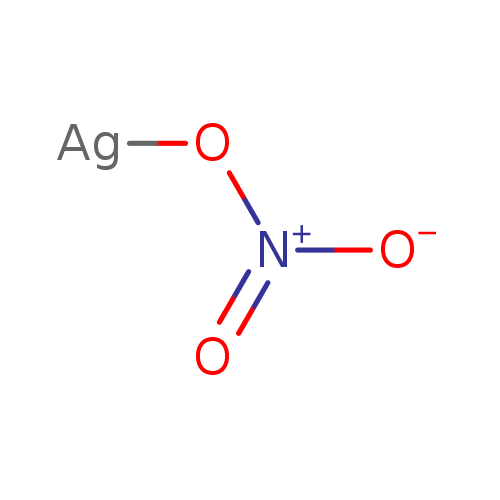
Silver nitrate is a nitrate of silver. It is a versatile precursor to many other silver compounds, such as those used in photography, and is commonly used in inorganic chemistry to abstract halides. Silver nitrate is also used in organic synthesis and for silver staining of proteins and nucleic acids, such as in PAGE gels and scanning electron microscopy. Silver is a metallic element with the chemical symbol Ag and atomic number 47. It occurs naturally in its pure, free form, as an alloy with gold and other metals, and in minerals such as argentite and chlorargyrite. Nitrite is a toxic compound known to cause methemoglobinemia. (12, 8, 9, 11)
belongs to the class of inorganic compounds known as transition metal nitrates. These are inorganic compounds in which the largest oxoanion is nitrate, and in which the heaviest atom not in an oxoanion is a transition metal.
Metallic silver is oxidized and may deposit in the tissues, causing arygria. The silver ion is known to inhibit glutathione peroxidase and NA+,K+-ATPase activity, disrupting selenium-catalyzed sulfhydryl oxidation-reduction reactions and intracellular ion concentrations, respectively. Silver nanoparticles are believed to disrupt the mitochondrial respiratory chain, causing oxidative stress, reduced ATP synthesis, and DNA damage. Nitrate's toxicity is a result of it's conversion to nitrite once in the body. Nitrite causes the autocatalytic oxidation of oxyhemoglobin to hydrogen peroxide and methemoglobin. This elevation of methemoglobin levels is a condition known as methemoglobinemia, and is characterized by tissue hypoxia, as methemoglobin cannot bind oxygen. (5, 13, 8, 1, 2, 3, 4)
Metabolism
Silver and its compounds can be absorbed via inhalation, while silver compounds can also be absorbed orally and dermally. It distributes throughout the body in the blood, particularily to the liver. Insoluble silver salts are transformed into soluble silver sulfide albuminates, bind to amino or carboxyl groups in RNA, DNA, and proteins, or are reduced to metallic silver by ascorbic acid or catecholamines. Metallic silver is oxidized and may deposit in the tissues, causing arygria. Silver is eliminated primarily in the faeces. Intake of some amount of nitrates and nitrites is a normal part of the nitrogen cycle in humans. In vivo conversion of nitrates to nitrites can occur in the gastrointestional tract under the right conditions, significantly enhancing nitrates' toxic potency. The major metabolic pathway for nitrate is conversion to nitrite, and then to ammonia. Nitrites, nitrates, and their metabolites are excreted in the urine. (12, 8)
Ingested nitrate or nitrite under conditions that result in endogenous nitrosation is probably carcinogenic to humans (Group 2A). (6)
Uses/Sources
Silver nitrate is a versatile precursor to many other silver compounds, such as those used in photography, and is commonly used in inorganic chemistry to abstract halides. Silver nitrate is also used in organic synthesis and for silver staining of proteins and nucleic acids, such as in PAGE gels and scanning electron microscopy. (11)
Minimum Risk Level
Not Available
Health Effects
Exposure to high levels of silver for a long period of time may result in a condition called arygria, a blue-gray discoloration of the skin and other body tissues. Argyria is a permanent effect but does not appear to be harmful to health. While silver itself is not toxic, most silver salts are, and may damage the liver, kidney, and central nervous system, as well as be carcinogenic. Nitrate and nitrite poisoning causes methemoglobinemia. Nitrites may cause pregnancy complications and developmental effects. They may also be carcinogenic. (12, 8, 9, 10)
Symptoms
Exposure to high levels of silver for a long period of time may result in a condition called arygria, a blue-gray discoloration of the skin and other body tissues. Argyria is a permanent effect but does not appear to be harmful to health. Exposure to high levels of silver in the air has resulted in breathing problems, lung and throat irritation, and stomach pains. Skin contact with silver can cause mild allergic reactions such as rash, swelling, and inflammation in some people. Nitrate and nitrite poisoning causes methemoglobinemia. Symptoms include cyanosis, cardiac dysrhythmias and circulatory failure, and progressive central nervous system (CNS) effects. CNS effects can range from mild dizziness and lethargy to coma and convulsions. (12, 8)
Treatment
Methemoglobinemia can be treated with supplemental oxygen and methylene blue 1% solution administered intravenously slowly over five minutes followed by IV flush with normal saline. Methylene blue restores the iron in hemoglobin to its normal (reduced) oxygen-carrying state. (13)