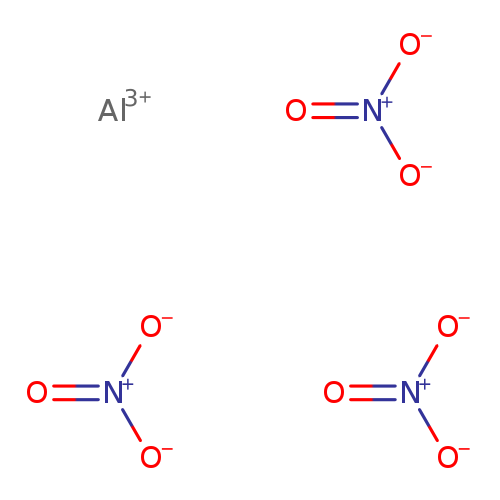
Aluminium nitrate is a chemical compound of aluminum. It is used in tanning leather, antiperspirants, corrosion inhibitors, extraction of uranium, petroleum refining, and as a nitrating agent. Aluminum is the most abundant metal in the earth's crust and is always found combined with other elements such as oxygen, silicon, and fluorine. Nitrite is a toxic compound known to cause methemoglobinemia. (9, 6, 7, 8)
belongs to the class of inorganic compounds known as post-transition metal nitrates. These are inorganic compounds in which the largest oxoanion is nitrate, and in which the heaviest atom not in an oxoanion is a post-transition metal.
The main target organs of aluminum are the central nervous system and bone. Aluminum binds with dietary phosphorus and impairs gastrointestinal absorption of phosphorus. The decreased phosphate body burden results in osteomalacia (softening of the bones due to defective bone mineralization) and rickets. Aluminum's neurotoxicity is believed to involve several mechanisms. Changes in cytoskeletal protein functions as a results of altered phosphorylation, proteolysis, transport, and synthesis are believed to be one cause. Aluminum may induce neurobehavioral effects by affecting permeability of the blood-brain barrier, cholinergic activity, signal transduction pathways, lipid peroxidation, and impair neuronal glutamate nitric oxide-cyclic GMP pathway, as well as interfere with metabolism of essential trace elements because of similar coordination chemistries and consequent competitive interactions. Aluminum can also interact with estrogen receptors, increasing the expression of estrogen-related genes and contributing to the progression of breast cancer. Certain aluminum salts induce immune responses by activating inflammasomes. Nitrate's toxicity is a result of it's conversion to nitrite once in the body. Nitrite causes the autocatalytic oxidation of oxyhemoglobin to hydrogen peroxide and methemoglobin. This elevation of methemoglobin levels is a condition known as methemoglobinemia, and is characterized by tissue hypoxia, as methemoglobin cannot bind oxygen. (3, 10, 6, 1, 2)
Metabolism
Aluminum is poorly absorbed following either oral or inhalation exposure and is essentially not absorbed dermally. The bioavailability of aluminum is strongly influenced by the aluminum compound and the presence of dietary constituents which can complex with aluminum and enhance or inhibit its absorption. Aluminum binds to various ligands in the blood and distributes to every organ, with highest concentrations found in bone and lung tissues. In living organisms, aluminum is believed to exist in four different forms: as free ions, as low-molecular-weight complexes, as physically bound macromolecular complexes, and as covalently bound macromolecular complexes. Absorbed aluminum is excreted principally in the urine and, to a lesser extent, in the bile, while unabsorbed aluminum is excreted in the faeces. Intake of some amount of nitrates and nitrites is a normal part of the nitrogen cycle in humans. In vivo conversion of nitrates to nitrites can occur in the gastrointestional tract under the right conditions, significantly enhancing nitrates' toxic potency. The major metabolic pathway for nitrate is conversion to nitrite, and then to ammonia. Nitrites, nitrates, and their metabolites are excreted in the urine. (9, 6)
Ingested nitrate or nitrite under conditions that result in endogenous nitrosation is probably carcinogenic to humans (Group 2A). (5)
Uses/Sources
Aluminium nitrate is used in tanning leather, antiperspirants, corrosion inhibitors, extraction of uranium, petroleum refining, and as a nitrating agent. (8)
Aluminum targets the nervous system and causes decreased nervous system performance and is associated with altered function of the blood-brain barrier. The accumulation of aluminum in the body may cause bone or brain diseases. High levels of aluminum have been linked to Alzheimer's disease. A small percentage of people are allergic to aluminium and experience contact dermatitis, digestive disorders, vomiting or other symptoms upon contact or ingestion of products containing aluminium. Nitrate and nitrite poisoning causes methemoglobinemia. Nitrites may cause pregnancy complications and developmental effects. They may also be carcinogenic. (9, 6, 7)
Symptoms
Inhalating aluminum dust causes coughing and abnormal chest X-rays. A small percentage of people are allergic to aluminium and experience contact dermatitis, digestive disorders, vomiting or other symptoms upon contact or ingestion of products containing aluminium. Nitrate and nitrite poisoning causes methemoglobinemia. Symptoms include cyanosis, cardiac dysrhythmias and circulatory failure, and progressive central nervous system (CNS) effects. CNS effects can range from mild dizziness and lethargy to coma and convulsions. (9, 6, 7)
Treatment
Methemoglobinemia can be treated with supplemental oxygen and methylene blue 1% solution administered intravenously slowly over five minutes followed by IV flush with normal saline. Methylene blue restores the iron in hemoglobin to its normal (reduced) oxygen-carrying state. (10)