Record Information
Version1.0
Creation Date2009-06-19 21:58:38 UTC
Update Date2026-04-05 18:11:00 UTC
Accession NumberCHEM001151
Identification
Common NameLead tetraacetate
ClassSmall Molecule
DescriptionLead tetraacetate is a chemical compound of lead. Lead is a heavy metal and stable element with the symbol Pb and the atomic number 82, existing in metallic, organic, and inorganic forms. It is mainly found in nature as the mineral galena (PbS), cerussite (PbCO3) or anglesite (PbSO4), usually in ore with zinc, silver, or copper. (4)
Contaminant Sources
  • T3DB toxins
Contaminant Type
  • Industrial/Workplace Toxin
  • Inorganic Compound
  • Lead Compound
  • Organometallic
  • Synthetic Compound
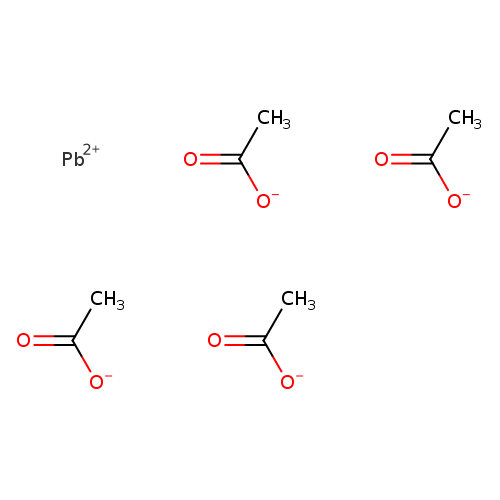
Chemical Structure
Thumb
Synonyms
ValueSource
Lead tetraacetic acidGenerator
Lead tetraacetate, (203)lead-labeledMeSH
Chemical FormulaC8H12O8Pb
Average Molecular Mass443.400 g/mol
Monoisotopic Mass444.030 g/mol
CAS Registry Number546-67-8
IUPAC Nameλ²-lead(2+) ion tetraacetate
Traditional Nameλ²-lead(2+) ion tetraacetate
SMILES[Pb++].CC([O-])=O.CC([O-])=O.CC([O-])=O.CC([O-])=O
InChI IdentifierInChI=1S/4C2H4O2.Pb/c4*1-2(3)4;/h4*1H3,(H,3,4);/q;;;;+2/p-4
InChI KeyACKFDYCQCBEDNU-UHFFFAOYSA-J
Chemical Taxonomy
Description belongs to the class of organic compounds known as acetate salts. These are organic compounds containing acetic acid as its acid component.
KingdomOrganic compounds
Super ClassOrganic acids and derivatives
ClassCarboxylic acids and derivatives
Sub ClassCarboxylic acid derivatives
Direct ParentAcetate salts
Alternative Parents
Substituents
  • Acetate salt
  • Monocarboxylic acid or derivatives
  • Carboxylic acid
  • Organic oxygen compound
  • Organic oxide
  • Hydrocarbon derivative
  • Organic lead salt
  • Organic salt
  • Organooxygen compound
  • Carbonyl group
  • Organic anion
  • Aliphatic acyclic compound
Molecular FrameworkNot Available
External DescriptorsNot Available
Biological Properties
StatusDetected and Not Quantified
OriginExogenous
Cellular Locations
  • Cytoplasm
  • Extracellular
Biofluid LocationsNot Available
Tissue LocationsNot Available
PathwaysNot Available
ApplicationsNot Available
Biological RolesNot Available
Chemical Roles
Physical Properties
StateSolid
AppearanceColorless crystals.
Experimental Properties
PropertyValue
Melting Point177.5°C
Boiling PointNot Available
SolubilityNot Available
Predicted Properties
PropertyValueSource
logP-0.22ChemAxon
pKa (Strongest Acidic)4.54ChemAxon
Physiological Charge-1ChemAxon
Hydrogen Acceptor Count2ChemAxon
Hydrogen Donor Count0ChemAxon
Polar Surface Area40.13 ŲChemAxon
Rotatable Bond Count0ChemAxon
Refractivity23.48 m³·mol⁻¹ChemAxon
Polarizability4.96 ųChemAxon
Number of Rings0ChemAxon
Bioavailability1ChemAxon
Rule of FiveYesChemAxon
Ghose FilterNoChemAxon
Veber's RuleNoChemAxon
MDDR-like RuleNoChemAxon
Spectra
Spectra
Spectrum TypeDescriptionSplash KeyView
Predicted LC-MS/MSPredicted LC-MS/MS Spectrum - 10V, Positivesplash10-0udi-0000900000-4401b2966e1bc0086054Spectrum
Predicted LC-MS/MSPredicted LC-MS/MS Spectrum - 20V, Positivesplash10-0udi-0000900000-4401b2966e1bc0086054Spectrum
Predicted LC-MS/MSPredicted LC-MS/MS Spectrum - 40V, Positivesplash10-0udi-0000900000-4401b2966e1bc0086054Spectrum
Predicted LC-MS/MSPredicted LC-MS/MS Spectrum - 10V, Negativesplash10-0002-0000900000-9809d0d6ccc2278b91b9Spectrum
Predicted LC-MS/MSPredicted LC-MS/MS Spectrum - 20V, Negativesplash10-0002-0000900000-9809d0d6ccc2278b91b9Spectrum
Predicted LC-MS/MSPredicted LC-MS/MS Spectrum - 40V, Negativesplash10-0002-0000900000-9809d0d6ccc2278b91b9Spectrum
MSMass Spectrum (Electron Ionization)splash10-014l-6093000000-478ad7929de759c42a49Spectrum
Toxicity Profile
Route of ExposureOral (7) ; inhalation (7) ; dermal (7)
Mechanism of ToxicityLead mimics other biologically important metals, such as zinc, calcium, and iron, competing as cofactors for many of their respective enzymatic reactions. For example, lead has been shown to competitively inhibit calcium's binding of calmodulin, interferring with neurotransmitter release. It exhibits similar competitive inhibition at the NMDA receptor and protein kinase C, which impairs brain microvascular formation and function, as well as alters the blood-brain barrier. Lead also affects the nervous system by impairing regulation of dopamine synthesis and blocking evoked release of acetylcholine. However, it's main mechanism of action occurs by inhibiting delta-aminolevulinic acid dehydratase, an enzyme vital in the biosynthesis of heme, which is a necesssary cofactor of hemoglobin. (8, 2, 3, 7)
MetabolismLead is absorbed following inhalation, oral, and dermal exposure. It is then distributed mainly to the bones and red blood cells. In the blood lead may be found bound to serum albumin or the metal-binding protein metallothionein. Organic lead is metabolized by cytochrome P-450 enzymes, whereas inorganic lead forms complexes with delta-aminolevulinic acid dehydratase. Lead is excreted mainly in the urine and faeces. (7)
Toxicity ValuesNot Available
Lethal Dose10 to 30 grams for and adult human (lead salts). (9)
Carcinogenicity (IARC Classification)Organic lead compounds are not classifiable as to their carcinogenicity to humans (Group 3). To the extent that organic lead compounds are metabolized in part to ionic lead, they are expected to exert the toxicities associated with inorganic lead (Group 2A, probably carcinogenic to humans). (6)
Uses/SourcesNot Available
Minimum Risk LevelChronic Inhalation: 0.05 mg/m3 (5)
Health EffectsLead is a neurotoxin and has been known to cause brain damage and reduced cognitive capacity, especially in children. Lead exposure can result in nephropathy, as well as blood disorders such as high blood pressure and anemia. Lead also exhibits reproductive toxicity and can results in miscarriages and reduced sperm production. (4)
SymptomsSymptions of chronic lead poisoning include reduced cognitive abilities, nausea, abdominal pain, irritability, insomnia, metal taste in the mouth, excess lethargy or hyperactivity, chest pain, headache and, in extreme cases, seizures, comas, and death. There are also associated gastrointestinal problems, such as constipation, diarrhea, vomiting, poor appetite, weight loss, which are common in acute poisoning. (1, 4)
TreatmentLead poisoning is usually treated with chelation therapy using DMSA, EDTA, or dimercaprol. (4)

Concentrations
Not Available
DrugBank IDNot Available
HMDB IDNot Available
FooDB IDNot Available
Phenol Explorer IDNot Available
KNApSAcK IDNot Available
BiGG IDNot Available
BioCyc IDNot Available
METLIN IDNot Available
PDB IDNot Available
Wikipedia LinkLead(IV) acetate
Chemspider IDNot Available
ChEBI IDNot Available
PubChem Compound ID11025
Kegg Compound IDNot Available
YMDB IDNot Available
ECMDB IDNot Available
References
Synthesis ReferenceNot Available
MSDSNot Available
General ReferencesNot Available