Record Information
Version1.0
Creation Date2009-06-19 21:58:22 UTC
Update Date2026-05-14 19:07:19 UTC
Accession NumberCHEM000988
Identification
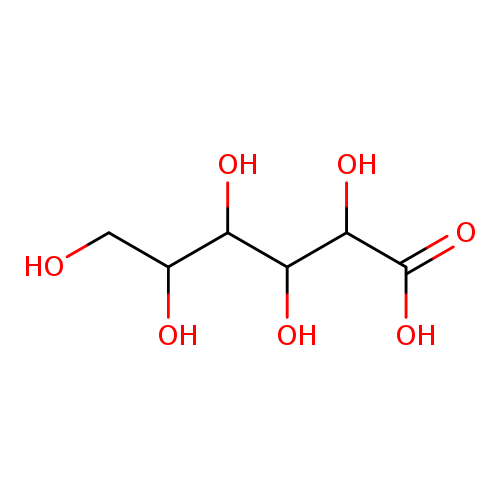
Common NameD-Gluconic acid Mn(II) salt
ClassSmall Molecule
DescriptionD-Gluconic acid Mn(II) salt is a dietary supplement.
Contaminant Sources
  • EAFUS Chemicals
  • FooDB Chemicals
  • T3DB toxins
Contaminant Type
  • Food Toxin
  • Household Toxin
  • Industrial/Workplace Toxin
  • Manganese Compound
  • Metabolite
  • Organic Compound
  • Organometallic
  • Synthetic Compound
Chemical Structure
Thumb
Synonyms
ValueSource
L-Galactonic acidKegg
L-GalactonateGenerator
D-Galactonic acidGenerator
D-Gluconate MN(II) saltGenerator
Altronic acidMeSH
Chemical FormulaC6H12O7
Average Molecular Mass196.155 g/mol
Monoisotopic Mass196.058 g/mol
CAS Registry Number6485-39-8
IUPAC Namemanganese(2+) bis((2R,3S,4R,5R)-2,3,4,5,6-pentahydroxyhexanoate)
Traditional Namemagnesium gluconate anhydrous
SMILESOCC(O)C(O)C(O)C(O)C(O)=O
InChI IdentifierInChI=1S/C6H12O7/c7-1-2(8)3(9)4(10)5(11)6(12)13/h2-5,7-11H,1H2,(H,12,13)
InChI KeyRGHNJXZEOKUKBD-UHFFFAOYSA-N
Chemical Taxonomy
Description belongs to the class of organic compounds known as medium-chain hydroxy acids and derivatives. These are hydroxy acids with a 6 to 12 carbon atoms long side chain.
KingdomOrganic compounds
Super ClassOrganic acids and derivatives
ClassHydroxy acids and derivatives
Sub ClassMedium-chain hydroxy acids and derivatives
Direct ParentMedium-chain hydroxy acids and derivatives
Alternative Parents
Substituents
  • Medium-chain hydroxy acid
  • Medium-chain fatty acid
  • Beta-hydroxy acid
  • Hydroxy fatty acid
  • Alpha-hydroxy acid
  • Monosaccharide
  • Fatty acyl
  • Fatty acid
  • Secondary alcohol
  • Polyol
  • Monocarboxylic acid or derivatives
  • Carboxylic acid
  • Carboxylic acid derivative
  • Organooxygen compound
  • Hydrocarbon derivative
  • Organic oxide
  • Carbonyl group
  • Primary alcohol
  • Alcohol
  • Organic oxygen compound
  • Aliphatic acyclic compound
Molecular FrameworkAliphatic acyclic compounds
External DescriptorsNot Available
Biological Properties
StatusDetected and Not Quantified
OriginExogenous
Cellular Locations
  • Cytoplasm
  • Extracellular
  • Membrane
Biofluid LocationsNot Available
Tissue LocationsNot Available
PathwaysNot Available
ApplicationsNot Available
Biological RolesNot Available
Chemical RolesNot Available
Physical Properties
StateSolid
AppearanceWhite powder.
Experimental Properties
PropertyValue
Melting Point113 - 118°C
Boiling PointNot Available
SolubilityNot Available
Predicted Properties
PropertyValueSource
Water Solubility159 g/LALOGPS
logP-2.6ALOGPS
logP-3.4ChemAxon
logS-0.09ALOGPS
pKa (Strongest Acidic)3.39ChemAxon
pKa (Strongest Basic)-3ChemAxon
Physiological Charge-1ChemAxon
Hydrogen Acceptor Count7ChemAxon
Hydrogen Donor Count6ChemAxon
Polar Surface Area138.45 ŲChemAxon
Rotatable Bond Count5ChemAxon
Refractivity38.27 m³·mol⁻¹ChemAxon
Polarizability16.83 ųChemAxon
Number of Rings0ChemAxon
Bioavailability1ChemAxon
Rule of FiveNoChemAxon
Ghose FilterNoChemAxon
Veber's RuleNoChemAxon
MDDR-like RuleNoChemAxon
Spectra
Spectra
Spectrum TypeDescriptionSplash KeyView
Predicted GC-MSPredicted GC-MS Spectrum - GC-MS (Non-derivatized) - 70eV, Positivesplash10-06tu-9500000000-abc0b019db16afd3352bSpectrum
Predicted GC-MSPredicted GC-MS Spectrum - GC-MS (Non-derivatized) - 70eV, PositiveNot AvailableSpectrum
Predicted GC-MSPredicted GC-MS Spectrum - GC-MS (TMS_1_1) - 70eV, PositiveNot AvailableSpectrum
Predicted GC-MSPredicted GC-MS Spectrum - GC-MS (TMS_1_2) - 70eV, PositiveNot AvailableSpectrum
Predicted GC-MSPredicted GC-MS Spectrum - GC-MS (TMS_1_3) - 70eV, PositiveNot AvailableSpectrum
Predicted GC-MSPredicted GC-MS Spectrum - GC-MS (TMS_1_4) - 70eV, PositiveNot AvailableSpectrum
Predicted GC-MSPredicted GC-MS Spectrum - GC-MS (TMS_1_5) - 70eV, PositiveNot AvailableSpectrum
Predicted GC-MSPredicted GC-MS Spectrum - GC-MS (TMS_1_6) - 70eV, PositiveNot AvailableSpectrum
Predicted GC-MSPredicted GC-MS Spectrum - GC-MS (TMS_2_1) - 70eV, PositiveNot AvailableSpectrum
Predicted GC-MSPredicted GC-MS Spectrum - GC-MS (TMS_2_2) - 70eV, PositiveNot AvailableSpectrum
Predicted GC-MSPredicted GC-MS Spectrum - GC-MS (TMS_2_3) - 70eV, PositiveNot AvailableSpectrum
Predicted GC-MSPredicted GC-MS Spectrum - GC-MS (TMS_2_4) - 70eV, PositiveNot AvailableSpectrum
Predicted GC-MSPredicted GC-MS Spectrum - GC-MS (TMS_2_5) - 70eV, PositiveNot AvailableSpectrum
Predicted GC-MSPredicted GC-MS Spectrum - GC-MS (TMS_2_6) - 70eV, PositiveNot AvailableSpectrum
Predicted GC-MSPredicted GC-MS Spectrum - GC-MS (TMS_2_7) - 70eV, PositiveNot AvailableSpectrum
Predicted GC-MSPredicted GC-MS Spectrum - GC-MS (TMS_2_8) - 70eV, PositiveNot AvailableSpectrum
Predicted GC-MSPredicted GC-MS Spectrum - GC-MS (TMS_2_9) - 70eV, PositiveNot AvailableSpectrum
Predicted GC-MSPredicted GC-MS Spectrum - GC-MS (TMS_2_10) - 70eV, PositiveNot AvailableSpectrum
Predicted GC-MSPredicted GC-MS Spectrum - GC-MS (TMS_2_11) - 70eV, PositiveNot AvailableSpectrum
Predicted GC-MSPredicted GC-MS Spectrum - GC-MS (TMS_2_12) - 70eV, PositiveNot AvailableSpectrum
Predicted GC-MSPredicted GC-MS Spectrum - GC-MS (TMS_2_13) - 70eV, PositiveNot AvailableSpectrum
Predicted GC-MSPredicted GC-MS Spectrum - GC-MS (TMS_2_14) - 70eV, PositiveNot AvailableSpectrum
Predicted GC-MSPredicted GC-MS Spectrum - GC-MS (TMS_2_15) - 70eV, PositiveNot AvailableSpectrum
Predicted GC-MSPredicted GC-MS Spectrum - GC-MS (TMS_3_1) - 70eV, PositiveNot AvailableSpectrum
Predicted GC-MSPredicted GC-MS Spectrum - GC-MS (TMS_3_2) - 70eV, PositiveNot AvailableSpectrum
Predicted LC-MS/MSPredicted LC-MS/MS Spectrum - 10V, Positivesplash10-004j-2900000000-2e0c26c445c5561e064cSpectrum
Predicted LC-MS/MSPredicted LC-MS/MS Spectrum - 20V, Positivesplash10-03di-9500000000-08150b4c43e2fcfe6007Spectrum
Predicted LC-MS/MSPredicted LC-MS/MS Spectrum - 40V, Positivesplash10-0bvi-9100000000-8da11e6efabcbf705943Spectrum
Predicted LC-MS/MSPredicted LC-MS/MS Spectrum - 10V, Negativesplash10-05ic-9800000000-4dc890f0b0119480c820Spectrum
Predicted LC-MS/MSPredicted LC-MS/MS Spectrum - 20V, Negativesplash10-052r-9400000000-d470360cffa908b2cb78Spectrum
Predicted LC-MS/MSPredicted LC-MS/MS Spectrum - 40V, Negativesplash10-0a4i-9100000000-a7d8afb4037ece167045Spectrum
Predicted LC-MS/MSPredicted LC-MS/MS Spectrum - 10V, Positivesplash10-024m-8900000000-7ecf18d54cb462c04558Spectrum
Predicted LC-MS/MSPredicted LC-MS/MS Spectrum - 20V, Positivesplash10-074i-9000000000-a24dd2cb9b57deddeaaeSpectrum
Predicted LC-MS/MSPredicted LC-MS/MS Spectrum - 40V, Positivesplash10-08fr-9000000000-ae48df53c8de11d2cae6Spectrum
Predicted LC-MS/MSPredicted LC-MS/MS Spectrum - 10V, Negativesplash10-004i-9100000000-ff1473e44b436e4f8fa5Spectrum
Predicted LC-MS/MSPredicted LC-MS/MS Spectrum - 20V, Negativesplash10-0a6r-9000000000-aac8778b161b37e56a13Spectrum
Predicted LC-MS/MSPredicted LC-MS/MS Spectrum - 40V, Negativesplash10-0a6r-9000000000-8920759ff7b62f308018Spectrum
1D NMR13C NMR SpectrumNot AvailableSpectrum
1D NMR1H NMR SpectrumNot AvailableSpectrum
1D NMR13C NMR SpectrumNot AvailableSpectrum
1D NMR1H NMR SpectrumNot AvailableSpectrum
1D NMR13C NMR SpectrumNot AvailableSpectrum
1D NMR1H NMR SpectrumNot AvailableSpectrum
1D NMR13C NMR SpectrumNot AvailableSpectrum
1D NMR1H NMR SpectrumNot AvailableSpectrum
1D NMR13C NMR SpectrumNot AvailableSpectrum
1D NMR1H NMR SpectrumNot AvailableSpectrum
1D NMR13C NMR SpectrumNot AvailableSpectrum
1D NMR1H NMR SpectrumNot AvailableSpectrum
1D NMR13C NMR SpectrumNot AvailableSpectrum
1D NMR1H NMR SpectrumNot AvailableSpectrum
1D NMR13C NMR SpectrumNot AvailableSpectrum
1D NMR1H NMR SpectrumNot AvailableSpectrum
Toxicity Profile
Route of ExposureOral (2) ; inhalation (2)
Mechanism of ToxicityManganese is a cellular toxicant that can impair transport systems, enzyme activities, and receptor functions. It primarily targets the central nervous system, particularily the globus pallidus of the basal ganglia. It is believed that the manganese ion, Mn(II), enhances the autoxidation or turnover of various intracellular catecholamines, leading to increased production of free radicals, reactive oxygen species, and other cytotoxic metabolites, along with a depletion of cellular antioxidant defense mechanisms, leading to oxidative damage and selective destruction of dopaminergic neurons. In addition to dopamine, manganese is thought to perturbations other neurotransmitters, such as GABA and glutamate. In order to produce oxidative damage, manganese must first overwhelm the antioxidant enzyme manganese superoxide dismutase. The neurotoxicity of Mn(II) has also been linked to its ability to substitute for Ca(II) under physiological conditions. It can enter mitochondria via the calcium uniporter and inhibit mitochondrial oxidative phosphorylation. It may also inhibit the efflux of Ca(II), which can result in a loss of mitochondrial membrane integrity. Mn(II) has been shown to inhibit mitochondrial aconitase activity to a significant level, altering amino acid metabolism and cellular iron homeostasis. (2)
MetabolismManganese is absorbed mainly via ingestion, but can also be inhaled. It binds to alpha-2-macroglobulin, albumin, or transferrin in the plasma and is distributed to the brain and all other mammalian tissues, though it tends to accumulate more in the liver, pancreas, and kidney. Manganese is capable of existing in a number of oxidation states and is believed to undergo changes in oxidation state within the body. Manganese oxidation state can influence tissue toxicokinetic behavior, and possibly toxicity. Manganese is excreted primarily in the faeces. (2)
Toxicity ValuesNot Available
Lethal DoseNot Available
Carcinogenicity (IARC Classification)No indication of carcinogenicity to humans (not listed by IARC).
Uses/SourcesNot Available
Minimum Risk LevelChronic Inhalation: 0.0003 mg/m3 (1)
Health EffectsManganese mainly affects the nervous system and may cause behavioral changes and other nervous system effects, which include movements that may become slow and clumsy. This combination of symptoms when sufficiently severe is referred to as “manganism”. (2)
SymptomsManganese mainly affects the nervous system and may cause behavioral changes and other nervous system effects, which include movements that may become slow and clumsy. This combination of symptoms when sufficiently severe is referred to as “manganism”. (2)
TreatmentNot Available
Concentrations
Not Available
DrugBank IDNot Available
HMDB IDHMDB0184581
FooDB IDFDB001855
Phenol Explorer IDNot Available
KNApSAcK IDNot Available
BiGG IDNot Available
BioCyc IDNot Available
METLIN IDNot Available
PDB IDNot Available
Wikipedia LinkNot Available
Chemspider IDNot Available
ChEBI IDNot Available
PubChem Compound ID604
Kegg Compound IDC15930
YMDB IDNot Available
ECMDB IDECMDB20140
References
Synthesis ReferenceNot Available
MSDSNot Available
General ReferencesNot Available