Record Information
Version1.0
Creation Date2009-06-19 21:58:18 UTC
Update Date2026-04-05 16:13:37 UTC
Accession NumberCHEM000942
Identification
Common NameBarium chloride
ClassSmall Molecule
DescriptionBarium chloride is a chemical compound of barium. It is used in the laboratory as a test for sulfate ion. In industry, barium chloride is mainly used in the purification of brine solution in caustic chlorine plants and also in the manufacture of heat treatment salts, case hardening of steel, in the manufacture of pigments, and in the manufacture of other barium salts. It is also used in fireworks to give a bright green color. Barium is a metallic alkaline earth metal with the symbol Ba, and atomic number 56. It never occurs in nature in its pure form due to its reactivity with air, but combines with other chemicals such as sulfur or carbon and oxygen to form barium compounds that may be found as minerals. (3, 2)
Contaminant Sources
  • HPV EPA Chemicals
  • OECD HPV Chemicals
  • T3DB toxins
  • ToxCast & Tox21 Chemicals
Contaminant Type
  • Barium Compound
  • Household Toxin
  • Industrial/Workplace Toxin
  • Inorganic Compound
  • Synthetic Compound
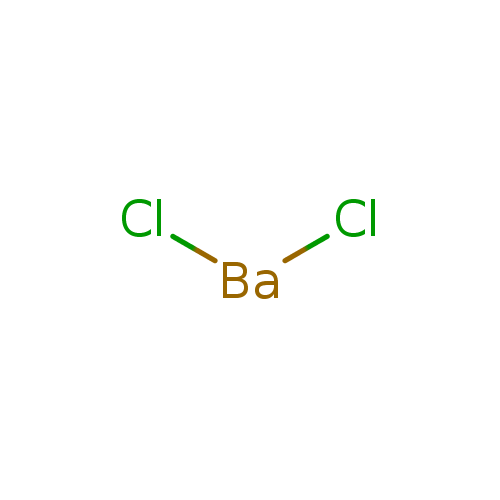
Chemical Structure
Thumb
Synonyms
ValueSource
BaCl2ChEBI
Barium chloride, (140)bacl2MeSH
Barium chloride, (153)bacl2MeSH
Barium chloride, hexahydrateMeSH
Barium chloride, octaammoniateMeSH
Barium chloride, dihydrateMeSH
Barium chloride, monohydrateMeSH
Barium dichlorideMeSH
Chemical FormulaBaCl2
Average Molecular Mass208.233 g/mol
Monoisotopic Mass207.843 g/mol
CAS Registry Number10361-37-2
IUPAC Namedichlorobarium
Traditional Namedichlorobarium
SMILESCl[Ba]Cl
InChI IdentifierInChI=1S/Ba.2ClH/h;2*1H/q+2;;/p-2
InChI KeyWDIHJSXYQDMJHN-UHFFFAOYSA-L
Chemical Taxonomy
Description belongs to the class of inorganic compounds known as alkaline earth metal chlorides. These are inorganic compounds in which the largest halogen atom is Chlorine, and the heaviest metal atom is a lanthanide.
KingdomInorganic compounds
Super ClassMixed metal/non-metal compounds
ClassAlkaline earth metal salts
Sub ClassAlkaline earth metal chlorides
Direct ParentAlkaline earth metal chlorides
Alternative Parents
Substituents
  • Alkaline earth metal chloride
  • Inorganic chloride salt
  • Inorganic salt
Molecular FrameworkNot Available
External Descriptors
Biological Properties
StatusDetected and Not Quantified
OriginExogenous
Cellular Locations
  • Cytoplasm
  • Extracellular
Biofluid LocationsNot Available
Tissue LocationsNot Available
PathwaysNot Available
ApplicationsNot Available
Biological Roles
Chemical RolesNot Available
Physical Properties
StateSolid
AppearanceWhite crystals.
Experimental Properties
PropertyValue
Melting PointNot Available
Boiling PointNot Available
SolubilityNot Available
Predicted Properties
PropertyValueSource
logP1.07ChemAxon
Physiological Charge0ChemAxon
Hydrogen Acceptor Count0ChemAxon
Hydrogen Donor Count0ChemAxon
Polar Surface Area0 ŲChemAxon
Rotatable Bond Count0ChemAxon
Refractivity12.27 m³·mol⁻¹ChemAxon
Polarizability7.26 ųChemAxon
Number of Rings0ChemAxon
Bioavailability1ChemAxon
Rule of FiveYesChemAxon
Ghose FilterNoChemAxon
Veber's RuleYesChemAxon
MDDR-like RuleNoChemAxon
Spectra
Spectra
Spectrum TypeDescriptionSplash KeyView
Predicted LC-MS/MSPredicted LC-MS/MS Spectrum - 10V, Positivesplash10-0a4i-0090000000-b7e6ce5b99a961a108a0Spectrum
Predicted LC-MS/MSPredicted LC-MS/MS Spectrum - 20V, Positivesplash10-0a4i-0090000000-28becb6cdcfbc60f3449Spectrum
Predicted LC-MS/MSPredicted LC-MS/MS Spectrum - 40V, Positivesplash10-0a4i-1190000000-36af7759f77210714cf5Spectrum
Toxicity Profile
Route of ExposureOral (3) ; inhalation (3)
Mechanism of ToxicityBarium is a competitive potassium channel antagonist that blocks the passive efflux of intracellular potassium, resulting in a shift of potassium from extracellular to intracellular compartments. The intracellular translocation of potassium results in a decreased resting membrane potential, making the muscle fibers electrically unexcitable and causing paralysis. Some of these barium's effects may also be due to barium induced neuromuscular blockade and membrane depolarization. (3)
MetabolismBarium compounds are absorbed via ingestion and inhalation, the extent of which depends on the individual compound. In the body, the majority of the barium is found in the bone, while small amounts exists in the muscle, adipose, skin, and connective tissue. Barium is not metabolized in the body, but it may be transported or incorporated into complexes or tissues. Barium is excreted in the urine and faeces. (3)
Toxicity ValuesLD50: 220 mg/kg (Oral, Rat) (4) LD50: 178 mg/kg (Subcutaneous, Rat) (5) LD50: 20 mg/kg (Intravenous, Rat)
Lethal Dose1 to 15 grams for an adult human (barium salts). (6)
Carcinogenicity (IARC Classification)No indication of carcinogenicity to humans (not listed by IARC).
Uses/SourcesBarium chloride is used in the laboratory as a test for sulfate ion. In industry, barium chloride is mainly used in the purification of brine solution in caustic chlorine plants and also in the manufacture of heat treatment salts, case hardening of steel, in the manufacture of pigments, and in the manufacture of other barium salts. It is also used in fireworks to give a bright green color. (2)
Minimum Risk LevelIntermediate Oral: 0.2 mg/kg/day (1) Chronic Oral: 0.2 mg/kg/day (1)
Health EffectsThe health effects of the different barium compounds depend on how well the compound dissolves in water or the stomach contents. At low doses, barium acts as a muscle stimulant, while higher doses affect the nervous system, causing cardiac irregularities, tremors, weakness, anxiety, dyspnea, paralysisand possibly death. Barium may also cause gastrointestinal disturbances, damage the kidneys and cause decreases in body weight. (3)
SymptomsIngesting excess barium may cause vomiting, abdominal cramps, diarrhea, difficulties in breathing, increased or decreased blood pressure, numbness around the face, and muscle weakness. High levels may result in changes in heart rhythm or paralysis and possibly death. (3)
TreatmentIntravenous infusion of potassium often relieves many of the symptoms of barium toxicity. (3)

Concentrations
Not Available
DrugBank IDNot Available
HMDB IDNot Available
FooDB IDNot Available
Phenol Explorer IDNot Available
KNApSAcK IDNot Available
BiGG IDNot Available
BioCyc IDCPD0-1592
METLIN IDNot Available
PDB IDNot Available
Wikipedia LinkBarium_chloride
Chemspider IDNot Available
ChEBI ID63317
PubChem Compound IDNot Available
Kegg Compound IDNot Available
YMDB IDNot Available
ECMDB IDNot Available
References
Synthesis ReferenceNot Available
MSDSNot Available
General References
1. https://www.ncbi.nlm.nih.gov/pubmed/?term=21601246