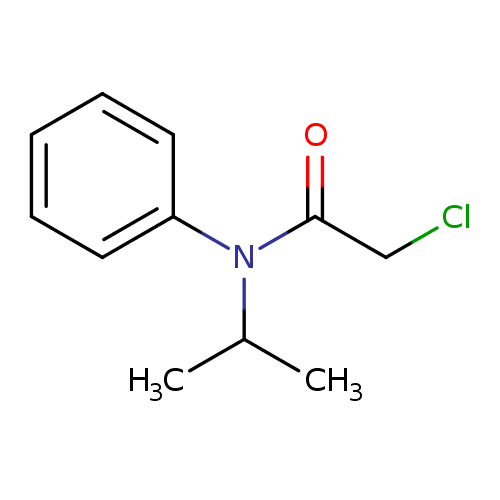
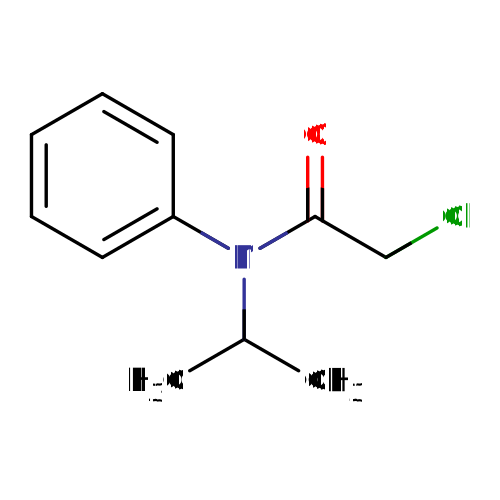
Propachlor is widely used as a selective herbicide worldwide in corn, soybean and other crop cultures. Elevated concentrations of these herbicides and their degradation products have been detected in surface and groundwater. Propachlor is a pre-emergence herbicide, effective against annual grasses and certain broad-leaved weeds. It is a compound of the family of chloroacetanilides. (1, 3)
belongs to the class of organic compounds known as anilides. These are organic heterocyclic compounds derived from oxoacids RkE(=O)l(OH)m (l not 0) by replacing an OH group by the NHPh group or derivative formed by ring substitution.
Propachlor poisoning causes an induction of microsomal hepatic UDPGT activity, which produces increased clearance of thyroid hormone, T4. Decreased levels of T4 would result in increased levels of thyroid stimulating hormone (TSH). Increased levels of TSH would result in the hyperplastic and eventually tumorigenic response of the thyroid. Propachlor metabolites also bind to nAChRs in the nervous system and cause endocrine disruption in humans by binding to and inhibiting the estrogen receptor. (6, 2, 10)
Metabolism
Propachlor can be absorbed in mammals through the respiratory and gastrointestinal tracts as well as through the skin. It does not accumulate in the body, since it is rapidly metabolized through the mercapturic acid pathway (MAP). Cysteine conjugates are formed by glutathione conjugation and this conjugate has been proposed as an intermediate in the metabolic formation of mercapturic acid conjugation. It has been shown that a cysteine conjugate of propachlor is the source of sulfur in methylsulfonyl- containing metabolites, but that the carbon in the methylsulfonyl group does not come from the cysteine moiety. Propachlor is conjugated firstly with glutathione and the reaction is mediated by glutathione transferases. The glutathione conjugation provides a means for inactivation of reactive electrophiles. Glutathione conjugates have the required physico-chemical properties for biliary excretion and will generally be present, together with their catabolites cysteinyl-glycine, cysteine and N-acetylcysteine-mercapturic acid, in relatively high concentrations in the bile. After excretion with the bile, they are metabolized in the intestine where the C-S lyase present cleaves the cysteine conjugate, allowing further metabolism of sulfur to a methylsulfonyl-containing moiety. Eleven urinary metabolites, six of which are 2-methylsulfonylacetanalides have been isolated. The major fecal metabolite is identified as the cysteine conjugate. (3, 4, 5)
Propachlor is used on a variety of food plants, including onions, field corn, hybrid seed, silage corn, sweet corn, grain sorghum, green peas, soybeans, flax, pumpkin, and strawberries. (3)
Minimum Risk Level
Not Available
Health Effects
Eye exposure may cause corneal damage. Erythematopapular contact eczema can follow exposure to propachlor. (3, 4)
Symptoms
Irritation and/or severe burns of the skin, eye, esophagus or gastrointestinal tract, and the respiratory tract, depending on the route of exposure. (7)
Treatment
Consider gastric lavage, as well was dilution with milk or water after ingestion. Administer charcoal as a slurry following ingestion; however, activated charcoal should not be given to patients ingesting strong acidic or basic caustic chemicals. In case of inhalation, move patient to fresh air. Monitor for respiratory distress. If cough or difficulty breathing develops, evaluate for respiratory tract irritation, bronchitis, or pneumonitis. Administer oxygen and assist ventilation as required. Treat bronchospasm with inhaled beta2 agonist and oral or parenteral corticosteroids. Irrigate exposed eyes with copious amounts of room temperature water for at least 15 minutes. Following dermal exposure, remove contaminated clothing and wash exposed area thoroughly with soap and water. Treat dermal irritation or burns with standard topical therapy. Patients developing dermal hypersensitivity reactions may require treatment with systemic or topical corticosteroids or antihistamines. Administer symptomatic treatment as necessary. (7)