Record Information
Version1.0
Creation Date2009-06-18 20:15:07 UTC
Update Date2026-05-14 16:43:42 UTC
Accession NumberCHEM000897
Identification
Common NameIvermectin
ClassSmall Molecule
DescriptionIvermectin is a broad-spectrum anti-parasite medication. It was first marketed under the name Stromectol® and used against worms (except tapeworms), but, in 2012, it was approved for the topical treatment of head lice infestations in patients 6 months of age and older, and marketed under the name Sklice™ as well. Ivermectin is mainly used in humans in the treatment of onchocerciasis, but is also effective against other worm infestations (such as strongyloidiasis, ascariasis, trichuriasis and enterobiasis).
Contaminant Sources
  • HMDB Contaminants - Urine
  • STOFF IDENT Compounds
  • T3DB toxins
Contaminant Type
  • Antiparasitic Agent
  • Avermectin
  • Drug
  • Human Neurotoxin
  • Insecticide
  • Lachrymator
  • Metabolite
  • Organic Compound
  • Synthetic Compound
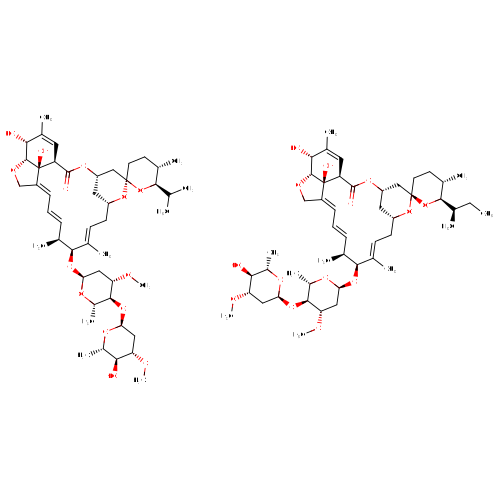
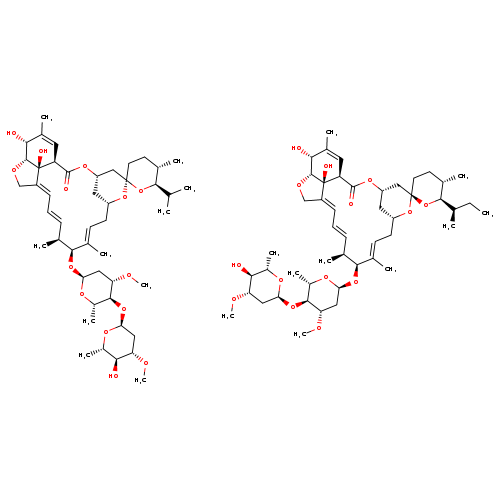
Chemical Structure
Thumb
Synonyms
ValueSource
22,23-Dihydroxy-avermectin bHMDB
22,23-Dihyroavermectin b1HMDB
5-O-Demethyl-22,23-dihydro-avermectin a1aHMDB
Chemical FormulaC95H146O28
Average Molecular Mass1736.159 g/mol
Monoisotopic Mass1735.000 g/mol
CAS Registry Number70288-86-7
IUPAC Name(1'R,2R,4'S,5S,6R,8'R,10'E,12'S,13'S,14'E,16'E,20'R,21'R,24'S)-21',24'-dihydroxy-12'-{[(2R,4S,5S,6S)-5-{[(2S,4S,5S,6S)-5-hydroxy-4-methoxy-6-methyloxan-2-yl]oxy}-4-methoxy-6-methyloxan-2-yl]oxy}-5,11',13',22'-tetramethyl-6-(propan-2-yl)-3',7',19'-trioxaspiro[oxane-2,6'-tetracyclo[15.6.1.1^{4,8}.0^{20,24}]pentacosane]-10',14',16',22'-tetraen-2'-one; (1'R,2R,4'S,5S,6R,8'R,10'E,12'S,13'S,14'E,16'E,20'R,21'R,24'S)-6-[(2S)-butan-2-yl]-21',24'-dihydroxy-12'-{[(2R,4S,5S,6S)-5-{[(2S,4S,5S,6S)-5-hydroxy-4-methoxy-6-methyloxan-2-yl]oxy}-4-methoxy-6-methyloxan-2-yl]oxy}-5,11',13',22'-tetramethyl-3',7',19'-trioxaspiro[oxane-2,6'-tetracyclo[15.6.1.1^{4,8}.0^{20,24}]pentacosane]-10',14',16',22'-tetraen-2'-one
Traditional Name(1'R,2R,4'S,5S,6R,8'R,10'E,12'S,13'S,14'E,16'E,20'R,21'R,24'S)-6-[(2R)-butan-2-yl]-21',24'-dihydroxy-12'-{[(2R,4S,5S,6S)-5-{[(2S,4S,5S,6S)-5-hydroxy-4-methoxy-6-methyloxan-2-yl]oxy}-4-methoxy-6-methyloxan-2-yl]oxy}-5,11',13',22'-tetramethyl-3',7',19'-trioxaspiro[oxane-2,6'-tetracyclo[15.6.1.1⁴,⁸.0²⁰,²⁴]pentacosane]-10',14',16',22'-tetraen-2'-one; dihydroavermectin B1b
SMILESCO[C@H]1C[C@@H](O[C@@H](C)[C@@H]1O)O[C@H]1[C@H](C)O[C@H](C[C@@H]1OC)O[C@H]1[C@@H](C)\C=C\C=C2/CO[C@@H]3[C@H](O)C(C)=C[C@@H](C(=O)O[C@H]4C[C@@H](C\C=C1/C)O[C@@]1(CC[C@H](C)[C@@H](C(C)C)O1)C4)[C@]23O.CC[C@@H](C)[C@H]1O[C@@]2(CC[C@@H]1C)O[C@@H]1C\C=C(C)\[C@@H](O[C@@H]3O[C@@H](C)[C@H](O[C@@H]4O[C@@H](C)[C@H](O)[C@@H](OC)C4)[C@@H](OC)C3)[C@@H](C)\C=C\C=C3/CO[C@@H]4[C@H](O)C(C)=C[C@@H](C(=O)O[C@@H](C1)C2)[C@]34O
InChI IdentifierInChI=1S/C48H74O14.C47H72O14/c1-11-25(2)43-28(5)17-18-47(62-43)23-34-20-33(61-47)16-15-27(4)42(26(3)13-12-14-32-24-55-45-40(49)29(6)19-35(46(51)58-34)48(32,45)52)59-39-22-37(54-10)44(31(8)57-39)60-38-21-36(53-9)41(50)30(7)56-38;1-24(2)41-27(5)16-17-46(61-41)22-33-19-32(60-46)15-14-26(4)42(25(3)12-11-13-31-23-54-44-39(48)28(6)18-34(45(50)57-33)47(31,44)51)58-38-21-36(53-10)43(30(8)56-38)59-37-20-35(52-9)40(49)29(7)55-37/h12-15,19,25-26,28,30-31,33-45,49-50,52H,11,16-18,20-24H2,1-10H3;11-14,18,24-25,27,29-30,32-44,48-49,51H,15-17,19-23H2,1-10H3/b13-12+,27-15+,32-14+;12-11+,26-14+,31-13+/t25-,26+,28+,30+,31+,33-,34+,35+,36+,37+,38+,39+,40-,41+,42+,43-,44+,45-,47-,48-;25-,27-,29-,30-,32+,33-,34-,35-,36-,37-,38-,39+,40-,41+,42-,43-,44+,46+,47+/m10/s1
InChI KeySPBDXSGPUHCETR-CVSKBELMSA-N
Chemical Taxonomy
Description belongs to the class of organic compounds known as milbemycins. These are a group of macrolides with a structure containing a 16-membered lactone ring fused to a 1,7-dioxaspiroundecane ring system and to either a benzofuran (or hydrogenated derivative thereof). In some cases (e.g. Milbemycin E), the tetrahydrofuranyl ring is missing. Milbemycins can be o-glycosylated at C13 to form Avermectins. Milbemycins are produced by Streptomyces species.
KingdomOrganic compounds
Super ClassPhenylpropanoids and polyketides
ClassMacrolides and analogues
Sub ClassMilbemycins
Direct ParentMilbemycins
Alternative Parents
Substituents
  • Milbemycin
  • Disaccharide
  • Glycosyl compound
  • O-glycosyl compound
  • Ketal
  • Oxane
  • Tetrahydrofuran
  • Tertiary alcohol
  • Carboxylic acid ester
  • Lactone
  • Secondary alcohol
  • Acetal
  • Carboxylic acid derivative
  • Dialkyl ether
  • Ether
  • Oxacycle
  • Organoheterocyclic compound
  • Monocarboxylic acid or derivatives
  • Organic oxide
  • Carbonyl group
  • Hydrocarbon derivative
  • Alcohol
  • Organic oxygen compound
  • Organooxygen compound
  • Aliphatic heteropolycyclic compound
Molecular FrameworkNot Available
External DescriptorsNot Available
Biological Properties
StatusDetected and Not Quantified
OriginExogenous
Cellular Locations
  • Membrane
Biofluid LocationsNot Available
Tissue LocationsNot Available
PathwaysNot Available
Applications
Biological Roles
Chemical RolesNot Available
Physical Properties
StateSolid
AppearanceWhite powder.
Experimental Properties
PropertyValue
Melting Point155°C
Boiling PointNot Available
SolubilityInsoluble
Predicted Properties
PropertyValueSource
logP5.83ChemAxon
pKa (Strongest Acidic)12.47ChemAxon
pKa (Strongest Basic)-3.4ChemAxon
Physiological Charge0ChemAxon
Hydrogen Acceptor Count13ChemAxon
Hydrogen Donor Count3ChemAxon
Polar Surface Area170.06 ŲChemAxon
Rotatable Bond Count15ChemAxon
Refractivity230.33 m³·mol⁻¹ChemAxon
Polarizability96.87 ųChemAxon
Number of Rings14ChemAxon
Bioavailability0ChemAxon
Rule of FiveNoChemAxon
Ghose FilterNoChemAxon
Veber's RuleNoChemAxon
MDDR-like RuleYesChemAxon
Spectra
Spectra
Spectrum TypeDescriptionSplash KeyView
Predicted LC-MS/MSPredicted LC-MS/MS Spectrum - 10V, Positivesplash10-000i-0000000900-df27c9c77d7d15aefc4eSpectrum
Predicted LC-MS/MSPredicted LC-MS/MS Spectrum - 20V, Positivesplash10-000i-0000000900-df27c9c77d7d15aefc4eSpectrum
Predicted LC-MS/MSPredicted LC-MS/MS Spectrum - 40V, Positivesplash10-000i-0000000900-df27c9c77d7d15aefc4eSpectrum
Predicted LC-MS/MSPredicted LC-MS/MS Spectrum - 10V, Negativesplash10-001i-0000000900-d0af2ff89ca8f60cbf69Spectrum
Predicted LC-MS/MSPredicted LC-MS/MS Spectrum - 20V, Negativesplash10-001i-0000000900-d0af2ff89ca8f60cbf69Spectrum
Predicted LC-MS/MSPredicted LC-MS/MS Spectrum - 40V, Negativesplash10-001i-0000000900-d0af2ff89ca8f60cbf69Spectrum
Toxicity Profile
Route of ExposureModerately well absorbed. Improved absorption with high fat meal.
Mechanism of ToxicityIvermectin binds selectively and with high affinity to glutamate-gated chloride ion channels in invertebrate muscle and nerve cells of the microfilaria. This binding causes an increase in the permeability of the cell membrane to chloride ions and results in hyperpolarization of the cell, leading to paralysis and death of the parasite. Ivermectin also is believed to act as an agonist of the neurotransmitter gamma-aminobutyric acid (GABA), thereby disrupting GABA-mediated central nervous system (CNS) neurosynaptic transmission. Ivermectin may also impair normal intrauterine development of O. volvulus microfilariae and may inhibit their release from the uteri of gravid female worms. It has low solubility in water and extensive non-specific binding. It opens GABA-insensitive chloride channels, reducing membrane resistance and increasing conductance inward. (3)
MetabolismPrimarily hepatic. Ivermectin and/or its metabolites are excreted almost exclusively in the feces over an estimated 12 days, with less than 1 % of the administered dose excreted in the urine. Route of Elimination: Ivermectin is metabolized in the liver, and ivermectin and/or its metabolites are excreted almost exclusively in the feces over an estimated 12 days, with less than 1% of the administered dose excreted in the urine. Half Life: 16 hours (also reported at 22-28 hours)
Toxicity ValuesLD50 = 29.5 mg/kg (Mouse, oral) LD50 = 10 mg/kg (Rat, oral)
Lethal DoseNot Available
Carcinogenicity (IARC Classification)Not listed by IARC.
Uses/SourcesFor the treatment of intestinal (i.e., nondisseminated) strongyloidiasis due to the nematode parasite Strongyloides stercoralis. Also for the treatment of onchocerciasis (river blindness) due to the nematode parasite Onchocerca volvulus. Can be used to treat scabies caused by Sarcoptes scabiei. Active ingredient in some commercial ant bait traps. (1)
Minimum Risk LevelNot Available
Health EffectsAvermectins are neurotoxic and have reproductive and developmental effects. (2)
SymptomsAvermectins cause irritation of skin and eyes, central nervous system depression (incoordination, tremors, lethargy, excitation, pupil dilation, coma), vomiting, convulsions and/or tremors, and respiratory failure at high doses. (2) Adverse effects include muscle or joint pain, dizziness, fever, headache, skin rash, fast heartbeat.
TreatmentNot Available
Concentrations
Not Available
DrugBank IDDB00602
HMDB IDHMDB0014740
FooDB IDNot Available
Phenol Explorer IDNot Available
KNApSAcK IDNot Available
BiGG IDNot Available
BioCyc IDNot Available
METLIN IDNot Available
PDB IDNot Available
Wikipedia LinkIvermectin
Chemspider ID30776735
ChEBI IDNot Available
PubChem Compound ID46936176
Kegg Compound IDNot Available
YMDB IDNot Available
ECMDB IDNot Available
References
Synthesis Reference

Shuet-Hing L. Chiu, Josephine R. Carlin, Rae Taub, “Ivermectin derivative compounds and process for preparing the same.” U.S. Patent US4963667, issued June, 1982.

MSDSLink
General ReferencesNot Available