Record Information
Version1.0
Creation Date2009-06-18 17:03:35 UTC
Update Date2026-03-31 17:33:05 UTC
Accession NumberCHEM000896
Identification
Common NameFluvalinate
ClassSmall Molecule
DescriptionFluvalinate is a synthetic pyrethroid (type 1). It was developed in 1980 . It was originally introduced as the racemic mixture. The use of fluvalinate has been discontinued and replaced by tau-fluvalinate which is derived from one isomer (the R-form) of fluvalinate. A pyrethroid is a synthetic chemical compound similar to the natural chemical pyrethrins produced by the flowers of pyrethrums (Chrysanthemum cinerariaefolium and C. coccineum). Pyrethroids are common in commercial products such as household insecticides and insect repellents. In the concentrations used in such products, they are generally harmless to human beings but can harm sensitive individuals. They are usually broken apart by sunlight and the atmosphere in one or two days, and do not significantly affect groundwater quality except for being toxic to fish. (4, 7, 5, 8)
Contaminant Sources
  • Clean Air Act Chemicals
  • HPV EPA Chemicals
  • T3DB toxins
  • ToxCast & Tox21 Chemicals
Contaminant Type
  • Amine
  • Ester
  • Ether
  • Household Toxin
  • Nitrile
  • Organic Compound
  • Organochloride
  • Organofluoride
  • Pesticide
  • Pyrethroid
  • Synthetic Compound
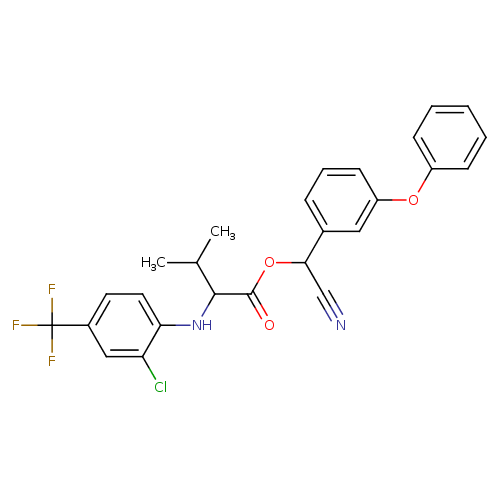
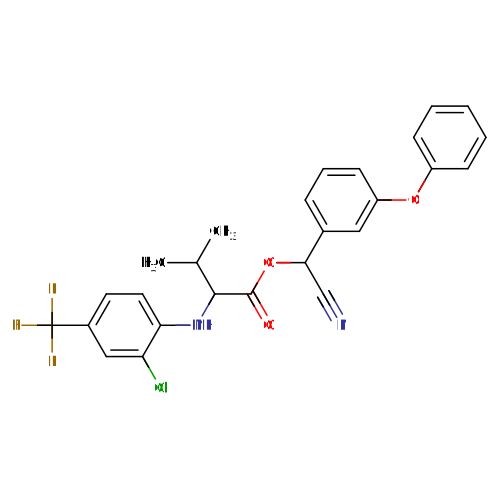
Chemical Structure
Thumb
Synonyms
ValueSource
Fluvalinic acidGenerator
MavrikMeSH
alpha-cyano-3-Phenoxybenzyl 2-(2-chloro-4-trifluoromethylanilino)-3-methylbutanoateMeSH
Chemical FormulaC26H22ClF3N2O3
Average Molecular Mass502.913 g/mol
Monoisotopic Mass502.127 g/mol
CAS Registry Number69409-94-5
IUPAC Namecyano(3-phenoxyphenyl)methyl 2-{[2-chloro-4-(trifluoromethyl)phenyl]amino}-3-methylbutanoate
Traditional NameSPUR
SMILESCC(C)C(NC1=CC=C(C=C1Cl)C(F)(F)F)C(=O)OC(C#N)C1=CC=CC(OC2=CC=CC=C2)=C1
InChI IdentifierInChI=1S/C26H22ClF3N2O3/c1-16(2)24(32-22-12-11-18(14-21(22)27)26(28,29)30)25(33)35-23(15-31)17-7-6-10-20(13-17)34-19-8-4-3-5-9-19/h3-14,16,23-24,32H,1-2H3
InChI KeyINISTDXBRIBGOC-UHFFFAOYSA-N
Chemical Taxonomy
Description belongs to the class of organic compounds known as macrolides and analogues. These are organic compounds containing a lactone ring of at least twelve members.
KingdomOrganic compounds
Super ClassPhenylpropanoids and polyketides
ClassMacrolides and analogues
Sub ClassNot Available
Direct ParentMacrolides and analogues
Alternative Parents
Substituents
  • Macrolide
  • Disaccharide
  • Glycosyl compound
  • O-glycosyl compound
  • Ketal
  • Oxane
  • Pyran
  • Tetrahydrofuran
  • Tertiary alcohol
  • Secondary alcohol
  • Carboxylic acid ester
  • Lactone
  • Acetal
  • Carboxylic acid derivative
  • Organoheterocyclic compound
  • Dialkyl ether
  • Ether
  • Monocarboxylic acid or derivatives
  • Oxacycle
  • Organic oxygen compound
  • Alcohol
  • Organic oxide
  • Organooxygen compound
  • Hydrocarbon derivative
  • Carbonyl group
  • Aliphatic heteropolycyclic compound
Molecular FrameworkAliphatic heteropolycyclic compounds
External Descriptors
Biological Properties
StatusDetected and Not Quantified
OriginExogenous
Cellular Locations
  • Membrane
Biofluid LocationsNot Available
Tissue LocationsNot Available
PathwaysNot Available
Applications
Biological Roles
Chemical RolesNot Available
Physical Properties
StateLiquid
AppearanceYellow amber liquid (9).
Experimental Properties
PropertyValue
Melting Point< 25°C
Boiling PointNot Available
Solubility5e-06 mg/mL at 25°C [WAUCHOPE,RD et al. (1991A)]
Predicted Properties
PropertyValueSource
Water Solubility0.00049 g/LALOGPS
logP6.65ALOGPS
logP6.98ChemAxon
logS-6ALOGPS
pKa (Strongest Acidic)10.62ChemAxon
pKa (Strongest Basic)0.58ChemAxon
Physiological Charge0ChemAxon
Hydrogen Acceptor Count3ChemAxon
Hydrogen Donor Count1ChemAxon
Polar Surface Area71.35 ŲChemAxon
Rotatable Bond Count10ChemAxon
Refractivity127.04 m³·mol⁻¹ChemAxon
Polarizability46.01 ųChemAxon
Number of Rings3ChemAxon
Bioavailability0ChemAxon
Rule of FiveNoChemAxon
Ghose FilterNoChemAxon
Veber's RuleNoChemAxon
MDDR-like RuleYesChemAxon
Spectra
Spectra
Spectrum TypeDescriptionSplash KeyView
Predicted LC-MS/MSPredicted LC-MS/MS Spectrum - 10V, Positivesplash10-0udi-0050490000-e2ee8e12709026b89b68Spectrum
Predicted LC-MS/MSPredicted LC-MS/MS Spectrum - 20V, Positivesplash10-0fb9-2190410000-44a165415c49ebf3226cSpectrum
Predicted LC-MS/MSPredicted LC-MS/MS Spectrum - 40V, Positivesplash10-003r-3590000000-14c310660632df801c81Spectrum
Predicted LC-MS/MSPredicted LC-MS/MS Spectrum - 10V, Negativesplash10-0uk9-0060190000-3bb7775b7504cf1c161dSpectrum
Predicted LC-MS/MSPredicted LC-MS/MS Spectrum - 20V, Negativesplash10-0fk9-3390230000-66196c3e1fc5249a1794Spectrum
Predicted LC-MS/MSPredicted LC-MS/MS Spectrum - 40V, Negativesplash10-0006-9630000000-1d1ef52307e32002ce38Spectrum
Predicted LC-MS/MSPredicted LC-MS/MS Spectrum - 10V, Positivesplash10-0zi0-0090240000-c2aaa03bb772028c6d07Spectrum
Predicted LC-MS/MSPredicted LC-MS/MS Spectrum - 20V, Positivesplash10-0zfr-1190000000-c17b66028e90d7cc2f13Spectrum
Predicted LC-MS/MSPredicted LC-MS/MS Spectrum - 40V, Positivesplash10-0a4i-2490000000-201afc04a14519a91238Spectrum
Predicted LC-MS/MSPredicted LC-MS/MS Spectrum - 10V, Negativesplash10-0udi-0050490000-e6b52821d438dbc6aa55Spectrum
Predicted LC-MS/MSPredicted LC-MS/MS Spectrum - 20V, Negativesplash10-052f-3390010000-fe5a4f44e7abd72401edSpectrum
Predicted LC-MS/MSPredicted LC-MS/MS Spectrum - 40V, Negativesplash10-000x-9630000000-8e24443479b5818a9fc8Spectrum
MSMass Spectrum (Electron Ionization)splash10-0udi-2490000000-475141efba85f96592dcSpectrum
1D NMR1H NMR SpectrumNot AvailableSpectrum
1D NMR13C NMR SpectrumNot AvailableSpectrum
Toxicity Profile
Route of ExposureInhalation (5) ; oral (5) ; dermal (5) ; eye contact (5).
Mechanism of ToxicityBoth type I and type II pyrethroids exert their effect by prolonging the open phase of the sodium channel gates when a nerve cell is excited. They appear to bind to the membrane lipid phase in the immediate vicinity of the sodium channel, thus modifying the channel kinetics. This blocks the closing of the sodium gates in the nerves, and thus prolongs the return of the membrane potential to its resting state. The repetitive (sensory, motor) neuronal discharge and a prolonged negative afterpotential produces effects quite similar to those produced by DDT, leading to hyperactivity of the nervous system which can result in paralysis and/or death. Other mechanisms of action of pyrethroids include antagonism of gamma-aminobutyric acid (GABA)-mediated inhibition, modulation of nicotinic cholinergic transmission, enhancement of noradrenaline release, and actions on calcium ions. They also inhibit calium channels and Ca2+, Mg2+-ATPase. (10, 11, 5)
MetabolismThe major metabolic pathways are cleavage of ester linkage and oxidation at the acid and alcohol moieties. Ester hydrolysis leads to formation of anilino acid. The anilino acid is further conjugated with amino acids (glycine, serine, threonine, and valine), bile acids (cholic, taurochoric, and taurochenodeoxycholic), and glycerols (oleoyl- and linoleoylglycerol). In addition, an amide derivative of anilino acid was found. These conjugation reactions of anilino acid with bile acid (cholic acid, taurocholic acid, and taurochenodeoxycholic acid) and with glycerol and monoglycerides have rarely been reported as conjugates with xenobiotics. The major urinary metabolites are anilino acid, its hydroxymethyl derivative, its glycine conjugate, haloaniline, and sulfate conjugate of hydroxyhaloaniline. On the other hand, the major fecal metabolites are anilino acid, its amide derivative, and several conjugates of anilino acid with several endogenous components. An unexpected difference between fluvalinate and other pyrethroids is the minimal amt of hydroxylation at the 4'-position of the alcohol moiety. (13)
Toxicity ValuesLD50: 261-282 mg/kg (Oral, Rat) (9)
Lethal DoseNot Available
Carcinogenicity (IARC Classification)Spraying and application of nonarsenical insecticides entail exposures that are probably carcinogenic to humans (Group 2A). (2)
Uses/SourcesPyrethroids are used as insecticides. (5)
Minimum Risk LevelNot Available
Health EffectsAt high doses, signs of poisoning attributable to fluvalinate include profuse salivation and pulmonary edema, clonic seizures, opisthotonos (i.e., the spine is bent forward such that a supine body rests on its head and heels), coma, and death. At lower doses, commonly observed effects include paresthesia and erythema. (6)
SymptomsFollowing dermal exposure to fluvalinate, feelings of numbness, itching, burning, stinging, tingling, or warmth may occur, that could last for a few hours. Dizziness, headache, nausea, muscle twitching, reduced energy, and changes in awareness can result from inhalation or ingestion of large amounts of fluvalinate. Paralysis can occur after exposure. (5)
TreatmentFollowing oral exposure, the treatment is symptomatic and supportive and includes monitoring for the development of hypersensitivity reactions with respiratory distress. Provide adequate airway management when needed. Gastric decontamination is usually not required unless the pyrethrin product is combined with a hydrocarbon. Following inhalation exposure, move patient to fresh air. monitor for respiratory distress. If cough or difficulty breathing develops, evaluate for respiratory tract irritation, bronchitis, or pneumonitis. Administer oxygen and assist ventilation as required. Treat bronchospasm with inhaled beta2 agonist and oral or parenteral corticosteroids. In case of eye exposure, irrigate exposed eyes with copious amounts of room temperature water for at least 15 minutes. If irritation, pain, swelling, lacrimation, or photophobia persist, the patient should be seen in a health care facility. If the contamination occurs through dermal exposure, Remove contaminated clothing and wash exposed area thoroughly with soap and water. A physician may need to examine the area if irritation or pain persists. Vitamin E topical application is highly effective in relieving parenthesis. (3)

Concentrations
Not Available
DrugBank IDNot Available
HMDB IDNot Available
FooDB IDNot Available
Phenol Explorer IDNot Available
KNApSAcK IDNot Available
BiGG IDNot Available
BioCyc IDNot Available
METLIN IDNot Available
PDB IDNot Available
Wikipedia LinkFluvalinate
Chemspider IDNot Available
ChEBI ID5135
PubChem Compound ID50516
Kegg Compound IDC10989
YMDB IDNot Available
ECMDB IDNot Available
References
Synthesis ReferenceNot Available
MSDSNot Available
General ReferencesNot Available