Record Information
Version1.0
Creation Date2009-06-18 17:03:35 UTC
Update Date2026-05-14 19:36:47 UTC
Accession NumberCHEM000886
Identification
Common NameTetramethrin
ClassSmall Molecule
DescriptionTetramethrin is a potent synthetic insecticide in the pyrethroid (type 1) family. A pyrethroid is a synthetic chemical compound similar to the natural chemical pyrethrins produced by the flowers of pyrethrums (Chrysanthemum cinerariaefolium and C. coccineum). Pyrethroids are common in commercial products such as household insecticides and insect repellents. In the concentrations used in such products, they are generally harmless to human beings but can harm sensitive individuals. They are usually broken apart by sunlight and the atmosphere in one or two days, and do not significantly affect groundwater quality except for being toxic to fish. (4)
Contaminant Sources
  • Clean Air Act Chemicals
  • HPV EPA Chemicals
  • My Exposome Chemicals
  • STOFF IDENT Compounds
  • T3DB toxins
  • ToxCast & Tox21 Chemicals
Contaminant Type
  • Amide
  • Amine
  • Ester
  • Ether
  • Household Toxin
  • Organic Compound
  • Pesticide
  • Pyrethroid
  • Synthetic Compound
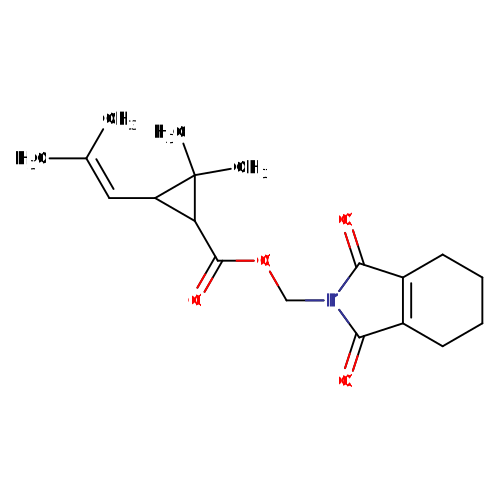
Chemical Structure
Thumb
Synonyms
ValueSource
Neo-pynaminChEBI
NeopinaminChEBI
PhthalthrinChEBI
NeopinamineMeSH
2,2-Dimethyl-3-(2-methylpropenyl)cyclopropanecarboxylic acid, ester with N-(hydroxymethyl)-1-cyclo hexene 1,2-dicarboximideMeSH
NeopynaminMeSH
Chemical FormulaC19H25NO4
Average Molecular Mass331.406 g/mol
Monoisotopic Mass331.178 g/mol
CAS Registry Number7696-12-0
IUPAC Name(1,3-dioxo-2,3,4,5,6,7-hexahydro-1H-isoindol-2-yl)methyl 2,2-dimethyl-3-(2-methylprop-1-en-1-yl)cyclopropane-1-carboxylate
Traditional Nametetramethrin
SMILESCC(C)=CC1C(C(=O)OCN2C(=O)C3=C(CCCC3)C2=O)C1(C)C
InChI IdentifierInChI=1S/C19H25NO4/c1-11(2)9-14-15(19(14,3)4)18(23)24-10-20-16(21)12-7-5-6-8-13(12)17(20)22/h9,14-15H,5-8,10H2,1-4H3
InChI KeyCXBMCYHAMVGWJQ-UHFFFAOYSA-N
Chemical Taxonomy
Description belongs to the class of organic compounds known as isoindolones. These are aromatic polycyclic compounds that an isoindole bearing a ketone.
KingdomOrganic compounds
Super ClassOrganoheterocyclic compounds
ClassIsoindoles and derivatives
Sub ClassIsoindolines
Direct ParentIsoindolones
Alternative Parents
Substituents
  • Bicyclic monoterpenoid
  • Isoindolone
  • Monoterpenoid
  • Isoindole
  • Maleimide
  • Cyclopropanecarboxylic acid or derivatives
  • Carboxylic acid imide, n-substituted
  • Pyrroline
  • Carboxylic acid imide
  • Dicarboximide
  • Carboxylic acid ester
  • Lactam
  • Azacycle
  • Carboxylic acid derivative
  • Monocarboxylic acid or derivatives
  • Organooxygen compound
  • Organic oxygen compound
  • Organopnictogen compound
  • Organic oxide
  • Organic nitrogen compound
  • Organonitrogen compound
  • Carbonyl group
  • Hydrocarbon derivative
  • Aliphatic heteropolycyclic compound
Molecular FrameworkAliphatic heteropolycyclic compounds
External Descriptors
Biological Properties
StatusDetected and Not Quantified
OriginExogenous
Cellular Locations
  • Membrane
Biofluid LocationsNot Available
Tissue LocationsNot Available
PathwaysNot Available
Applications
Biological Roles
Chemical RolesNot Available
Physical Properties
StateSolid
AppearanceThe racemic isomer is a colourless crystalline solid. The (1R)-isomer is a yellow or brown viscous liquid (6).
Experimental Properties
PropertyValue
Melting Point69°C
Boiling PointNot Available
Solubility0.00183 mg/mL at 25°C [TOMLIN,C (1997)]
Predicted Properties
PropertyValueSource
Water Solubility0.075 g/LALOGPS
logP2.84ALOGPS
logP3.09ChemAxon
logS-3.6ALOGPS
pKa (Strongest Basic)-4.1ChemAxon
Physiological Charge0ChemAxon
Hydrogen Acceptor Count3ChemAxon
Hydrogen Donor Count0ChemAxon
Polar Surface Area63.68 ŲChemAxon
Rotatable Bond Count5ChemAxon
Refractivity90.19 m³·mol⁻¹ChemAxon
Polarizability36.16 ųChemAxon
Number of Rings3ChemAxon
Bioavailability1ChemAxon
Rule of FiveYesChemAxon
Ghose FilterYesChemAxon
Veber's RuleNoChemAxon
MDDR-like RuleNoChemAxon
Spectra
Spectra
Spectrum TypeDescriptionSplash KeyView
Predicted GC-MSPredicted GC-MS Spectrum - GC-MS (Non-derivatized) - 70eV, PositiveNot AvailableSpectrum
Predicted LC-MS/MSPredicted LC-MS/MS Spectrum - 10V, Positivesplash10-0w30-0914000000-8d0f8879961828dc6abfSpectrum
Predicted LC-MS/MSPredicted LC-MS/MS Spectrum - 20V, Positivesplash10-0ik9-1900000000-962d8c4288f0e1b2d7b8Spectrum
Predicted LC-MS/MSPredicted LC-MS/MS Spectrum - 40V, Positivesplash10-0zgi-9600000000-3a0666ffcfaf453348bfSpectrum
Predicted LC-MS/MSPredicted LC-MS/MS Spectrum - 10V, Negativesplash10-0fai-0904000000-2534905791b09dd44487Spectrum
Predicted LC-MS/MSPredicted LC-MS/MS Spectrum - 20V, Negativesplash10-0udi-1901000000-81333aa37d4f7eae1da0Spectrum
Predicted LC-MS/MSPredicted LC-MS/MS Spectrum - 40V, Negativesplash10-0pk9-2900000000-a348ae4a06d6c20ce637Spectrum
Toxicity Profile
Route of ExposureInhalation (5) ; oral (5) ; dermal (5) ; eye contact (5).
Mechanism of ToxicityBoth type I and type II pyrethroids exert their effect by prolonging the open phase of the sodium channel gates when a nerve cell is excited. They appear to bind to the membrane lipid phase in the immediate vicinity of the sodium channel, thus modifying the channel kinetics. This blocks the closing of the sodium gates in the nerves, and thus prolongs the return of the membrane potential to its resting state. The repetitive (sensory, motor) neuronal discharge and a prolonged negative afterpotential produces effects quite similar to those produced by DDT, leading to hyperactivity of the nervous system which can result in paralysis and/or death. Other mechanisms of action of pyrethroids include antagonism of gamma-aminobutyric acid (GABA)-mediated inhibition, modulation of nicotinic cholinergic transmission, enhancement of noradrenaline release, and actions on calcium ions. They also inhibit calium channels and Ca2+, Mg2+-ATPase. (7, 8, 5)
MetabolismThe reactions occuring during metabolism of tetramethrin are: ester cleavage; loss of the hydroxymethyl group from the alcohol moiety; reduction of the 1-2 bond of the alcohol moiety; oxidation at the isobutenyl methyl moiety of the acid and at the 2-, 3-, and 4-positions of the alcohol moiety; conjugation of the resultant acids and alcohols with glucuronic acid; and cis/trans isomerization. The metabolites are excreted in the urine and faeces in more or less equal amounts. (6)
Toxicity ValuesLD50: 5000 mg/kg (Oral, Rat) (6) LD50 (racemate isomer): 2000 mg/kg (Oral, Mouse) (6) LD50 (1R-isomer): 1060 mg/kg (Oral, Mouse) (6)
Lethal DoseNot Available
Carcinogenicity (IARC Classification)No indication of carcinogenicity to humans (not listed by IARC).
Uses/SourcesPyrethroids are used as insecticides. (5)
Minimum Risk LevelNot Available
Health EffectsPyrethroid effects typically include rapid onset of aggressive behavior and increased sensitivity to external stimuli, followed by fine tremor, prostration with coarse whole body tremor, elevated body temperature, coma, and death. Paresthesia, severe corneal damage, hypotension and tachycardia, associated with anaphylaxis, can also occur following pyrethriod poisoning. (5)
SymptomsFollowing oral exposure, severe fine tremor, marked reflex hyperexcitability, sympathetic activation can occur. Nausea, vomiting and abdominal pain commonly occur and develop following ingestion. Sudden bronchospasm, swelling of oral and laryngeal mucous membranes, and anaphylactoid reactions have been reported after inhalation. Hypersensitivity reactions characterized by pneumonitis, cough, dyspnea, wheezing, chest pain, irritability to sound and touch, and bronchospasm may occur too . Dermatitis is the main effect of a dermal exposure to tetramethrin. (9)
TreatmentFollowing oral exposure, the treatment is symptomatic and supportive and includes monitoring for the development of hypersensitivity reactions with respiratory distress. Provide adequate airway management when needed. Gastric decontamination is usually not required unless the pyrethrin product is combined with a hydrocarbon. Following inhalation exposure, move patient to fresh air. monitor for respiratory distress. If cough or difficulty breathing develops, evaluate for respiratory tract irritation, bronchitis, or pneumonitis. Administer oxygen and assist ventilation as required. Treat bronchospasm with inhaled beta2 agonist and oral or parenteral corticosteroids. In case of eye exposure, irrigate exposed eyes with copious amounts of room temperature water for at least 15 minutes. If irritation, pain, swelling, lacrimation, or photophobia persist, the patient should be seen in a health care facility. If the contamination occurs through dermal exposure, Remove contaminated clothing and wash exposed area thoroughly with soap and water. A physician may need to examine the area if irritation or pain persists. Vitamin E topical application is highly effective in relieving parenthesis. (3)

Concentrations
Not Available
DrugBank IDDB13752
HMDB IDHMDB0258915
FooDB IDNot Available
Phenol Explorer IDNot Available
KNApSAcK IDNot Available
BiGG IDNot Available
BioCyc IDNot Available
METLIN IDNot Available
PDB IDNot Available
Wikipedia LinkTetramethrin
Chemspider ID75773
ChEBI ID39397
PubChem Compound IDNot Available
Kegg Compound IDC18373
YMDB IDNot Available
ECMDB IDNot Available
References
Synthesis ReferenceNot Available
MSDSNot Available
General ReferencesNot Available