Record Information
Version1.0
Creation Date2009-06-17 23:53:05 UTC
Update Date2026-08-18 00:32:33 UTC
Accession NumberCHEM000861
Identification
Common NamePropham
ClassSmall Molecule
DescriptionPropham is a carbamate pesticide. Carbamate pesticides are derived from carbamic acid and kill insects in a similar fashion as organophosphate insecticides. They are widely used in homes, gardens and agriculture. The first carbamate, carbaryl, was introduced in 1956 and more of it has been used throughout the world than all other carbamates combined. Because of carbaryl's relatively low mammalian oral and dermal toxicity and broad control spectrum, it has had wide use in lawn and garden settings. Most of the carbamates are extremely toxic to Hymenoptera, and precautions must be taken to avoid exposure to foraging bees or parasitic wasps. Some of the carbamates are translocated within plants, making them an effective systemic treatment. (4)
Contaminant Sources
  • Clean Air Act Chemicals
  • HPV EPA Chemicals
  • IARC Carcinogens Group 3
  • My Exposome Chemicals
  • STOFF IDENT Compounds
  • T3DB toxins
  • ToxCast & Tox21 Chemicals
Contaminant Type
  • Amine
  • Carbamate
  • Ester
  • Ether
  • Organic Compound
  • Pesticide
  • Synthetic Compound
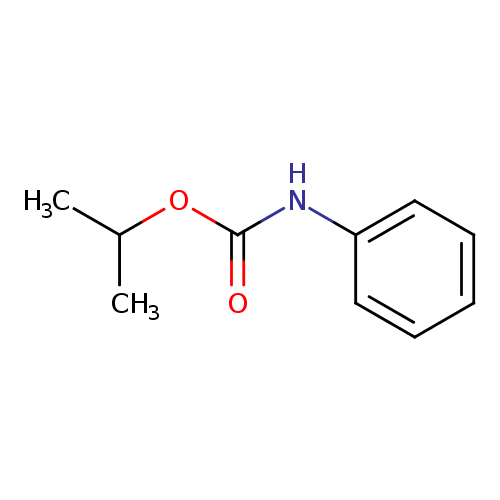
Chemical Structure
Thumb
Synonyms
ValueSource
1-Methylethyl N-phenylcarbamateChEBI
1-Methylethyl phenylcarbamateChEBI
AgerminChEBI
Ban-hoeChEBI
Beet-kleenChEBI
BirginChEBI
Chem-hoeChEBI
CollavinChEBI
IFCChEBI
IFKChEBI
INPCChEBI
IPPCChEBI
Isopropyl carbanilateChEBI
Isopropyl carbanilic acid esterChEBI
Isopropyl phenyl urethaneChEBI
Isopropyl phenylcarbamateChEBI
Isopropyl-N-phenylcarbamateChEBI
N-Phenyl isopropyl carbamateChEBI
O-Isopropyl N-phenylcarbamateChEBI
PremaloxChEBI
ProfamChEBI
ProphosChEBI
TixitChEBI
TriherbideChEBI
TuberitChEBI
TuberiteChEBI
1-Methylethyl N-phenylcarbamic acidGenerator
1-Methylethyl phenylcarbamic acidGenerator
Isopropyl carbanilic acidGenerator
Isopropyl carbanilate esterGenerator
Isopropyl phenylcarbamic acidGenerator
Isopropyl-N-phenylcarbamic acidGenerator
N-Phenyl isopropyl carbamic acidGenerator
O-Isopropyl N-phenylcarbamic acidGenerator
Merck-4925MeSH
Isopropyl N-phenylcarbamateMeSH
Merck 4925MeSH
Chemical FormulaC10H13NO2
Average Molecular Mass179.216 g/mol
Monoisotopic Mass179.095 g/mol
CAS Registry Number122-42-9
IUPAC Namepropan-2-yl N-phenylcarbamate
Traditional Nameisopropyl phenyl carbamate
SMILESCC(C)OC(=O)NC1=CC=CC=C1
InChI IdentifierInChI=1S/C10H13NO2/c1-8(2)13-10(12)11-9-6-4-3-5-7-9/h3-8H,1-2H3,(H,11,12)
InChI KeyVXPLXMJHHKHSOA-UHFFFAOYSA-N
Chemical Taxonomy
Description belongs to the class of organic compounds known as phenylcarbamic acid esters. These are ester derivatives of phenylcarbamic acids.
KingdomOrganic compounds
Super ClassBenzenoids
ClassBenzene and substituted derivatives
Sub ClassPhenylcarbamic acid esters
Direct ParentPhenylcarbamic acid esters
Alternative Parents
Substituents
  • Phenylcarbamic acid ester
  • Carbamic acid ester
  • Carbonic acid derivative
  • Organic nitrogen compound
  • Organic oxygen compound
  • Organopnictogen compound
  • Organic oxide
  • Hydrocarbon derivative
  • Organooxygen compound
  • Organonitrogen compound
  • Carbonyl group
  • Aromatic homomonocyclic compound
Molecular FrameworkAromatic homomonocyclic compounds
External Descriptors
Biological Properties
StatusDetected and Not Quantified
OriginExogenous
Cellular Locations
  • Membrane
Biofluid LocationsNot Available
Tissue LocationsNot Available
PathwaysNot Available
ApplicationsNot Available
Biological RolesNot Available
Chemical RolesNot Available
Physical Properties
StateSolid
AppearanceWhite powder.
Experimental Properties
PropertyValue
Melting Point87.3°C
Boiling PointNot Available
Solubility0.179 mg/mL at 25°C [YALKOWSKY,SH & HE,Y (2003)]
Predicted Properties
PropertyValueSource
Water Solubility1.92 g/LALOGPS
logP2.6ALOGPS
logP2.6ChemAxon
logS-2ALOGPS
pKa (Strongest Acidic)13.04ChemAxon
pKa (Strongest Basic)-0.94ChemAxon
Physiological Charge0ChemAxon
Hydrogen Acceptor Count2ChemAxon
Hydrogen Donor Count1ChemAxon
Polar Surface Area38.33 ŲChemAxon
Rotatable Bond Count3ChemAxon
Refractivity51.71 m³·mol⁻¹ChemAxon
Polarizability19.18 ųChemAxon
Number of Rings1ChemAxon
Bioavailability1ChemAxon
Rule of FiveYesChemAxon
Ghose FilterYesChemAxon
Veber's RuleYesChemAxon
MDDR-like RuleNoChemAxon
Spectra
Spectra
Spectrum TypeDescriptionSplash KeyView
Predicted LC-MS/MSPredicted LC-MS/MS Spectrum - 10V, Positivesplash10-03el-8900000000-09aed53f94b46c4d5ae6Spectrum
Predicted LC-MS/MSPredicted LC-MS/MS Spectrum - 20V, Positivesplash10-0006-9300000000-4c6dae4e4fbf35f6471eSpectrum
Predicted LC-MS/MSPredicted LC-MS/MS Spectrum - 40V, Positivesplash10-0006-9100000000-d42ebb34c93904bd46e8Spectrum
Predicted LC-MS/MSPredicted LC-MS/MS Spectrum - 10V, Negativesplash10-016r-5900000000-2a9a662183a82b668d59Spectrum
Predicted LC-MS/MSPredicted LC-MS/MS Spectrum - 20V, Negativesplash10-066u-9700000000-9fe7b5f21c54d80b0c22Spectrum
Predicted LC-MS/MSPredicted LC-MS/MS Spectrum - 40V, Negativesplash10-052f-9100000000-f3d7572b49c546cd7216Spectrum
MSMass Spectrum (Electron Ionization)splash10-0006-9200000000-01800cb872c195605426Spectrum
Toxicity Profile
Route of ExposureInhalation (3) ; oral (3); dermal (3)
Mechanism of ToxicityPropham is a cholinesterase or acetylcholinesterase (AChE) inhibitor. Carbamates form unstable complexes with chlolinesterases by carbamoylation of the active sites of the enzymes. This inhibition is reversible. A cholinesterase inhibitor suppresses the action of acetylcholine esterase. Because of its essential function, chemicals that interfere with the action of acetylcholine esterase are potent neurotoxins, causing excessive salivation and eye-watering in low doses. Headache, salivation, nausea, vomiting, abdominal pain and diarrhea are often prominent at higher levels of exposure. Acetylcholine esterase breaks down the neurotransmitter acetylcholine, which is released at nerve and muscle junctions, in order to allow the muscle or organ to relax. The result of acetylcholine esterase inhibition is that acetylcholine builds up and continues to act so that any nerve impulses are continually transmitted and muscle contractions do not stop.
MetabolismThe carbamates are hydrolyzed enzymatically by the liver; degradation products are excreted by the kidneys and the liver. (3)
Toxicity ValuesNot Available
Lethal DoseNot Available
Carcinogenicity (IARC Classification)3, not classifiable as to its carcinogenicity to humans. (2)
Uses/SourcesPropham is widely used as an insecticide or pesticide in homes, gardens and agricultural applications. It is a synthetic compound.
Minimum Risk LevelNot Available
Health EffectsAcute exposure to cholinesterase inhibitors can cause a cholinergic crisis characterized by severe nausea/vomiting, salivation, sweating, bradycardia, hypotension, collapse, and convulsions. Increasing muscle weakness is a possibility and may result in death if respiratory muscles are involved. Accumulation of ACh at motor nerves causes overstimulation of nicotinic expression at the neuromuscular junction. When this occurs symptoms such as muscle weakness, fatigue, muscle cramps, fasciculation, and paralysis can be seen. When there is an accumulation of ACh at autonomic ganglia this causes overstimulation of nicotinic expression in the sympathetic system. Symptoms associated with this are hypertension, and hypoglycemia. Overstimulation of nicotinic acetylcholine receptors in the central nervous system, due to accumulation of ACh, results in anxiety, headache, convulsions, ataxia, depression of respiration and circulation, tremor, general weakness, and potentially coma. When there is expression of muscarinic overstimulation due to excess acetylcholine at muscarinic acetylcholine receptors symptoms of visual disturbances, tightness in chest, wheezing due to bronchoconstriction, increased bronchial secretions, increased salivation, lacrimation, sweating, peristalsis, and urination can occur. Chronically high (>10 years) exposure leads to neuropsychological consequences including disturbances in perception and visuo-motor processing (1).
SymptomsAs with organophosphates, the signs and symptoms are based on excessive cholinergic stimulation. Unlike organophosphate poisoning, carbamate poisonings tend to be of shorter duration because the inhibition of nervous tissue acetylcholinesterase is reversible, and carbamates are more rapidly metabolized. Muscle weakness, dizziness, sweating and slight body discomfort are commonly reported early symptoms. Headache, salivation, nausea, vomiting, abdominal pain and diarrhea are often prominent at higher levels of exposure. Contraction of the pupils with blurred vision, incoordination, muscle twitching and slurred speech have been reported. (4)
TreatmentIf the compound has been ingested, rapid gastric lavage should be performed using 5% sodium bicarbonate. For skin contact, the skin should be washed with soap and water. If the compound has entered the eyes, they should be washed with large quantities of isotonic saline or water. In serious cases, atropine and/or pralidoxime should be administered. Anti-cholinergic drugs work to counteract the effects of excess acetylcholine and reactivate AChE. Atropine can be used as an antidote in conjunction with pralidoxime or other pyridinium oximes (such as trimedoxime or obidoxime), though the use of '-oximes' has been found to be of no benefit, or possibly harmful, in at least two meta-analyses. Atropine is a muscarinic antagonist, and thus blocks the action of acetylcholine peripherally.

Concentrations
Not Available
DrugBank IDNot Available
HMDB IDNot Available
FooDB IDNot Available
Phenol Explorer IDNot Available
KNApSAcK IDNot Available
BiGG IDNot Available
BioCyc IDNot Available
METLIN IDNot Available
PDB IDNot Available
Wikipedia LinkNot Available
Chemspider IDNot Available
ChEBI ID82035
PubChem Compound ID24685
Kegg Compound IDC18887
YMDB IDNot Available
ECMDB IDNot Available
References
Synthesis ReferenceNot Available
MSDSNot Available
General References
1. https://www.ncbi.nlm.nih.gov/pubmed/?term=4858217
2. https://www.ncbi.nlm.nih.gov/pubmed/?term=5066259