Record Information
Version1.0
Creation Date2009-06-17 23:53:04 UTC
Update Date2026-03-26 18:51:45 UTC
Accession NumberCHEM000848
Identification
Common NameMolinate
ClassSmall Molecule
DescriptionMolinate is a selective herbicide which belongs to the thiocarbamate chemical class. It is used to control weeds in rice paddies (1, 4, 6, 8). It is toxic to germinating broad-leafed and grassy weeds. Thiocarbamates are mainly used in agriculture as insecticides, herbicides, and fungicides. Additional uses are as biocides for industrial or other commercial applications, and in household products. Some are used for vector control in public health. Thiocarbamates are mostly liquids or solids with low melting points.
Contaminant Sources
  • Clean Air Act Chemicals
  • HPV EPA Chemicals
  • My Exposome Chemicals
  • STOFF IDENT Compounds
  • T3DB toxins
  • ToxCast & Tox21 Chemicals
Contaminant Type
  • Amine
  • Carbamate
  • Ether
  • Herbicide
  • Organic Compound
  • Synthetic Compound
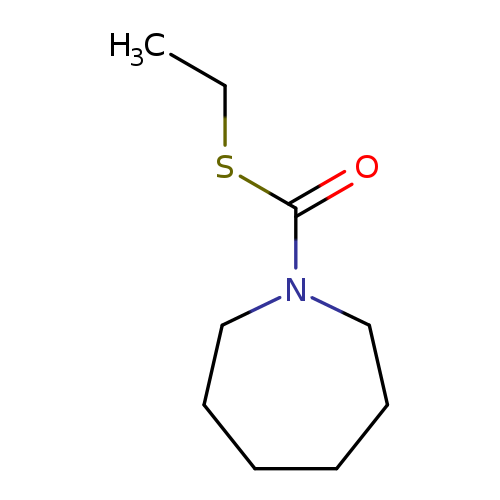
Chemical Structure
Thumb
Synonyms
ValueSource
Ethyl 1-hexamethyleneiminecarbothiolateChEBI
OrdramChEBI
S-Ethyl 1-hexamethyleneiminothiocarbamateChEBI
S-Ethyl hexahydro-1H-azepine-1-carbothioateChEBI
S-Ethyl hexahydroazepine-1-carbothioateChEBI
S-Ethyl N,N-hexamethylenethiocarbamateChEBI
S-Ethyl N,N-hexamethylenothiocarbamateChEBI
S-Ethyl perhydroazepine-1-carbothioateChEBI
S-Ethyl perhydroazepine-1-thiocarboxylateChEBI
S-Ethyl-N-hexamethylenethiocarbamateChEBI
Ethyl 1-hexamethyleneiminecarbothiolic acidGenerator
S-Ethyl 1-hexamethyleneiminothiocarbamic acidGenerator
S-Ethyl hexahydro-1H-azepine-1-carbothioic acidGenerator
S-Ethyl hexahydroazepine-1-carbothioic acidGenerator
S-Ethyl N,N-hexamethylenethiocarbamic acidGenerator
S-Ethyl N,N-hexamethylenothiocarbamic acidGenerator
S-Ethyl perhydroazepine-1-carbothioic acidGenerator
S-Ethyl perhydroazepine-1-thiocarboxylic acidGenerator
S-Ethyl-N-hexamethylenethiocarbamic acidGenerator
Molinic acidGenerator
hexahydro-1H-Azepine-1-carbothioic acid S-ethyl esterMeSH
IalanMeSH
S-Ethyl 1-hexamethylenamino-thiocarbamateMeSH
S-Ethyl 1-hexamethylenaminothiocarbamateMeSH
JalanMeSH
Chemical FormulaC9H17NOS
Average Molecular Mass187.302 g/mol
Monoisotopic Mass187.103 g/mol
CAS Registry Number2212-67-1
IUPAC Nameazepan-1-yl(ethylsulfanyl)methanone
Traditional Namejalan
SMILESCCSC(=O)N1CCCCCC1
InChI IdentifierInChI=1S/C9H17NOS/c1-2-12-9(11)10-7-5-3-4-6-8-10/h2-8H2,1H3
InChI KeyDEDOPGXGGQYYMW-UHFFFAOYSA-N
Chemical Taxonomy
Description belongs to the class of organic compounds known as azepanes. These are organic compounds containing a saturated seven member heterocycle, with one nitrogen atom.
KingdomOrganic compounds
Super ClassOrganoheterocyclic compounds
ClassAzepanes
Sub ClassNot Available
Direct ParentAzepanes
Alternative Parents
Substituents
  • Azepane
  • Thiocarbamic acid derivative
  • Carbonic acid derivative
  • Azacycle
  • Sulfenyl compound
  • Organic nitrogen compound
  • Organic oxygen compound
  • Organopnictogen compound
  • Organic oxide
  • Hydrocarbon derivative
  • Organosulfur compound
  • Organooxygen compound
  • Organonitrogen compound
  • Carbonyl group
  • Aliphatic heteromonocyclic compound
Molecular FrameworkAliphatic heteromonocyclic compounds
External Descriptors
Biological Properties
StatusDetected and Not Quantified
OriginExogenous
Cellular Locations
  • Membrane
Biofluid LocationsNot Available
Tissue LocationsNot Available
PathwaysNot Available
ApplicationsNot Available
Biological RolesNot Available
Chemical RolesNot Available
Physical Properties
StateLiquid
AppearanceColorless liquid
Experimental Properties
PropertyValue
Melting Point< 25°C
Boiling PointNot Available
Solubility0.97 mg/mL at 25°C [WAUCHOPE,RD et al. (1991A)]
Predicted Properties
PropertyValueSource
Water Solubility1.47 g/LALOGPS
logP2.56ALOGPS
logP2.34ChemAxon
logS-2.1ALOGPS
Physiological Charge0ChemAxon
Hydrogen Acceptor Count1ChemAxon
Hydrogen Donor Count0ChemAxon
Polar Surface Area20.31 ŲChemAxon
Rotatable Bond Count2ChemAxon
Refractivity53.72 m³·mol⁻¹ChemAxon
Polarizability20.92 ųChemAxon
Number of Rings1ChemAxon
Bioavailability1ChemAxon
Rule of FiveYesChemAxon
Ghose FilterYesChemAxon
Veber's RuleYesChemAxon
MDDR-like RuleNoChemAxon
Spectra
Spectra
Spectrum TypeDescriptionSplash KeyView
Predicted LC-MS/MSPredicted LC-MS/MS Spectrum - 10V, Positivesplash10-01p9-6900000000-b3c2a75d935df1d1be7cSpectrum
Predicted LC-MS/MSPredicted LC-MS/MS Spectrum - 20V, Positivesplash10-004i-5900000000-d6cada5018419be97a95Spectrum
Predicted LC-MS/MSPredicted LC-MS/MS Spectrum - 40V, Positivesplash10-052f-9000000000-de72486ebbc5c448629dSpectrum
Predicted LC-MS/MSPredicted LC-MS/MS Spectrum - 10V, Negativesplash10-000i-4900000000-79d54c82d132167d1ea7Spectrum
Predicted LC-MS/MSPredicted LC-MS/MS Spectrum - 20V, Negativesplash10-022a-9700000000-a3cc271200b204afd277Spectrum
Predicted LC-MS/MSPredicted LC-MS/MS Spectrum - 40V, Negativesplash10-0002-9200000000-1bd6a1943e7f5af52230Spectrum
MSMass Spectrum (Electron Ionization)splash10-056r-9500000000-8c9c56e5a4f9afc1a28aSpectrum
Toxicity Profile
Route of ExposureInhalation (1) ; oral (1); dermal (1)
Mechanism of ToxicitySome thiocarbamates (EPTC, Molinate, Pebulate, and Cycloate) share a common mechanism of toxicity, i.e. the inhibition of acetylcholinesterase. An acetylcholinesterase inhibitor suppresses the action of acetylcholine esterase. Because of its essential function, chemicals that interfere with the action of acetylcholine esterase are potent neurotoxins, causing excessive salivation and eye-watering in low doses. Headache, salivation, nausea, vomiting, abdominal pain and diarrhea are often prominent at higher levels of exposure. Acetylcholine esterase breaks down the neurotransmitter acetylcholine, which is released at nerve and muscle junctions, in order to allow the muscle or organ to relax. The result of acetylcholine esterase inhibition is that acetylcholine builds up and continues to act so that any nerve impulses are continually transmitted and muscle contractions do not stop.
MetabolismAs a general rule, thiocarbamates can be absorbed via the skin, mucous membranes, and the respiratory and gastrointestinal tracts. They are eliminated quite rapidly, mainly via expired air and urine. Two major pathways exist for the metabolism of thiocarbamates in mammals. One is via sulfoxidation and conjugation with glutathione. The conjugation product is then cleaved to a cysteine derivative, which is metabolized to a mercapturic acid compound. The second route is oxidation of the sulfur to a sulfoxide, which is then oxidized to a sulfone, or hydroxylation to compounds that enter the carbon metabolic pool.
Toxicity ValuesNot Available
Lethal DoseNot Available
Carcinogenicity (IARC Classification)No indication of carcinogenicity to humans (not listed by IARC).
Uses/SourcesThiocarbamates are widely used throughout the world and are produced in great quantities, mainly as herbicides and fungicides.
Minimum Risk LevelNot Available
Health EffectsData concerning the effects of thiocarbamates on man are scarce. However, cases of irritation and sensitization have been observed among agricultural workers. Some thiocarbamates, e.g., molinate, have an effect on sperm morphology and, consequently, on reproduction. However, no teratogenic effects have been observed. The results of mutagenicity studies have shown that thiocarbamates containing dichloroallyl groups are highly mutagenic. Some thiocarbamates are acetylcholine esterase inhibitors. Acute exposure to cholinesterase inhibitors can cause a cholinergic crisis characterized by severe nausea/vomiting, salivation, sweating, bradycardia, hypotension, collapse, and convulsions. Increasing muscle weakness is a possibility and may result in death if respiratory muscles are involved.
SymptomsAs with organophosphates, the signs and symptoms are based on excessive cholinergic stimulation. Unlike organophosphate poisoning, carbamate poisonings tend to be of shorter duration because the inhibition of nervous tissue acetylcholinesterase is reversible, and carbamates are more rapidly metabolized. Muscle weakness, dizziness, sweating and slight body discomfort are commonly reported early symptoms. Headache, salivation, nausea, vomiting, abdominal pain and diarrhea are often prominent at higher levels of exposure. Contraction of the pupils with blurred vision, incoordination, muscle twitching and slurred speech have been reported. (2)
TreatmentTreatment of carbamate poisoning is similar to that of organophosphate poisoning in that atropine sulfate injections readily reverse the effects. For acute exposures and first aid: EYES: irrigate opened eyes for several minutes under running water. INGESTION: do not induce vomiting. Rinse mouth with water (never give anything by mouth to an unconscious person). Seek immediate medical advice. SKIN: should be treated immediately by rinsing the affected parts in cold running water for at least 15 minutes, followed by thorough washing with soap and water. If necessary, the person should shower and change contaminated clothing and shoes, and then must seek medical attention. INHALATION: supply fresh air. If required provide artificial respiration.

Concentrations
Not Available
DrugBank IDNot Available
HMDB IDNot Available
FooDB IDNot Available
Phenol Explorer IDNot Available
KNApSAcK IDNot Available
BiGG IDNot Available
BioCyc IDNot Available
METLIN IDNot Available
PDB IDNot Available
Wikipedia LinkNot Available
Chemspider IDNot Available
ChEBI ID6964
PubChem Compound ID16653
Kegg Compound IDC11086
YMDB IDNot Available
ECMDB IDNot Available
References
Synthesis ReferenceNot Available
MSDSNot Available
General References
1. https://www.ncbi.nlm.nih.gov/pubmed/?term=11452140
2. https://www.ncbi.nlm.nih.gov/pubmed/?term=16380149
3. https://www.ncbi.nlm.nih.gov/pubmed/?term=16417035
4. https://www.ncbi.nlm.nih.gov/pubmed/?term=19545510
5. https://www.ncbi.nlm.nih.gov/pubmed/?term=20862524
6. https://www.ncbi.nlm.nih.gov/pubmed/?term=20954713
7. https://www.ncbi.nlm.nih.gov/pubmed/?term=21216347
8. https://www.ncbi.nlm.nih.gov/pubmed/?term=22456730
9. https://www.ncbi.nlm.nih.gov/pubmed/?term=24193246
10. https://www.ncbi.nlm.nih.gov/pubmed/?term=24928378
11. https://www.ncbi.nlm.nih.gov/pubmed/?term=24946031
12. https://www.ncbi.nlm.nih.gov/pubmed/?term=25636851
13. https://www.ncbi.nlm.nih.gov/pubmed/?term=25905461
14. https://www.ncbi.nlm.nih.gov/pubmed/?term=27421102
15.