Record Information
Version1.0
Creation Date2009-06-17 23:53:04 UTC
Update Date2026-03-27 02:15:58 UTC
Accession NumberCHEM000844
Identification
Common NameMethomyl
ClassSmall Molecule
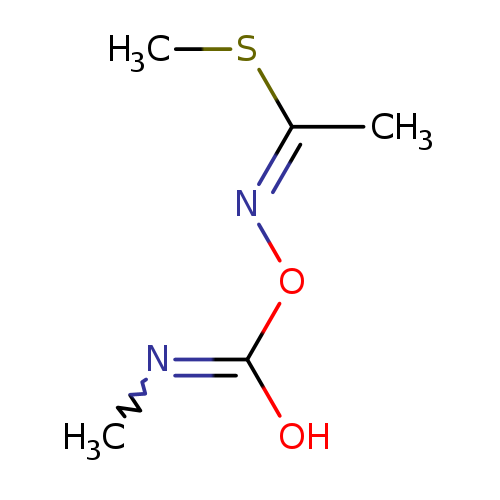
DescriptionMethomyl is a carbamate pesticide. Methomyl is an Agricultural insecticide and nematocide. Methomyl belongs to the family of Carbamic Acids. These are compounds containing the carbamic acid structure.
Contaminant Sources
  • Clean Air Act Chemicals
  • EPA Endocrine Screening
  • FooDB Chemicals
  • HPV EPA Chemicals
  • My Exposome Chemicals
  • STOFF IDENT Compounds
  • T3DB toxins
  • ToxCast & Tox21 Chemicals
Contaminant Type
  • Amine
  • Carbamate
  • Ether
  • Food Toxin
  • Insecticide
  • Metabolite
  • Organic Compound
  • Pesticide
  • Synthetic Compound
Chemical Structure
Thumb
Synonyms
ValueSource
1-(Methylthio)acetaldehyde O-methylcarbamoyloximeHMDB
1-(Methylthio)ethylideneamino methylcarbamateHMDB
2-Methylthio-acetaldehyd-O-(methylcarbamoyl)-oximHMDB
2-Methylthio-acetaldehyd-O-(methylcarbamoyl)-oximeHMDB
2-Methylthio-propionaldehyd-O-(methylcarbamoyl)-oximHMDB
3-Thiabutan-2-one, O-(methylcarbamoyl)oximeHMDB
Acetimidothioic acid, methyl-, N-(methylcarbamoyl) esterHMDB
Du pont 1179HMDB
Du pont insecticide 1179HMDB
Dupont 1179HMDB
FlytekHMDB
Insecticide 1,179HMDB
Insecticide 1179HMDB
KipsinHMDB
LannabaitHMDB
LannateHMDB
Lannate 20HMDB
Lannate LHMDB
Lannate LBHMDB
Lannate LVHMDB
Lannate(R)HMDB
LanoxHMDB
Lanox 216HMDB
LANOX 90HMDB
MemileneHMDB
MesomileHMDB
MethavinHMDB
MethomexHMDB
Methomyl (lannate)HMDB
Methomyl 5gHMDB
Methomyl lannateHMDB
Methyl (1E)-N-([(methylamino)carbonyl]oxy)ethanimidothioateHMDB
Methyl N-(((methylamino)carbonyl)oxy)ethanimidothioateHMDB
Methyl N-((methylcarbamoyl)oxy)thioacetimidateHMDB
Methyl N-(methylcarbamoyloxy)ethanimidothioateHMDB
Methyl N-[(methylcarbamoyl)oxy]thioacetimidateHMDB
Methyl N-[[(methylamino)carbonyl]oxy]ethanimidothioate, 9ciHMDB
Methyl O-(methylcarbamoyl)thiolacethohydroxamateHMDB
Methyl O-(methylcarbamoyl)thiolacetohydroxamateHMDB
Methyl O-(methylcarbamyl)thiolacetohydroxamateHMDB
MetomilHMDB
N-((Methylcarbamoyl)oxy)thioacetimidic acid methyl esterHMDB
N-[(Methylcarbamoyl)oxy]thioacetimidic acid methyl esterHMDB
N-[[(Methylamino)carbonyl]oxy]-2-(methylthio)ethanimineHMDB
Nu-bait IIHMDB
NudrinHMDB
S-Methyl N-(methylcarbamoyloxy)thioacetimidateHMDB
S-Methyl N-[[(methylamino)carbonyl]oxy]ethanimidothioateHMDB
Sorex golden fly baitHMDB
Thiobutan-2-one, O-(methylcarbamoyl)oximeHMDB
20, LannateHMDB
Chemical FormulaC5H10N2O2S
Average Molecular Mass162.210 g/mol
Monoisotopic Mass162.046 g/mol
CAS Registry Number16752-77-5
IUPAC Name(E)-[(methyl-C-hydroxycarbonimidoyl)oxy][1-(methylsulfanyl)ethylidene]amine
Traditional Namelannate LV
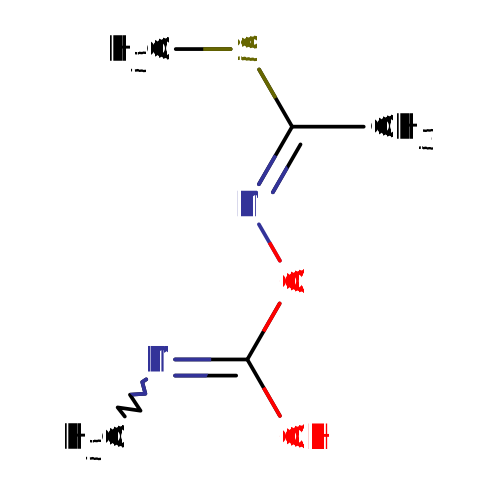
SMILESCS\C(C)=N\OC(O)=NC
InChI IdentifierInChI=1S/C5H10N2O2S/c1-4(10-3)7-9-5(8)6-2/h1-3H3,(H,6,8)/b7-4+
InChI KeyUHXUZOCRWCRNSJ-QPJJXVBHSA-N
Chemical Taxonomy
Description belongs to the class of organic compounds known as carboximidic acids and derivatives. Carboximidic acids and derivatives are compounds containing a carboximidic group, with the general formula R-C(=NR1)OR2.
KingdomOrganic compounds
Super ClassOrganic acids and derivatives
ClassCarboximidic acids and derivatives
Sub ClassNot Available
Direct ParentCarboximidic acids and derivatives
Alternative Parents
Substituents
  • Organic 1,3-dipolar compound
  • Propargyl-type 1,3-dipolar organic compound
  • Sulfenyl compound
  • Carboximidic acid derivative
  • Organic nitrogen compound
  • Organic oxygen compound
  • Organopnictogen compound
  • Hydrocarbon derivative
  • Organosulfur compound
  • Organooxygen compound
  • Organonitrogen compound
  • Imine
  • Aliphatic acyclic compound
Molecular FrameworkAliphatic acyclic compounds
External Descriptors
Biological Properties
StatusDetected and Not Quantified
OriginExogenous
Cellular Locations
  • Cytoplasm
  • Extracellular
Biofluid LocationsNot Available
Tissue LocationsNot Available
PathwaysNot Available
Applications
Biological Roles
Chemical Roles
Physical Properties
StateSolid
AppearanceWhite powder.
Experimental Properties
PropertyValue
Melting Point78 - 79°C
Boiling PointNot Available
Solubility58 mg/mL at 25°C
Predicted Properties
PropertyValueSource
Water Solubility2.76 g/LALOGPS
logP1.07ALOGPS
logP1.54ChemAxon
logS-1.8ALOGPS
pKa (Strongest Acidic)3.48ChemAxon
pKa (Strongest Basic)1.33ChemAxon
Physiological Charge0ChemAxon
Hydrogen Acceptor Count4ChemAxon
Hydrogen Donor Count1ChemAxon
Polar Surface Area54.18 ŲChemAxon
Rotatable Bond Count3ChemAxon
Refractivity40.78 m³·mol⁻¹ChemAxon
Polarizability16.35 ųChemAxon
Number of Rings0ChemAxon
Bioavailability1ChemAxon
Rule of FiveYesChemAxon
Ghose FilterYesChemAxon
Veber's RuleNoChemAxon
MDDR-like RuleNoChemAxon
Spectra
Spectra
Spectrum TypeDescriptionSplash KeyView
Predicted GC-MSPredicted GC-MS Spectrum - GC-MS (Non-derivatized) - 70eV, Positivesplash10-052b-9200000000-08a2425520720fc4ddebSpectrum
Predicted GC-MSPredicted GC-MS Spectrum - GC-MS (1 TMS) - 70eV, Positivesplash10-006t-9200000000-e336671b45724f2223f8Spectrum
Predicted GC-MSPredicted GC-MS Spectrum - GC-MS (Non-derivatized) - 70eV, PositiveNot AvailableSpectrum
LC-MS/MSLC-MS/MS Spectrum - LC-ESI-ITFT , positivesplash10-00y0-9700000000-fb58e6c723ee86fa0521Spectrum
LC-MS/MSLC-MS/MS Spectrum - LC-ESI-ITFT , positivesplash10-052r-9500000000-bc37fefdbd44b78215b6Spectrum
LC-MS/MSLC-MS/MS Spectrum - LC-ESI-ITFT , positivesplash10-052r-9500000000-c048d4fb7391b51e8092Spectrum
LC-MS/MSLC-MS/MS Spectrum - LC-ESI-ITFT , positivesplash10-052r-9500000000-b6e2ca797273130b4579Spectrum
LC-MS/MSLC-MS/MS Spectrum - LC-ESI-ITFT , positivesplash10-052r-9300000000-7208ae44a68a6aefb55aSpectrum
LC-MS/MSLC-MS/MS Spectrum - LC-ESI-ITFT , positivesplash10-052r-9200000000-a3d913d869d143089c32Spectrum
LC-MS/MSLC-MS/MS Spectrum - LC-ESI-ITFT , positivesplash10-05g0-9100000000-ef272eaa6dee90335521Spectrum
LC-MS/MSLC-MS/MS Spectrum - LC-ESI-ITFT , positivesplash10-052r-9600000000-f23a2fc883ac3c1eec87Spectrum
LC-MS/MSLC-MS/MS Spectrum - LC-ESI-ITFT , positivesplash10-052r-9500000000-b725712ec0d1c8f22d6dSpectrum
LC-MS/MSLC-MS/MS Spectrum - LC-ESI-ITFT , positivesplash10-052r-9500000000-6c16bc52b03ec9f35248Spectrum
LC-MS/MSLC-MS/MS Spectrum - LC-ESI-ITFT , positivesplash10-052r-9400000000-58a29283a18ff87fed94Spectrum
LC-MS/MSLC-MS/MS Spectrum - LC-ESI-ITFT , positivesplash10-052r-9200000000-db11172c09d336f4352bSpectrum
LC-MS/MSLC-MS/MS Spectrum - LC-ESI-ITFT , positivesplash10-05g0-9000000000-c800429b256376d754aeSpectrum
LC-MS/MSLC-MS/MS Spectrum - LC-ESI-ITFT , positivesplash10-00y0-9800000000-e1b10436e09d20202a33Spectrum
LC-MS/MSLC-MS/MS Spectrum - 90V, Positivesplash10-05g0-9100000000-ef272eaa6dee90335521Spectrum
LC-MS/MSLC-MS/MS Spectrum - 75V, Positivesplash10-052r-9200000000-a3d913d869d143089c32Spectrum
LC-MS/MSLC-MS/MS Spectrum - 30V, Positivesplash10-052r-9500000000-dbe88752e49f586980efSpectrum
LC-MS/MSLC-MS/MS Spectrum - 45V, Positivesplash10-052r-9500000000-a30a2ae7d641e550cec1Spectrum
LC-MS/MSLC-MS/MS Spectrum - 75V, Positivesplash10-052r-9200000000-db11172c09d336f4352bSpectrum
Predicted LC-MS/MSPredicted LC-MS/MS Spectrum - 10V, Positivesplash10-03di-9800000000-28c1600c0ec8ebe5185fSpectrum
Predicted LC-MS/MSPredicted LC-MS/MS Spectrum - 20V, Positivesplash10-00di-9000000000-a24d6210888235a5f3ddSpectrum
Predicted LC-MS/MSPredicted LC-MS/MS Spectrum - 40V, Positivesplash10-056r-9000000000-4aa2ee0cb39b1280c11eSpectrum
Predicted LC-MS/MSPredicted LC-MS/MS Spectrum - 10V, Negativesplash10-0ik9-4900000000-c24b0468dccb53bcd16bSpectrum
Predicted LC-MS/MSPredicted LC-MS/MS Spectrum - 20V, Negativesplash10-0a4r-9100000000-c487f2a68e3df2908ea3Spectrum
Predicted LC-MS/MSPredicted LC-MS/MS Spectrum - 40V, Negativesplash10-00gm-9000000000-3c743531b809e60da5c1Spectrum
MSMass Spectrum (Electron Ionization)splash10-0a4i-9300000000-52e81fc7bc39a7bd7ad4Spectrum
1D NMR1H NMR SpectrumNot AvailableSpectrum
1D NMR13C NMR SpectrumNot AvailableSpectrum
1D NMR1H NMR SpectrumNot AvailableSpectrum
1D NMR13C NMR SpectrumNot AvailableSpectrum
1D NMR1H NMR SpectrumNot AvailableSpectrum
1D NMR13C NMR SpectrumNot AvailableSpectrum
1D NMR1H NMR SpectrumNot AvailableSpectrum
1D NMR13C NMR SpectrumNot AvailableSpectrum
1D NMR1H NMR SpectrumNot AvailableSpectrum
1D NMR13C NMR SpectrumNot AvailableSpectrum
1D NMR1H NMR SpectrumNot AvailableSpectrum
1D NMR13C NMR SpectrumNot AvailableSpectrum
1D NMR1H NMR SpectrumNot AvailableSpectrum
1D NMR13C NMR SpectrumNot AvailableSpectrum
1D NMR1H NMR SpectrumNot AvailableSpectrum
1D NMR13C NMR SpectrumNot AvailableSpectrum
1D NMR1H NMR SpectrumNot AvailableSpectrum
1D NMR13C NMR SpectrumNot AvailableSpectrum
1D NMR1H NMR SpectrumNot AvailableSpectrum
1D NMR13C NMR SpectrumNot AvailableSpectrum
1D NMR1H NMR SpectrumNot AvailableSpectrum
Toxicity Profile
Route of ExposureInhalation (2) ; oral (2); dermal (2)
Mechanism of ToxicityMethomyl is a cholinesterase or acetylcholinesterase (AChE) inhibitor. Carbamates form unstable complexes with chlolinesterases by carbamoylation of the active sites of the enzymes. This inhibition is reversible. A cholinesterase inhibitor suppresses the action of acetylcholine esterase. Because of its essential function, chemicals that interfere with the action of acetylcholine esterase are potent neurotoxins, causing excessive salivation and eye-watering in low doses. Headache, salivation, nausea, vomiting, abdominal pain and diarrhea are often prominent at higher levels of exposure. Acetylcholine esterase breaks down the neurotransmitter acetylcholine, which is released at nerve and muscle junctions, in order to allow the muscle or organ to relax. The result of acetylcholine esterase inhibition is that acetylcholine builds up and continues to act so that any nerve impulses are continually transmitted and muscle contractions do not stop.
MetabolismThe carbamates are hydrolyzed enzymatically by the liver; degradation products are excreted by the kidneys and the liver. (2)
Toxicity ValuesLD50: 10 mg/kg (Oral, Mouse) (4) LD50: 9 mg/kg (Subcutaneous, Rat) (4) LC50: 0.45 mg/kg over 4 hours (Inhalation, Rat)
Lethal DoseNot Available
Carcinogenicity (IARC Classification)No indication of carcinogenicity to humans (not listed by IARC).
Uses/SourcesMethomyl is widely used as an insecticide or pesticide in homes, gardens and agricultural applications. It is a synthetic compound.
Minimum Risk LevelNot Available
Health EffectsAcute exposure to cholinesterase inhibitors can cause a cholinergic crisis characterized by severe nausea/vomiting, salivation, sweating, bradycardia, hypotension, collapse, and convulsions. Increasing muscle weakness is a possibility and may result in death if respiratory muscles are involved. Accumulation of ACh at motor nerves causes overstimulation of nicotinic expression at the neuromuscular junction. When this occurs symptoms such as muscle weakness, fatigue, muscle cramps, fasciculation, and paralysis can be seen. When there is an accumulation of ACh at autonomic ganglia this causes overstimulation of nicotinic expression in the sympathetic system. Symptoms associated with this are hypertension, and hypoglycemia. Overstimulation of nicotinic acetylcholine receptors in the central nervous system, due to accumulation of ACh, results in anxiety, headache, convulsions, ataxia, depression of respiration and circulation, tremor, general weakness, and potentially coma. When there is expression of muscarinic overstimulation due to excess acetylcholine at muscarinic acetylcholine receptors symptoms of visual disturbances, tightness in chest, wheezing due to bronchoconstriction, increased bronchial secretions, increased salivation, lacrimation, sweating, peristalsis, and urination can occur. Chronically high (>10 years) exposure leads to neuropsychological consequences including disturbances in perception and visuo-motor processing (1).
SymptomsAs with organophosphates, the signs and symptoms are based on excessive cholinergic stimulation. Unlike organophosphate poisoning, carbamate poisonings tend to be of shorter duration because the inhibition of nervous tissue acetylcholinesterase is reversible, and carbamates are more rapidly metabolized. Muscle weakness, dizziness, sweating and slight body discomfort are commonly reported early symptoms. Headache, salivation, nausea, vomiting, abdominal pain and diarrhea are often prominent at higher levels of exposure. Contraction of the pupils with blurred vision, incoordination, muscle twitching and slurred speech have been reported. (3)
TreatmentIf the compound has been ingested, rapid gastric lavage should be performed using 5% sodium bicarbonate. For skin contact, the skin should be washed with soap and water. If the compound has entered the eyes, they should be washed with large quantities of isotonic saline or water. In serious cases, atropine and/or pralidoxime should be administered. Anti-cholinergic drugs work to counteract the effects of excess acetylcholine and reactivate AChE. Atropine can be used as an antidote in conjunction with pralidoxime or other pyridinium oximes (such as trimedoxime or obidoxime), though the use of '-oximes' has been found to be of no benefit, or possibly harmful, in at least two meta-analyses. Atropine is a muscarinic antagonist, and thus blocks the action of acetylcholine peripherally.
Concentrations
Not Available
DrugBank IDNot Available
HMDB IDHMDB0031804
FooDB IDFDB008477
Phenol Explorer IDNot Available
KNApSAcK IDNot Available
BiGG IDNot Available
BioCyc IDNot Available
METLIN IDNot Available
PDB IDNot Available
Wikipedia LinkMethomyl
Chemspider ID4510206
ChEBI ID6835
PubChem Compound ID5353758
Kegg Compound IDC11196
YMDB IDNot Available
ECMDB IDNot Available
References
Synthesis ReferenceNot Available
MSDSNot Available
General References
1. Yannai, Shmuel. (2004) Dictionary of food compounds with CD-ROM: Additives, flavors, and ingredients. Boca Raton: Chapman & Hall/CRC.