Record Information
Version1.0
Creation Date2009-06-17 21:02:15 UTC
Update Date2026-03-26 18:34:50 UTC
Accession NumberCHEM000756
Identification
Common NamePendimethalin
ClassSmall Molecule
DescriptionPendimethalin is a preemergent herbicide used to prevent crabgrass from germinating. Pendimethalin was included in a biocide ban proposed by the Swedish Chemicals Agency and approved by the European Parliament in January 13, 2009 (4).
Contaminant Sources
  • Clean Air Act Chemicals
  • HPV EPA Chemicals
  • My Exposome Chemicals
  • STOFF IDENT Compounds
  • T3DB toxins
  • ToxCast & Tox21 Chemicals
Contaminant Type
  • Amine
  • Aromatic Hydrocarbon
  • Herbicide
  • Household Toxin
  • Lachrymator
  • Organic Compound
  • Organochloride
  • Pesticide
  • Synthetic Compound
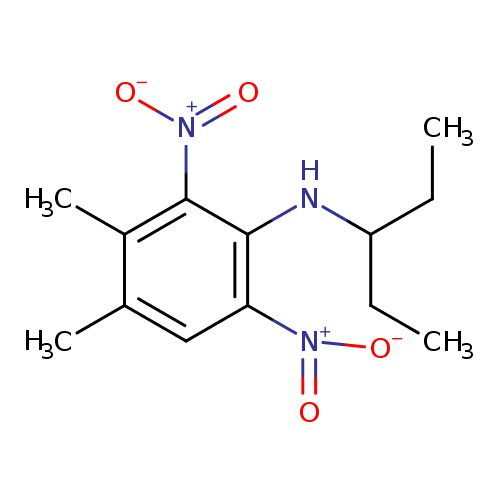
Chemical Structure
Thumb
Synonyms
ValueSource
3,4-Dimethyl-2,6-dinitro-N-(1-ethylpropyl)anilineChEBI
N-(1-Ethylpropyl)-2,6-dinitro-3,4-xylidineChEBI
N-(1-Ethylpropyl)-3,4-dimethyl-2,6-dinitroanilineChEBI
N-(1-Ethylpropyl)-3,4-dimethyl-2,6-dinitrobenzenamineChEBI
N-(3-Pentyl)-3,4-dimethyl-2,6-dinitroanilineChEBI
PendimethalineChEBI
PenoxalinChEBI
PenoxalineChEBI
PenoxynChEBI
PhenoxalinChEBI
ProwlMeSH
Chemical FormulaC13H19N3O4
Average Molecular Mass281.308 g/mol
Monoisotopic Mass281.138 g/mol
CAS Registry Number40487-42-1
IUPAC Name3,4-dimethyl-2,6-dinitro-N-(pentan-3-yl)aniline
Traditional Nameway up
SMILESCCC(CC)NC1=C(C=C(C)C(C)=C1[N+]([O-])=O)[N+]([O-])=O
InChI IdentifierInChI=1S/C13H19N3O4/c1-5-10(6-2)14-12-11(15(17)18)7-8(3)9(4)13(12)16(19)20/h7,10,14H,5-6H2,1-4H3
InChI KeyCHIFOSRWCNZCFN-UHFFFAOYSA-N
Chemical Taxonomy
Description belongs to the class of organic compounds known as dinitroanilines. These are organic compounds containing an aniline moiety, which is substituted at 2 positions by a nitro group.
KingdomOrganic compounds
Super ClassBenzenoids
ClassBenzene and substituted derivatives
Sub ClassAniline and substituted anilines
Direct ParentDinitroanilines
Alternative Parents
Substituents
  • Dinitroaniline
  • Nitrobenzene
  • Nitrotoluene
  • Phenylalkylamine
  • Nitroaromatic compound
  • Xylene
  • O-xylene
  • Secondary aliphatic/aromatic amine
  • C-nitro compound
  • Organic nitro compound
  • Organic oxoazanium
  • Secondary amine
  • Organic 1,3-dipolar compound
  • Propargyl-type 1,3-dipolar organic compound
  • Allyl-type 1,3-dipolar organic compound
  • Organopnictogen compound
  • Organic zwitterion
  • Amine
  • Organonitrogen compound
  • Organic oxygen compound
  • Hydrocarbon derivative
  • Organic nitrogen compound
  • Organic oxide
  • Aromatic homomonocyclic compound
Molecular FrameworkAromatic homomonocyclic compounds
External Descriptors
Biological Properties
StatusDetected and Not Quantified
OriginExogenous
Cellular Locations
  • Membrane
Biofluid LocationsNot Available
Tissue LocationsNot Available
PathwaysNot Available
ApplicationsNot Available
Biological RolesNot Available
Chemical RolesNot Available
Physical Properties
StateSolid
AppearanceOrange-yellow crystals (7).
Experimental Properties
PropertyValue
Melting Point56°C
Boiling PointNot Available
Solubility0.0003 mg/mL at 20°C [TOMLIN,C (1997)]
Predicted Properties
PropertyValueSource
Water Solubility0.032 g/LALOGPS
logP4.36ALOGPS
logP4.82ChemAxon
logS-3.9ALOGPS
pKa (Strongest Acidic)10.94ChemAxon
pKa (Strongest Basic)-1ChemAxon
Physiological Charge0ChemAxon
Hydrogen Acceptor Count5ChemAxon
Hydrogen Donor Count1ChemAxon
Polar Surface Area103.67 ŲChemAxon
Rotatable Bond Count6ChemAxon
Refractivity79.2 m³·mol⁻¹ChemAxon
Polarizability28.32 ųChemAxon
Number of Rings1ChemAxon
Bioavailability1ChemAxon
Rule of FiveYesChemAxon
Ghose FilterYesChemAxon
Veber's RuleNoChemAxon
MDDR-like RuleNoChemAxon
Spectra
Spectra
Spectrum TypeDescriptionSplash KeyView
Predicted GC-MSPredicted GC-MS Spectrum - GC-MS (Non-derivatized) - 70eV, Positivesplash10-03di-2190000000-0eb48b441cfd67f91051Spectrum
Predicted GC-MSPredicted GC-MS Spectrum - GC-MS (Non-derivatized) - 70eV, PositiveNot AvailableSpectrum
LC-MS/MSLC-MS/MS Spectrum - 40V, Positivesplash10-002b-0900000000-1124a2ab0e02590841f0Spectrum
LC-MS/MSLC-MS/MS Spectrum - 60V, Positivesplash10-00kg-3900000000-c8b5aaad7e1660fb8163Spectrum
LC-MS/MSLC-MS/MS Spectrum - 45V, Positivesplash10-0297-2910000000-b484f99c74bd5885b936Spectrum
LC-MS/MSLC-MS/MS Spectrum - 35V, Positivesplash10-03di-0090000000-e5b0cb75fb9100293a0aSpectrum
LC-MS/MSLC-MS/MS Spectrum - 55V, Positivesplash10-03di-0090000000-1a42c5869d2756d25804Spectrum
LC-MS/MSLC-MS/MS Spectrum - 35V, Positivesplash10-03fr-2980000000-abaf73326bea0690072eSpectrum
LC-MS/MSLC-MS/MS Spectrum - 15V, Positivesplash10-03di-0090000000-b82c77870e70301ba65dSpectrum
LC-MS/MSLC-MS/MS Spectrum - 55V, Positivesplash10-00mn-1900000000-5c62bdea59694da44c70Spectrum
LC-MS/MSLC-MS/MS Spectrum - 80V, Positivesplash10-0fr7-3900000000-29fccd1614d8083b5ef1Spectrum
LC-MS/MSLC-MS/MS Spectrum - 30V, Positivesplash10-03di-0390000000-abf36ca529adebb5ded3Spectrum
LC-MS/MSLC-MS/MS Spectrum - 90V, Positivesplash10-014l-9800000000-10a009231153a223ecafSpectrum
LC-MS/MSLC-MS/MS Spectrum - 75V, Positivesplash10-00kg-5900000000-5758bc0a45fdc9d53407Spectrum
LC-MS/MSLC-MS/MS Spectrum - 50V, Positivesplash10-0002-0900000000-86ff6c4d818fdb9cf7adSpectrum
LC-MS/MSLC-MS/MS Spectrum - 50V, Positivesplash10-0002-0900000000-ff2e937e85012fa0a2e7Spectrum
LC-MS/MSLC-MS/MS Spectrum - 30V, Positivesplash10-01r5-0920000000-0e330e39990dcf5e4300Spectrum
LC-MS/MSLC-MS/MS Spectrum - 40V, Positivesplash10-002b-0900000000-9165c0d471cd1a542ba0Spectrum
LC-MS/MSLC-MS/MS Spectrum - 20V, Positivesplash10-03di-0490000000-eb50cf95d5f3c0fcec3cSpectrum
LC-MS/MSLC-MS/MS Spectrum - 10V, Positivesplash10-03di-0090000000-aa7e3dcd894241a05706Spectrum
Predicted LC-MS/MSPredicted LC-MS/MS Spectrum - 10V, Positivesplash10-001i-1090000000-b42ada96d131b12ec1cfSpectrum
Predicted LC-MS/MSPredicted LC-MS/MS Spectrum - 20V, Positivesplash10-05fr-1090000000-64c713bc372170357a7eSpectrum
Predicted LC-MS/MSPredicted LC-MS/MS Spectrum - 40V, Positivesplash10-00di-9020000000-a1d45e05bba4c7623a01Spectrum
Predicted LC-MS/MSPredicted LC-MS/MS Spectrum - 10V, Negativesplash10-001i-0090000000-8662412b6faad754679aSpectrum
Predicted LC-MS/MSPredicted LC-MS/MS Spectrum - 20V, Negativesplash10-001i-0090000000-1f45ad080ef2f91e7c2aSpectrum
Predicted LC-MS/MSPredicted LC-MS/MS Spectrum - 40V, Negativesplash10-00di-4190000000-f588e443de7d72c5fea9Spectrum
MSMass Spectrum (Electron Ionization)splash10-0udi-6970000000-c257c6cd513d6c161144Spectrum
Toxicity Profile
Route of ExposureInhalation (3) ; oral (3) ; dermal (3).
Mechanism of ToxicityInhibits cell division and cell elongation (4).
MetabolismPendimethalin which does become absorbed into the bloodstream from the gastrointestinal tract is rapidly metabolized in the kidneys and liver and is then excreted in the urine. The major metabolic routes of pendimethalin involved hydroxylation of the 4-methyl and the N-1-ethyl group, oxidation of these alkyl groups to carboxylic acids, nitro reduction, cyclization, and conjugation based on the identification of the 12 metabolites in urine and tissues. Products of cyclization reactions giving rise to methylbenzimidazole carboxylic acids were unique to liver and kidney (2, 5).
Toxicity ValuesLD50: >5000 mg/kg (Oral, Rat) (5) LD50: >5000 mg/kg (Dermal, Rabbit) (5)
Lethal DoseNot Available
Carcinogenicity (IARC Classification)No indication of carcinogenicity to humans (not listed by IARC).
Uses/SourcesPendimethalin is a selective herbicide used to control most annual grasses and certain broadleaf weeds in field corn, potatoes, rice, cotton, soybeans, tobacco, peanuts and sunflowers. It is used both preemergence, that is before weed seeds have sprouted, and early postemergence (1).
Minimum Risk LevelNot Available
Health EffectsPoisoning can produce an allergic hypersensitivity dermatitis or asthma with bronchospasm and wheezing with chronic exposure. Moreover, abnormalities of the hematopoietic system, liver, and kidneys may follow (6).
SymptomsSymptoms include headache, dizziness, weakness, and nausea. Irritation of the eyes, skin, and respiratory tract, burns of the esophagus or gastrointestinal tract may follow, depending on the route of exposure (6).
TreatmentIn case of oral exposure, administer charcoal as a slurry. Consider gastric lavage after ingestion of a potentially life-threatening amount of poison if it can be performed soon after ingestion (generally within 1 hour). Protect airway by placement in Trendelenburg and left lateral decubitus position or by endotracheal intubation. Control any seizures first. In case of inhalation, move patient to fresh air, monitor for respiratory distress. If the exposure occurred via eye contact, irrigate exposed eyes with copious amounts of room temperature water for at least 15 minutes. Remove contaminated clothing and wash exposed area thoroughly with soap and water if the exposure occurred via dermal contact. (6)
Concentrations
Not Available
DrugBank IDNot Available
HMDB IDHMDB0256221
FooDB IDNot Available
Phenol Explorer IDNot Available
KNApSAcK IDNot Available
BiGG IDNot Available
BioCyc IDNot Available
METLIN IDNot Available
PDB IDNot Available
Wikipedia LinkPendimethalin
Chemspider ID35265
ChEBI ID83569
PubChem Compound IDNot Available
Kegg Compound IDC11019
YMDB IDNot Available
ECMDB IDNot Available
References
Synthesis ReferenceNot Available
MSDSNot Available
General References
1. https://www.ncbi.nlm.nih.gov/pubmed/?term=22983723
2. https://www.ncbi.nlm.nih.gov/pubmed/?term=23646829
3. https://www.ncbi.nlm.nih.gov/pubmed/?term=24007481
4. https://www.ncbi.nlm.nih.gov/pubmed/?term=24183287
5. https://www.ncbi.nlm.nih.gov/pubmed/?term=24240661
6. https://www.ncbi.nlm.nih.gov/pubmed/?term=24293324
7. https://www.ncbi.nlm.nih.gov/pubmed/?term=24587520
8. https://www.ncbi.nlm.nih.gov/pubmed/?term=24688423
9. https://www.ncbi.nlm.nih.gov/pubmed/?term=25145238
10. https://www.ncbi.nlm.nih.gov/pubmed/?term=25398239