Record Information
Version1.0
Creation Date2009-06-16 18:45:56 UTC
Update Date2026-05-14 19:33:48 UTC
Accession NumberCHEM000748
Identification
Common NameAntimony pentasulfide
ClassSmall Molecule
DescriptionAntimony pentasulfide is chemical compound of antimony. It is an expectorant. Also known as antimony red, it is used as a red pigment. Antimony is a metallic element with the chemical symbol Sb and atomic number 51. Small amounts of antimony are found in the earth's crust. (3, 4)
Contaminant Sources
  • T3DB toxins
  • ToxCast & Tox21 Chemicals
Contaminant Type
  • Amide
  • Amine
  • Antimony Compound
  • Ether
  • Food Toxin
  • Inorganic Compound
  • Organic Compound
  • Pollutant
  • Synthetic Compound
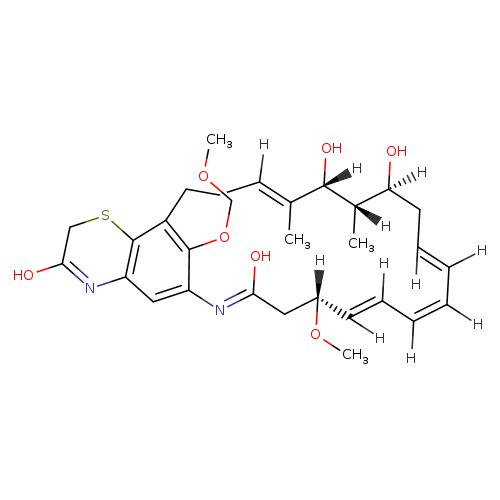
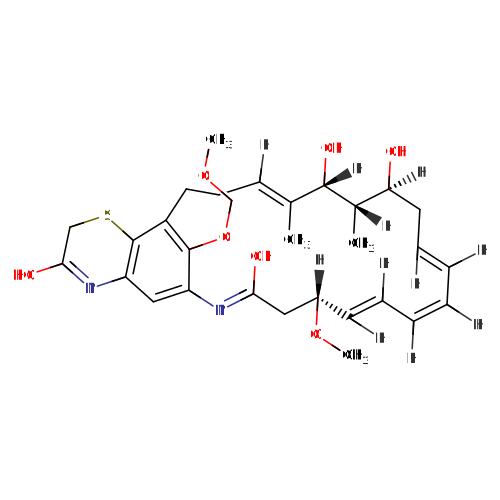
Chemical Structure
Thumb
SynonymsNot Available
Chemical FormulaC30H40N2O7S
Average Molecular Mass572.720 g/mol
Monoisotopic Mass572.256 g/mol
CAS Registry Number1315-04-4
IUPAC Namebis(lambda5-antimony(5+) ion) pentasulfanediide
Traditional Name(5R,6Z,8E,10E,13S,14S,15R,16Z)-5-methoxy-28-(methoxymethoxy)-14,16-dimethyl-22-thia-2,25-diazatricyclo[18.7.1.0²¹,²⁶]octacosa-1(27),2,6,8,10,16,20(28),21(26),24-nonaene-3,13,15,24-tetrol
SMILES[H]\C1=C([H])/C([H])=C([H])/C([H])=C([H])\[C@@]([H])(CC(O)=NC2=CC3=C(SCC(O)=N3)C(CC\C([H])=C(C)/[C@]([H])(O)[C@@]([H])(C)[C@@]([H])(O)C1)=C2OCOC)OC
InChI IdentifierInChI=1S/C30H40N2O7S/c1-19-11-10-13-22-29(39-18-37-3)23(16-24-30(22)40-17-27(35)32-24)31-26(34)15-21(38-4)12-8-6-5-7-9-14-25(33)20(2)28(19)36/h5-9,11-12,16,20-21,25,28,33,36H,10,13-15,17-18H2,1-4H3,(H,31,34)(H,32,35)/b6-5-,9-7+,12-8-,19-11-/t20-,21-,25-,28-/m0/s1
InChI KeyOEIXRVAJAKPPBU-FEYKVUJFSA-N
Chemical Taxonomy
Description belongs to the class of organic compounds known as benzothiazines. These are organic compounds containing a benzene fused to a thiazine ring (a six-membered ring with four carbon atoms, one nitrogen atom and one sulfur atom).
KingdomOrganic compounds
Super ClassOrganoheterocyclic compounds
ClassBenzothiazines
Sub ClassNot Available
Direct ParentBenzothiazines
Alternative Parents
Substituents
  • Benzothiazine
  • Aryl thioether
  • Alkylarylthioether
  • Benzenoid
  • Para-thiazine
  • Cyclic carboximidic acid
  • Secondary alcohol
  • Azacycle
  • Organic 1,3-dipolar compound
  • Propargyl-type 1,3-dipolar organic compound
  • Thioether
  • Polyol
  • Ether
  • Dialkyl ether
  • Acetal
  • Organic nitrogen compound
  • Organic oxygen compound
  • Organopnictogen compound
  • Hydrocarbon derivative
  • Organooxygen compound
  • Organonitrogen compound
  • Alcohol
  • Aromatic heteropolycyclic compound
Molecular FrameworkAromatic heteropolycyclic compounds
External DescriptorsNot Available
Biological Properties
StatusDetected and Not Quantified
OriginExogenous
Cellular Locations
  • Membrane
Biofluid LocationsNot Available
Tissue LocationsNot Available
PathwaysNot Available
ApplicationsNot Available
Biological RolesNot Available
Chemical RolesNot Available
Physical Properties
StateSolid
AppearanceWhite powder.
Experimental Properties
PropertyValue
Melting PointNot Available
Boiling PointNot Available
SolubilityNot Available
Predicted Properties
PropertyValueSource
Water Solubility0.0031 g/LALOGPS
logP3.66ALOGPS
logP4.51ChemAxon
logS-5.3ALOGPS
pKa (Strongest Acidic)3.95ChemAxon
pKa (Strongest Basic)0.22ChemAxon
Physiological Charge0ChemAxon
Hydrogen Acceptor Count9ChemAxon
Hydrogen Donor Count4ChemAxon
Polar Surface Area133.33 ŲChemAxon
Rotatable Bond Count4ChemAxon
Refractivity166.06 m³·mol⁻¹ChemAxon
Polarizability60.81 ųChemAxon
Number of Rings3ChemAxon
Bioavailability1ChemAxon
Rule of FiveNoChemAxon
Ghose FilterNoChemAxon
Veber's RuleNoChemAxon
MDDR-like RuleNoChemAxon
Spectra
Spectra
Spectrum TypeDescriptionSplash KeyView
Predicted LC-MS/MSPredicted LC-MS/MS Spectrum - 10V, Positivesplash10-01ot-0000890000-f08275c0ae9ab22ef611Spectrum
Predicted LC-MS/MSPredicted LC-MS/MS Spectrum - 20V, Positivesplash10-01u1-1000590000-352e7121ab102bc15807Spectrum
Predicted LC-MS/MSPredicted LC-MS/MS Spectrum - 40V, Positivesplash10-0fr2-1000900000-8ad6c44011d297e6f718Spectrum
Predicted LC-MS/MSPredicted LC-MS/MS Spectrum - 10V, Negativesplash10-00di-0000090000-06ccfc81ee5159428a79Spectrum
Predicted LC-MS/MSPredicted LC-MS/MS Spectrum - 20V, Negativesplash10-00mp-2000920000-3fc9c25d7e38b6a39b14Spectrum
Predicted LC-MS/MSPredicted LC-MS/MS Spectrum - 40V, Negativesplash10-0006-9000010000-fc751c86923457fb5c8eSpectrum
Toxicity Profile
Route of ExposureInhalation (3) ; oral (3) ; dermal (3)
Mechanism of ToxicityThe inhalation data suggest that the myocardium is a target of antimony toxicity. It is possible that antimony affects circulating glucose by interfering with enzymes of the glycogenolysis and gluconeogenesis pathways. The mechanism of action of antimony remains unclear. However, some studies suggest that antimony combines with sulfhydryl groups including those in several enzymes important for tissue respiration. The antidotal action of BAL depends on its ability to prevent or break the union between antimony and vital enzymes. Moreover, the The cause of death is believed to be essentially the same as that in acute arsenic poisoning. (5, 3, 1)
MetabolismAntimony is widely distributed throughout the body. The hair and skin contain the highest levels of antimony. The adrenal glands, lung, large intestine, trachea, cerebellum, and kidneys also contain relatively high levels of antimony. Blood is the main vehicle for the transport of absorbed antimony to various tissue compartments of the body. Antimony is a metal and, therefore, does not undergo catabolism. Antimony can covalently interact with sulfhydryl groups and phosphate, as well as numerous reversible binding interactions with endogenous ligands (e.g., proteins). It is not known if these interactions are toxicologically significant. Antimony is excreted via the urine and feces. Some of the fecal antimony may represent unabsorbed antimony that is cleared from the lung via mucociliary action into the esophagus to the gastrointestinal tract. (3)
Toxicity ValuesNot Available
Lethal DoseNot Available
Carcinogenicity (IARC Classification)No indication of carcinogenicity (not listed by IARC). (2)
Uses/SourcesBreathing air, drinking water, and eating foods that contain antimony. Exposure can also occur through dermal or skin contact (3).
Minimum Risk LevelNot Available
Health EffectsDermal exposure to antimony can cause antimony spots (papules and pustules around sweat and sebaceous glands). Antimony poisoning can also lead to pneumoconiosis. Alterations in pulmonary function and other effects including chronic bronchitis, chronic emphysema, inactive tuberculosis, pleural adhesions, and irritation can result from inhalation of antimony. Increased blood pressure can also result from antimony poisoning. Myocardial depression, vasodilation and fluid loss may cause shock with hypotension, electrolyte disturbances and acute renal failure. Cerebral oedema, coma, convulsions, and death are possible. (3)
SymptomsAbdominal pain, vomiting, diarrhea can result from inhalation of antimony. Dyspnea, headache, vomiting,cough, conjunctivitis, and bloody purulent discharge from nose can result from inhalation exposure. Skin or eye contact can cause pain and redness of the exposed surface. (7, 3)
TreatmentFollowing oral exposure to antimony, administer charcoal as a slurry (240 mL water/30 g charcoal). Following inhalation exposure, move patient to fresh air. Monitor for respiratory distress. If cough or difficulty breathing develops, evaluate for respiratory tract irritation, bronchitis, or pneumonitis. Administer oxygen and assist ventilation as required. Treat bronchospasm with inhaled beta2 agonist and oral or parenteral corticosteroids. In case of eye exposure, irrigate exposed eyes with copious amounts of room temperature water for at least 15 minutes. Following dermal exposure, remove contaminated clothing and wash exposed area thoroughly with soap and water. A physician may need to examine the area if irritation or pain persists. (6)

Concentrations
Not Available
DrugBank IDNot Available
HMDB IDNot Available
FooDB IDNot Available
Phenol Explorer IDNot Available
KNApSAcK IDNot Available
BiGG IDNot Available
BioCyc IDNot Available
METLIN IDNot Available
PDB IDNot Available
Wikipedia LinkNot Available
Chemspider IDNot Available
ChEBI IDNot Available
PubChem Compound IDNot Available
Kegg Compound IDNot Available
YMDB IDNot Available
ECMDB IDNot Available
References
Synthesis ReferenceNot Available
MSDSNot Available
General ReferencesNot Available