Record Information
Version1.0
Creation Date2009-06-15 17:20:33 UTC
Update Date2026-03-27 00:37:15 UTC
Accession NumberCHEM000747
Identification
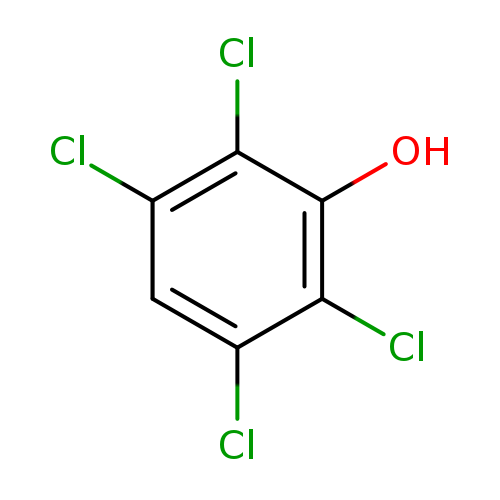
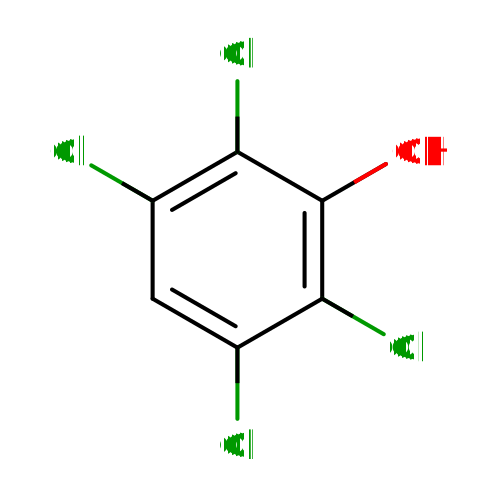
Common Name2,3,5,6-Tetrachlorophenol
ClassSmall Molecule
Description2,3,5,6-Tetrachlorophenol is a biodegradation product of polychlorinated benzene and polychlorinated biphenols.
Contaminant Sources
  • My Exposome Chemicals
  • Sludge Chemicals
  • T3DB toxins
  • ToxCast & Tox21 Chemicals
Contaminant Type
  • Aromatic Hydrocarbon
  • Food Toxin
  • Lachrymator
  • Organic Compound
  • Organochloride
  • Synthetic Compound
Chemical Structure
Thumb
Synonyms
ValueSource
2,3,5,6-TeCPChEBI
2,3,5,6-Tetrachloro phenolChEBI
2,3,5,6-TetrachlorophenateChEBI
2,3,5,6-Tetrachlorophenic acidGenerator
Chemical FormulaC6H2Cl4O
Average Molecular Mass231.891 g/mol
Monoisotopic Mass229.886 g/mol
CAS Registry Number935-95-5
IUPAC Name2,3,5,6-tetrachlorophenol
Traditional Name2,3,5,6-tetrachlorophenol
SMILESOC1=C(Cl)C(Cl)=CC(Cl)=C1Cl
InChI IdentifierInChI=1S/C6H2Cl4O/c7-2-1-3(8)5(10)6(11)4(2)9/h1,11H
InChI KeyKEWNKZNZRIAIAK-UHFFFAOYSA-N
Chemical Taxonomy
Description belongs to the class of organic compounds known as o-chlorophenols. These are chlorophenols carrying a iodine at the C2 position of the benzene ring.
KingdomOrganic compounds
Super ClassBenzenoids
ClassPhenols
Sub ClassHalophenols
Direct ParentO-chlorophenols
Alternative Parents
Substituents
  • 2-chlorophenol
  • 3-chlorophenol
  • 1-hydroxy-4-unsubstituted benzenoid
  • Halobenzene
  • Chlorobenzene
  • Monocyclic benzene moiety
  • Aryl halide
  • Aryl chloride
  • Organic oxygen compound
  • Hydrocarbon derivative
  • Organooxygen compound
  • Organochloride
  • Organohalogen compound
  • Aromatic homomonocyclic compound
Molecular FrameworkAromatic homomonocyclic compounds
External Descriptors
Biological Properties
StatusDetected and Not Quantified
OriginExogenous
Cellular Locations
  • Membrane
Biofluid LocationsNot Available
Tissue LocationsNot Available
PathwaysNot Available
ApplicationsNot Available
Biological RolesNot Available
Chemical RolesNot Available
Physical Properties
StateSolid
AppearanceWhite powder.
Experimental Properties
PropertyValue
Melting Point115°C
Boiling PointNot Available
SolubilityNot Available
Predicted Properties
PropertyValueSource
Water Solubility0.099 g/LALOGPS
logP4.45ALOGPS
logP4.09ChemAxon
logS-3.4ALOGPS
pKa (Strongest Acidic)5.25ChemAxon
pKa (Strongest Basic)-8.2ChemAxon
Physiological Charge-1ChemAxon
Hydrogen Acceptor Count1ChemAxon
Hydrogen Donor Count1ChemAxon
Polar Surface Area20.23 ŲChemAxon
Rotatable Bond Count0ChemAxon
Refractivity47.26 m³·mol⁻¹ChemAxon
Polarizability18.45 ųChemAxon
Number of Rings1ChemAxon
Bioavailability1ChemAxon
Rule of FiveYesChemAxon
Ghose FilterNoChemAxon
Veber's RuleYesChemAxon
MDDR-like RuleNoChemAxon
Spectra
Spectra
Spectrum TypeDescriptionSplash KeyView
Predicted GC-MSPredicted GC-MS Spectrum - GC-MS (TMS_1_1) - 70eV, PositiveNot AvailableSpectrum
Predicted LC-MS/MSPredicted LC-MS/MS Spectrum - 10V, Positivesplash10-001i-0090000000-08217b277413993527c9Spectrum
Predicted LC-MS/MSPredicted LC-MS/MS Spectrum - 20V, Positivesplash10-001i-0090000000-4c84de79bc4bbc2eca0aSpectrum
Predicted LC-MS/MSPredicted LC-MS/MS Spectrum - 40V, Positivesplash10-000x-0960000000-450f19d37b47584e56ddSpectrum
Predicted LC-MS/MSPredicted LC-MS/MS Spectrum - 10V, Negativesplash10-004i-0090000000-48c0be405602c36c1526Spectrum
Predicted LC-MS/MSPredicted LC-MS/MS Spectrum - 20V, Negativesplash10-004i-0090000000-e538b04aa45113cfaff1Spectrum
Predicted LC-MS/MSPredicted LC-MS/MS Spectrum - 40V, Negativesplash10-002f-0970000000-f2a72c45f0df9c0d74cfSpectrum
MSMass Spectrum (Electron Ionization)splash10-001i-4690000000-d32a2509948e34635636Spectrum
1D NMR1H NMR SpectrumNot AvailableSpectrum
1D NMR13C NMR SpectrumNot AvailableSpectrum
Toxicity Profile
Route of ExposureInhalation (3) ; oral (3) ; dermal (3) ; eye contact (3)
Mechanism of Toxicity2,3,5,6-tetrachlorophenol acts at the sites of adenosine triphosphate production and decreases or blocks it without blocking the electron transport chain. Thus the poison uncouples phosphorylation from oxidation. Free energy from the electron transport chain then converts to more body heat. As body temp rises, heat-dissipating mechanisms are overcome and metabolism is speeded. More adenosine diphosphate and other substrates accumulate, and these substrates stimulate the electron transport chain further. The electron transport chain responds by using up more and more available oxygen (increasing oxygen demand) in an effort to produce adenosine triphosphate, but much of the free energy generated is liberated as still more body heat. Oxygen demand quickly overcomes oxygen supply, and energy reserves become depleted (1).
Metabolism2,3,5,6-Tetrachlorophenol is rapidly absorbed and excreted following occupational exposure, which involves both the inhalation and dermal routes. Sulfation and glucuronidation are the main metabolic pathways of 2,3,5,6-tetrachlorophenol. Studies suggest rapid absorption after dermal application. 2,3,5,6-Tetrachlorophenol is excreted as tetrachloro-p-hydroquinone, and partly unchanged (3).
Toxicity ValuesLD50: 89 mg/kg (Oral, Mouse) (3) LD50: >2000 mg/kg (Dermal, Rabbit) (3)
Lethal DoseNot Available
Carcinogenicity (IARC Classification)Not directly listed by IARC, but related polychlorophenols are discussed, and combined exposures to polychlorophenols or to their sodium salts are classified as possibly carcinogenic to humans (Group 2B). (2)
Uses/SourcesBreathing contamiated air; drinking contaminated water; eating contaminating food; skin/eye contact (particularly while treating wood) (3).
Minimum Risk LevelNot Available
Health EffectsDermal exposure can cause corrosive skin damage (3).
SymptomsDust has been found irritating to the nose and throat. Skin or eye contact can cause irritation of the exposed surface. Clinical signs preceding death for all tetrachlorophenol isomers included initial hyperactivity followed by hypoactivity, neuromuscular weakness, and convulsions. Headache can also result from exposure to 2,3,5,6-tetrachlorophenol (3).
TreatmentIn case of oral exposure, dilution may enhance absorption of phenol, and should be avoided; charcoal may be administered. If methemoglobinemia occurs, administer 1 to 2 mg/kg of 1% methylene blue slowly IV in symptomatic patients. Additional doses may be required. if hypotensin occurs, infuse 10 to 20 mL/kg isotonic fluid. If hypotension persists, administer dopamine or norepinephrine. Following inhalation exposure, move patient to fresh air. Monitor for respiratory distress, and if cough or difficulty breathing develops, evaluate for respiratory tract irritation, bronchitis, or pneumonitis. Administer oxygen and assist ventilation as required. Treat bronchospasm with inhaled beta2 agonist and oral or parenteral corticosteroids. Irrigate exposed eyes with copious amounts of room temperature water for at least 15 minutes following eye exposure. Following dermal exposure, remove phenol with undiluted polyethylene glycol 300 to 400 or isopropyl alcohol prior to washing, if readily available. Wash exposed areas twice or for at least 10 minutes with large quantities of soapy water. Water alone may be harmful. (4)

Concentrations
Not Available
DrugBank IDNot Available
HMDB IDNot Available
FooDB IDNot Available
Phenol Explorer IDNot Available
KNApSAcK IDNot Available
BiGG IDNot Available
BioCyc IDNot Available
METLIN IDNot Available
PDB IDNot Available
Wikipedia LinkNot Available
Chemspider IDNot Available
ChEBI ID52048
PubChem Compound ID13636
Kegg Compound IDC15505
YMDB IDNot Available
ECMDB IDNot Available
References
Synthesis ReferenceNot Available
MSDSNot Available
General ReferencesNot Available