Record Information
Version1.0
Creation Date2009-06-15 17:16:04 UTC
Update Date2026-03-31 19:07:39 UTC
Accession NumberCHEM000746
Identification
Common Name4-Chlorophenol
ClassSmall Molecule
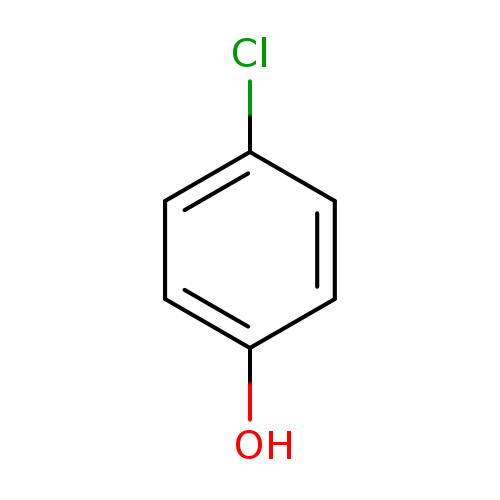
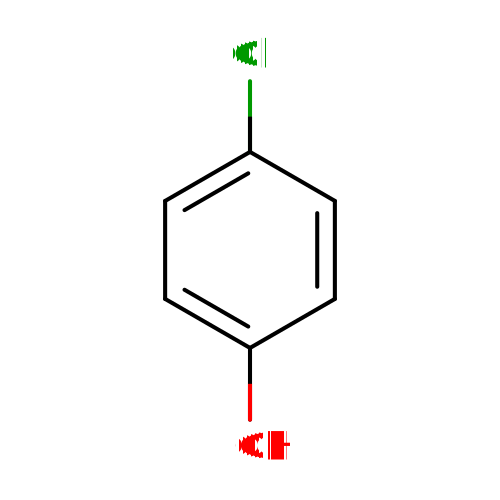
Description4-Chlorophenol or para-chlorophenol is a monochlorophenol isomer that has a chlorine atom in the para position. It is used as a disinfectant agent (2).
Contaminant Sources
  • My Exposome Chemicals
  • STOFF IDENT Compounds
  • Sludge Chemicals
  • T3DB toxins
  • ToxCast & Tox21 Chemicals
Contaminant Type
  • Aromatic Hydrocarbon
  • Household Toxin
  • Organic Compound
  • Organochloride
  • Synthetic Compound
Chemical Structure
Thumb
Synonyms
ValueSource
p-ChlorophenolChEBI
ParachlorophenolChEBI
4-Chlorophenol ion (1+)MeSH
4-Chlorophenol, nickel (+2) saltMeSH
4-Chlorophenol, titanium (+4) saltMeSH
4-ChlorophenoxideMeSH
Para-monochlorophenolMeSH
4-Chlorophenol, copper (+1) saltMeSH
4-MonochlorophenolMeSH
4-Chlorophenol, potassium saltMeSH
4-Chlorophenol, sodium saltMeSH
Chemical FormulaC6H5ClO
Average Molecular Mass128.556 g/mol
Monoisotopic Mass128.003 g/mol
CAS Registry Number106-48-9
IUPAC Name4-chlorophenol
Traditional Namechlorophenol
SMILESOC1=CC=C(Cl)C=C1
InChI IdentifierInChI=1S/C6H5ClO/c7-5-1-3-6(8)4-2-5/h1-4,8H
InChI KeyWXNZTHHGJRFXKQ-UHFFFAOYSA-N
Chemical Taxonomy
Description belongs to the class of organic compounds known as p-chlorophenols. These are chlorophenols carrying a iodine at the C4 position of the benzene ring.
KingdomOrganic compounds
Super ClassBenzenoids
ClassPhenols
Sub ClassHalophenols
Direct ParentP-chlorophenols
Alternative Parents
Substituents
  • 4-chlorophenol
  • 1-hydroxy-2-unsubstituted benzenoid
  • Halobenzene
  • Chlorobenzene
  • Monocyclic benzene moiety
  • Aryl halide
  • Aryl chloride
  • Organic oxygen compound
  • Hydrocarbon derivative
  • Organooxygen compound
  • Organochloride
  • Organohalogen compound
  • Aromatic homomonocyclic compound
Molecular FrameworkAromatic homomonocyclic compounds
External Descriptors
Biological Properties
StatusDetected and Not Quantified
OriginExogenous
Cellular Locations
  • Membrane
Biofluid LocationsNot Available
Tissue LocationsNot Available
PathwaysNot Available
ApplicationsNot Available
Biological RolesNot Available
Chemical RolesNot Available
Physical Properties
StateSolid
AppearanceWhite powder.
Experimental Properties
PropertyValue
Melting Point42.8°C
Boiling PointNot Available
Solubility24 mg/mL at 25°C [ROBERTS,MS et al. (1977)]
Predicted Properties
PropertyValueSource
Water Solubility14 g/LALOGPS
logP2.37ALOGPS
logP2.27ChemAxon
logS-0.96ALOGPS
pKa (Strongest Acidic)8.96ChemAxon
pKa (Strongest Basic)-6.3ChemAxon
Physiological Charge0ChemAxon
Hydrogen Acceptor Count1ChemAxon
Hydrogen Donor Count1ChemAxon
Polar Surface Area20.23 ŲChemAxon
Rotatable Bond Count0ChemAxon
Refractivity32.84 m³·mol⁻¹ChemAxon
Polarizability12.02 ųChemAxon
Number of Rings1ChemAxon
Bioavailability1ChemAxon
Rule of FiveYesChemAxon
Ghose FilterNoChemAxon
Veber's RuleYesChemAxon
MDDR-like RuleNoChemAxon
Spectra
Spectra
Spectrum TypeDescriptionSplash KeyView
GC-MSGC-MS Spectrum - EI-B (Non-derivatized)splash10-004i-8900000000-f5b8d40439248259fba6Spectrum
GC-MSGC-MS Spectrum - EI-B (Non-derivatized)splash10-004i-9800000000-3a8b74727039919cacc4Spectrum
GC-MSGC-MS Spectrum - EI-B (Non-derivatized)splash10-004i-5900000000-7c45de518d13780605c4Spectrum
GC-MSGC-MS Spectrum - EI-B (Non-derivatized)splash10-004i-5900000000-4855b919f4b9bab8519fSpectrum
GC-MSGC-MS Spectrum - EI-B (Non-derivatized)splash10-004i-9800000000-32ffdbba762c4f0fc609Spectrum
Predicted GC-MSPredicted GC-MS Spectrum - GC-MS (Non-derivatized) - 70eV, Positivesplash10-004i-4900000000-34735a026ba083fa0b7fSpectrum
Predicted GC-MSPredicted GC-MS Spectrum - GC-MS (Non-derivatized) - 70eV, PositiveNot AvailableSpectrum
Predicted GC-MSPredicted GC-MS Spectrum - GC-MS (TMS_1_1) - 70eV, PositiveNot AvailableSpectrum
Predicted GC-MSPredicted GC-MS Spectrum - GC-MS (TBDMS_1_1) - 70eV, PositiveNot AvailableSpectrum
LC-MS/MSLC-MS/MS Spectrum - LC-ESI-QFT , negativesplash10-004i-0900000000-edd6b8e255429561226bSpectrum
LC-MS/MSLC-MS/MS Spectrum - LC-ESI-QFT , negativesplash10-004i-0900000000-4f6d51ee33067bb474abSpectrum
LC-MS/MSLC-MS/MS Spectrum - LC-ESI-QFT , negativesplash10-004i-0900000000-099706b387a703bff163Spectrum
LC-MS/MSLC-MS/MS Spectrum - LC-ESI-QFT , negativesplash10-004i-1900000000-51fe6ac2fa9bed9bb10aSpectrum
LC-MS/MSLC-MS/MS Spectrum - LC-ESI-QFT , negativesplash10-004i-2900000000-a2fb225f178a8a1f4345Spectrum
LC-MS/MSLC-MS/MS Spectrum - LC-ESI-QFT , positivesplash10-004i-9600000000-ec3022a622bccb6ec3fbSpectrum
LC-MS/MSLC-MS/MS Spectrum - LC-ESI-QFT , positivesplash10-05r0-9400000000-1debf82a3dd9a5d2c117Spectrum
LC-MS/MSLC-MS/MS Spectrum - LC-ESI-QFT , positivesplash10-05r3-9200000000-a2b07eb09c8d6ed52d74Spectrum
LC-MS/MSLC-MS/MS Spectrum - LC-ESI-QFT , positivesplash10-0690-9100000000-657bec677b116442fc42Spectrum
LC-MS/MSLC-MS/MS Spectrum - LC-ESI-QFT , positivesplash10-014l-9000000000-ad1f7056f8d05e405129Spectrum
LC-MS/MSLC-MS/MS Spectrum - LC-ESI-QFT , positivesplash10-0gbc-9000000000-c791cec8d419b63d8d59Spectrum
LC-MS/MSLC-MS/MS Spectrum - 60V, Positivesplash10-0690-9100000000-657bec677b116442fc42Spectrum
LC-MS/MSLC-MS/MS Spectrum - 45V, Positivesplash10-05r3-9200000000-a2b07eb09c8d6ed52d74Spectrum
LC-MS/MSLC-MS/MS Spectrum - 30V, Positivesplash10-05r0-9400000000-1debf82a3dd9a5d2c117Spectrum
LC-MS/MSLC-MS/MS Spectrum - 90V, Positivesplash10-0gbc-9000000000-c791cec8d419b63d8d59Spectrum
LC-MS/MSLC-MS/MS Spectrum - 75V, Positivesplash10-014l-9000000000-ad1f7056f8d05e405129Spectrum
LC-MS/MSLC-MS/MS Spectrum - 30V, Negativesplash10-004i-0900000000-edd6b8e255429561226bSpectrum
LC-MS/MSLC-MS/MS Spectrum - 45V, Negativesplash10-004i-0900000000-4f6d51ee33067bb474abSpectrum
Predicted LC-MS/MSPredicted LC-MS/MS Spectrum - 10V, Positivesplash10-004i-0900000000-48f80a2ed99c319f28eeSpectrum
Predicted LC-MS/MSPredicted LC-MS/MS Spectrum - 20V, Positivesplash10-004i-0900000000-a9a4905ea5907e304129Spectrum
Predicted LC-MS/MSPredicted LC-MS/MS Spectrum - 40V, Positivesplash10-002b-9400000000-bf69c6609bd6a3690b0fSpectrum
Predicted LC-MS/MSPredicted LC-MS/MS Spectrum - 10V, Negativesplash10-004i-0900000000-f67531a18d328dd39602Spectrum
Predicted LC-MS/MSPredicted LC-MS/MS Spectrum - 20V, Negativesplash10-004i-0900000000-f67531a18d328dd39602Spectrum
Predicted LC-MS/MSPredicted LC-MS/MS Spectrum - 40V, Negativesplash10-004i-9800000000-244eb0ef00d140eea0abSpectrum
MSMass Spectrum (Electron Ionization)splash10-004i-9600000000-55d86628a011109663e2Spectrum
1D NMR1H NMR SpectrumNot AvailableSpectrum
1D NMR13C NMR SpectrumNot AvailableSpectrum
1D NMR1H NMR SpectrumNot AvailableSpectrum
1D NMR13C NMR SpectrumNot AvailableSpectrum
1D NMR1H NMR SpectrumNot AvailableSpectrum
1D NMR13C NMR SpectrumNot AvailableSpectrum
1D NMR1H NMR SpectrumNot AvailableSpectrum
1D NMR13C NMR SpectrumNot AvailableSpectrum
1D NMR1H NMR SpectrumNot AvailableSpectrum
1D NMR13C NMR SpectrumNot AvailableSpectrum
1D NMR1H NMR SpectrumNot AvailableSpectrum
1D NMR13C NMR SpectrumNot AvailableSpectrum
1D NMR1H NMR SpectrumNot AvailableSpectrum
1D NMR13C NMR SpectrumNot AvailableSpectrum
Toxicity Profile
Route of ExposureInhalation (2) ; oral (2) ; dermal (2)
Mechanism of Toxicity4-chlorophenol works as a weak uncoupler of oxidative phosphorylation and inhibitors of cellular respiration. The ability of chlorophenols to uncouple oxidative phosphorylation increases with increasing chlorination. In fact, studies indicate a concentration-dependent triphasic effect of chlorophenols on phosphorylation and cellular respiration. At low concentrations, uncoupling produces stimulation of the resting state respiration as a result of increased adenosine triphosphatase (ATPase) activity in the absence of a phosphate acceptor.Inhibition of active respiration is also observed. At moderate concentrations, resting respiration is neither stimulated nor inhibited. Significant inhibition of respiration, associated with a breakdown of the electron transport process and decreased ATPase activity, occurs at very high concentrations. Uncoupling activity has been attributed to a protonophoric effect (a disruption of the energy gradient across the mitochondrial membrane resulting from distribution of chlorophenols in the phospholipid bilayer of the membrane), whereas inhibition of cellular respiration has been attributed to a direct action on intracellular proteins (2).
MetabolismAbsorption of 4-chlorophenol is favored in the stomach and the intestine. Absorption through the gastrointestinal tract is by simple diffusion and is expected to be both rapid and virtually complete. It is proposed that 4-CP is metabolized by P-450 enzymes to intermediates that react with glutathione to form glutathionyl adducts.The metabolism of the 4-chlorophenol is principally via conjugation. The principal metabolite ecreted is the glucuronide. Other metabolites are sulfate conjugates such as the ethereal sulfate. The metabobites are excreted in urine (2).
Toxicity ValuesLD50: 670 mg/kg (Oral, Rat) (3) LC50: 11 mg/m3 (Inhalation, Rat) (3)
Lethal DoseNot Available
Carcinogenicity (IARC Classification)No indication of carcinogenicity (not listed by IARC). (1)
Uses/SourcesBreathing in contaminated air; drinking contaminated water; dermal and eye exposure (2).
Minimum Risk LevelAcute Oral: 0.01 mg/kg/day (Rat) (2)
Health Effects4-chlorophenol is corrosive to epithelial tissue. It produce effects ranging from slight hyperemia to severe corrosion when applied to the corneas. Acute inhalation exposure may lead to hemorrhage in the lungs and tachypnea. Oral exposure to 2-chlorophenol can produce a variety of neurological effects, including tremors, myoclonic convulsions, a hunched posture, dyspnea, collapse, and coma (2).
SymptomsCough, shortness of breath and sore throat can result from inhalation of 2-chlorophenol. These symptoms may be delayed. Abdominal pain, drowsiness, weakness, and convulsions can result from ingestion as well as inhalation. moreover, ingestion of 2-chlorophenol can cause restlessness, tremors, or central nervous system depression to occur. Eye exposure to 2-chlorophenol can lead to redness, pain, and blurred vision, while dermal contact can lead to redness and pain of the skin. Moreover, the substance can be rapidily absorbed after derma exposure (2).
TreatmentAvoid dilution following oral exposure; instead, administer charcoal as a slurry. Following inhalation, move patient to fresh air. Monitor for respiratory distress. If cough or difficulty breathing develops, evaluate for respiratory tract irritation, bronchitis, or pneumonitis. Administer oxygen and assist ventilation as required. Treat bronchospasm with inhaled beta2 agonist and oral or parenteral corticosteroids. If the exposure occurs through eye contact, irrigate exposed eyes with copious amounts of room temperature water for at least 15 minutes. Following dermal exposure, remove phenol with undiluted polyethylene glycol 300 to 400 or isopropyl alcohol prior to washing, if readily available. Wash exposed areas twice or for at least 10 minutes with large quantities of soapy water. Water alone may be harmful. (4)
Concentrations
Not Available
DrugBank IDNot Available
HMDB IDNot Available
FooDB IDNot Available
Phenol Explorer IDNot Available
KNApSAcK IDNot Available
BiGG IDNot Available
BioCyc IDCPD-10870
METLIN IDNot Available
PDB IDNot Available
Wikipedia Link4-Chlorophenol
Chemspider ID13875219
ChEBI ID28078
PubChem Compound IDNot Available
Kegg Compound IDC02124
YMDB IDNot Available
ECMDB IDNot Available
References
Synthesis ReferenceNot Available
MSDSNot Available
General References
1. https://www.ncbi.nlm.nih.gov/pubmed/?term=10848923
2. https://www.ncbi.nlm.nih.gov/pubmed/?term=24279624
3. https://www.ncbi.nlm.nih.gov/pubmed/?term=24390833
4. https://www.ncbi.nlm.nih.gov/pubmed/?term=24473310
5. https://www.ncbi.nlm.nih.gov/pubmed/?term=24583212
6. https://www.ncbi.nlm.nih.gov/pubmed/?term=24725749
7. https://www.ncbi.nlm.nih.gov/pubmed/?term=24762698
8. https://www.ncbi.nlm.nih.gov/pubmed/?term=24794625
9. https://www.ncbi.nlm.nih.gov/pubmed/?term=24926596