Record Information
Version1.0
Creation Date2009-06-08 16:35:18 UTC
Update Date2026-05-14 20:08:58 UTC
Accession NumberCHEM000731
Identification
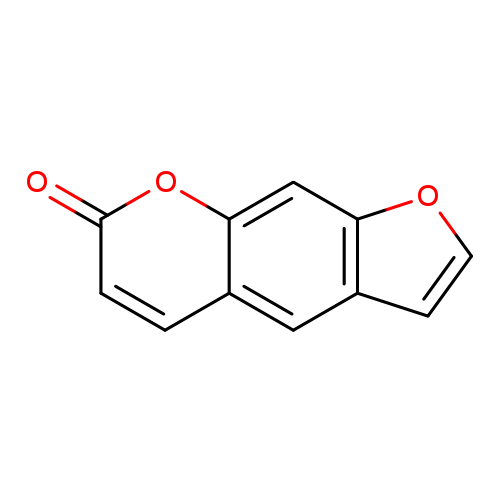
Common NamePsoralen
ClassSmall Molecule
DescriptionPsoralen is found in carrot. Psoralen is found in common vegetables, e.g. parsnip, celery especially if diseased or `spoiled' Psoralen is a significant mutagen and is used for this purpose in molecular biology research. Psoralen has been shown to exhibit anti-proliferative, anti-allergenic and anti-histamine functions (1, 2, 2). Psoralen belongs to the family of Furanocoumarins. These are polycyclic aromatic compounds containing a furan ring fused to a coumarin moeity.
Contaminant Sources
  • FooDB Chemicals
  • T3DB toxins
Contaminant Type
  • Aromatic Hydrocarbon
  • Ester
  • Food Toxin
  • Furocoumarin
  • Industrial/Workplace Toxin
  • Metabolite
  • Natural Compound
  • Organic Compound
  • PFAS
  • Phytotoxin
  • Plant Toxin
Chemical Structure
Thumb
Synonyms
ValueSource
3-(6-Hydroxy-5-benzofuranyl)-2-propenoic acid delta-lactoneChEBI
6,7-FuranocoumarinChEBI
6-Hydroxy-5-benzofuranacrylic acid delta-lactoneChEBI
7H-Furo[3,2-g][1]benzopyran-7-oneChEBI
FicusinChEBI
Furo[2',3':7,6]coumarinChEBI
Furo[4',5':6,7]coumarinChEBI
FurocoumarinChEBI
ManadermChEBI
PsoraleneChEBI
7H-Furo[3,2-g]chromen-7-oneKegg
3-(6-Hydroxy-5-benzofuranyl)-2-propenoate delta-lactoneGenerator
3-(6-Hydroxy-5-benzofuranyl)-2-propenoate δ-lactoneGenerator
3-(6-Hydroxy-5-benzofuranyl)-2-propenoic acid δ-lactoneGenerator
6-Hydroxy-5-benzofuranacrylate delta-lactoneGenerator
6-Hydroxy-5-benzofuranacrylate δ-lactoneGenerator
6-Hydroxy-5-benzofuranacrylic acid δ-lactoneGenerator
2H-furo[3,2-g]Chromen-2-oneHMDB
5-Benzofuranacrylic acid, 6-hydroxy-, delta-lactoneHMDB
6-Hydroxy-5-benzofuranacrylic acid beta-lactoneHMDB
6-Hydroxy-5-benzofuranacrylic acid gamma-lactoneHMDB
7H-furo(3,2-g)(1)Benzopyran-7-oneHMDB
7H-furo[3,2-g]Benzopyran-7-oneHMDB
7H-furo[3,2-g][1]Benzopyran-7-one, 9ciHMDB
furo(2',3',7,6)CoumarinHMDB
furo(3,2-g)-CoumarinHMDB
furo(4',5',6,7)CoumarinHMDB
furo[2'.3':7.6]CoumarinHMDB
furo[3,2-g]CoumarinHMDB
PhytoalexinHMDB
Phytoalexin-CMPDHMDB
Psorline-PHMDB
Chemical FormulaC11H6O3
Average Molecular Mass186.166 g/mol
Monoisotopic Mass186.032 g/mol
CAS Registry Number66-97-7
IUPAC Name7H-furo[3,2-g]chromen-7-one
Traditional Namepsoralen
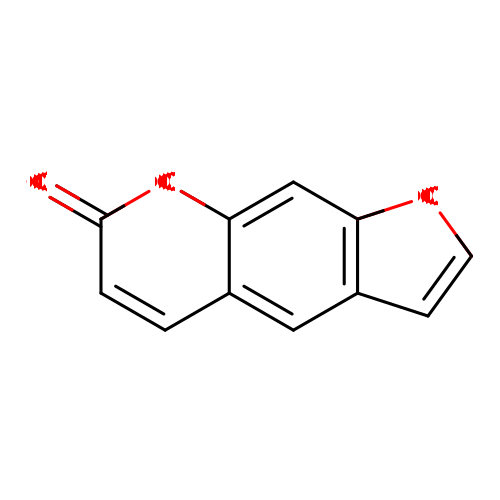
SMILESO=C1OC2=CC3=C(C=CO3)C=C2C=C1
InChI IdentifierInChI=1S/C11H6O3/c12-11-2-1-7-5-8-3-4-13-9(8)6-10(7)14-11/h1-6H
InChI KeyZCCUUQDIBDJBTK-UHFFFAOYSA-N
Chemical Taxonomy
Description belongs to the class of organic compounds known as psoralens. These are organic compounds containing a psoralen moiety, which consists of a furan fused to a chromenone to for 7H-furo[3,2-g]chromen-7-one.
KingdomOrganic compounds
Super ClassPhenylpropanoids and polyketides
ClassCoumarins and derivatives
Sub ClassFuranocoumarins
Direct ParentPsoralens
Alternative Parents
Substituents
  • Psoralen
  • Benzopyran
  • 1-benzopyran
  • Benzofuran
  • Pyranone
  • Benzenoid
  • Pyran
  • Furan
  • Heteroaromatic compound
  • Lactone
  • Oxacycle
  • Organoheterocyclic compound
  • Organooxygen compound
  • Hydrocarbon derivative
  • Organic oxide
  • Organic oxygen compound
  • Aromatic heteropolycyclic compound
Molecular FrameworkAromatic heteropolycyclic compounds
External Descriptors
Biological Properties
StatusDetected and Not Quantified
OriginExogenous
Cellular Locations
  • Cytoplasm
  • Extracellular
Biofluid LocationsNot Available
Tissue LocationsNot Available
PathwaysNot Available
ApplicationsNot Available
Biological Roles
Chemical RolesNot Available
Physical Properties
StateSolid
AppearanceWhite powder.
Experimental Properties
PropertyValue
Melting Point171°C
Boiling PointNot Available
SolubilityNot Available
Predicted Properties
PropertyValueSource
Water Solubility0.13 g/LALOGPS
logP2.15ALOGPS
logP1.94ChemAxon
logS-3.1ALOGPS
pKa (Strongest Basic)-2.9ChemAxon
Physiological Charge0ChemAxon
Hydrogen Acceptor Count1ChemAxon
Hydrogen Donor Count0ChemAxon
Polar Surface Area39.44 ŲChemAxon
Rotatable Bond Count0ChemAxon
Refractivity50.39 m³·mol⁻¹ChemAxon
Polarizability18.1 ųChemAxon
Number of Rings3ChemAxon
Bioavailability1ChemAxon
Rule of FiveYesChemAxon
Ghose FilterYesChemAxon
Veber's RuleYesChemAxon
MDDR-like RuleNoChemAxon
Spectra
Spectra
Spectrum TypeDescriptionSplash KeyView
GC-MSGC-MS Spectrum - GC-EI-TOF (Non-derivatized)splash10-0pbi-0900000000-f4158c6b7c0ecf20d9feSpectrum
GC-MSGC-MS Spectrum - GC-EI-TOF (Non-derivatized)splash10-0r2i-6900000000-276c6db470fc13777449Spectrum
GC-MSGC-MS Spectrum - GC-EI-TOF (Non-derivatized)splash10-0pbi-0900000000-f4158c6b7c0ecf20d9feSpectrum
GC-MSGC-MS Spectrum - GC-EI-TOF (Non-derivatized)splash10-0r2i-6900000000-276c6db470fc13777449Spectrum
Predicted GC-MSPredicted GC-MS Spectrum - GC-MS (Non-derivatized) - 70eV, Positivesplash10-052u-1900000000-900e13490ddfba7e89efSpectrum
Predicted GC-MSPredicted GC-MS Spectrum - GC-MS (Non-derivatized) - 70eV, PositiveNot AvailableSpectrum
LC-MS/MSLC-MS/MS Spectrum - LC-ESI-qTof , Positivesplash10-00lr-1900000000-ac91ad62c36a29665a71Spectrum
LC-MS/MSLC-MS/MS Spectrum - LC-ESI-QTOF , positivesplash10-000i-0900000000-75211365e04f08273288Spectrum
LC-MS/MSLC-MS/MS Spectrum - LC-ESI-QTOF , positivesplash10-00lr-0900000000-fa9d08e8d5421ebeaa77Spectrum
LC-MS/MSLC-MS/MS Spectrum - LC-ESI-QTOF , positivesplash10-0f89-0900000000-bacd49139ec536fb55e7Spectrum
LC-MS/MSLC-MS/MS Spectrum - , positivesplash10-00lr-1900000000-ac91ad62c36a29665a71Spectrum
LC-MS/MSLC-MS/MS Spectrum - , positivesplash10-001r-0900000000-195d9e7e3b29cf95c327Spectrum
LC-MS/MSLC-MS/MS Spectrum - 10V, Positivesplash10-000i-0900000000-75211365e04f08273288Spectrum
LC-MS/MSLC-MS/MS Spectrum - 20V, Positivesplash10-00lr-0900000000-fa9d08e8d5421ebeaa77Spectrum
LC-MS/MSLC-MS/MS Spectrum - 40V, Positivesplash10-0f89-0900000000-bacd49139ec536fb55e7Spectrum
Predicted LC-MS/MSPredicted LC-MS/MS Spectrum - 10V, Positivesplash10-000i-0900000000-287480067e742345fcb9Spectrum
Predicted LC-MS/MSPredicted LC-MS/MS Spectrum - 20V, Positivesplash10-000i-0900000000-2bf4a5ffe9d6883b015eSpectrum
Predicted LC-MS/MSPredicted LC-MS/MS Spectrum - 40V, Positivesplash10-0006-1900000000-519db61c8cb6a8a31549Spectrum
Predicted LC-MS/MSPredicted LC-MS/MS Spectrum - 10V, Negativesplash10-000i-0900000000-559cba64d14574cb0041Spectrum
Predicted LC-MS/MSPredicted LC-MS/MS Spectrum - 20V, Negativesplash10-000i-0900000000-503a6a3d5ba551e5c0f5Spectrum
Predicted LC-MS/MSPredicted LC-MS/MS Spectrum - 40V, Negativesplash10-0006-0900000000-857f114f045cf9aa2b39Spectrum
Predicted LC-MS/MSPredicted LC-MS/MS Spectrum - 10V, Positivesplash10-000i-0900000000-f3f07adc83a68e9e76ffSpectrum
Predicted LC-MS/MSPredicted LC-MS/MS Spectrum - 20V, Positivesplash10-000i-0900000000-f3f07adc83a68e9e76ffSpectrum
Predicted LC-MS/MSPredicted LC-MS/MS Spectrum - 40V, Positivesplash10-0a4i-0900000000-a2c2c14d0cf6b23ada92Spectrum
Predicted LC-MS/MSPredicted LC-MS/MS Spectrum - 10V, Negativesplash10-000i-0900000000-89e4df10d3690e5a6d15Spectrum
Predicted LC-MS/MSPredicted LC-MS/MS Spectrum - 20V, Negativesplash10-000i-0900000000-89e4df10d3690e5a6d15Spectrum
Predicted LC-MS/MSPredicted LC-MS/MS Spectrum - 40V, Negativesplash10-000i-0900000000-89e4df10d3690e5a6d15Spectrum
MSMass Spectrum (Electron Ionization)splash10-052r-3900000000-eff7b2146482de5c7740Spectrum
1D NMR1H NMR SpectrumNot AvailableSpectrum
Toxicity Profile
Route of ExposureNot Available
Mechanism of ToxicityThe mechanism of action many furocoumarins is based on their ability to form photoadducts with DNA and other cellular components such as RNA, proteins, and several proteins found in the membrane such as phospholipases A2 and C, Ca-dependent and cAMPdependent protein-kinase and epidermal growth factor. Furocoumarins intercalate between base pairs of DNA and after ultraviolet-A irradiation, giving cycloadducts. (7).
MetabolismNot Available
Toxicity ValuesNot Available
Lethal DoseNot Available
Carcinogenicity (IARC Classification)Not listed by IARC. IARC has assessed other furocoumarins, classifying 8-methoxypsoralen as carcinogenic to humans (Group 1), 5-methoxypsoralen as possibly carcinogenic to humans (Group 2A), and certain other furocoumarins as not being classifiable as to their carcinogenicity to humans (Group 3). (6)
Uses/SourcesAnthelmintics, cross-linking reagent, photosensitising agent. Photochemical reagent for the investigation of nucleic acid structure and function. (7)
Minimum Risk LevelNot Available
Health EffectsThe furocoumarin 8-methoxypsoralen is carcinogenic to humans, and possibly 5-methoxypsoralen as well (6). There is some evidence from mouse studies that other furocoumarins are carcinogenic when combined with exposure to UVA radiation (3). The SKLM regards the additional risk of skin cancer arising from the consumption of typical quantities of furocoumarin-containing foods, which remain significantly below the range of phototoxic doses, as insignificant. However, the consumption of phototoxic quantities cannot be ruled out for certain foods, particularly celery and parsnips, that may lead to significant increases in furocoumarin concentrations, depending on the storage, processing and production conditions. (8) Furocoumarin photochemotherapy is known to induce a number of side-effects including erythema, edema, hyperpigmentation, and premature aging of skin. All photobiological effects of furocoumarins result from their photochemical reactions. Because many dietary or water soluble furocoumarins are strong inhibitors of cytochrome P450s, they will also cause adverse drug reactions when taken with other drugs.
SymptomsHarmful if swallowed. Irritating to eyes, respiratory system and skin. (7)
TreatmentIn case of contact with eyes, rinse immediately with plenty of water and seek medical advice. (7)
Concentrations
Not Available
DrugBank IDNot Available
HMDB IDHMDB0034272
FooDB IDFDB012605
Phenol Explorer ID718
KNApSAcK IDC00000297
BiGG IDNot Available
BioCyc IDNot Available
METLIN IDNot Available
PDB IDNot Available
Wikipedia LinkPsoralen
Chemspider ID5964
ChEBI ID27616
PubChem Compound ID6199
Kegg Compound IDC09305
YMDB IDNot Available
ECMDB IDNot Available
References
Synthesis ReferenceNot Available
MSDSNot Available
General References
1. https://www.ncbi.nlm.nih.gov/pubmed/?term=20196083
2. https://www.ncbi.nlm.nih.gov/pubmed/?term=21468912
3. Rodighiero P, Guiotto A, Pastorini G, Manzini P, Bordin F, Baccichetti F, Carlassare F, Vedaldi D, Dall'Acqua F: Photochemical and photobiological properties of 4,5'-dimethylpsoralen, a bifunctional contaminant of synthetic 4,5'-dimethylangelicin. Farmaco Sci. 1981 Jul;36(7):648-62.
4. Insawang M, Wongpraparut C: Recalcitrant solar urticaria induced by UVA and visible light: a case report. J Med Assoc Thai. 2010 Oct;93(10):1238-41.
5. Yannai, Shmuel. (2004) Dictionary of food compounds with CD-ROM: Additives, flavors, and ingredients. Boca Raton: Chapman & Hall/CRC.