Record Information
Version1.0
Creation Date2009-06-05 16:53:48 UTC
Update Date2026-03-25 19:18:21 UTC
Accession NumberCHEM000723
Identification
Common NameAcetochlor
ClassSmall Molecule
DescriptionAcetochlor is an herbicide developed by Monsanto and Zeneca. It is a member of the class of herbicides known as chloroacetanilides (3).
Contaminant Sources
  • HPV EPA Chemicals
  • My Exposome Chemicals
  • STOFF IDENT Compounds
  • T3DB toxins
  • ToxCast & Tox21 Chemicals
Contaminant Type
  • Amide
  • Amine
  • Aromatic Hydrocarbon
  • Chloroacetanilide
  • Ether
  • Herbicide
  • Household Toxin
  • Organic Compound
  • Organochloride
  • Pesticide
  • Synthetic Compound
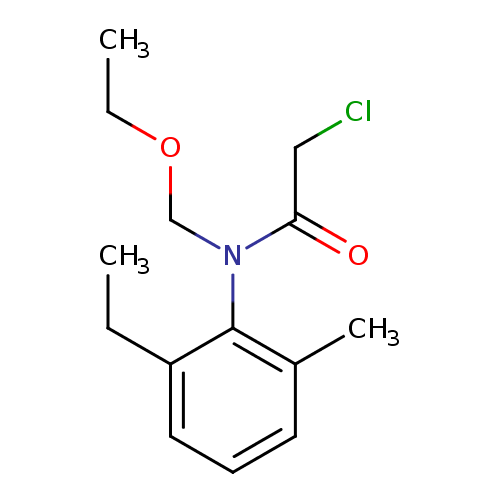
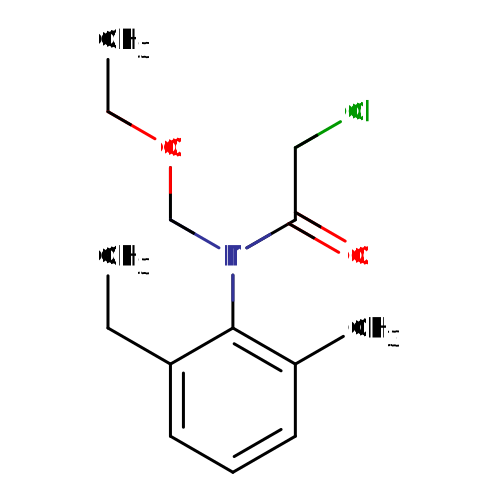
Chemical Structure
Thumb
Synonyms
ValueSource
2-Chloro-2'-methyl-6-ethyl-N-ethoxymethylacetanilideChEBI
2-Chloro-N-(ethoxymethyl)-6'-ethyl-O-acetotoluidideChEBI
2-Chloro-N-(ethoxymethyl)-6'-ethylacet-O-toluidideChEBI
AcetochloreChEBI
Chemical FormulaC14H20ClNO2
Average Molecular Mass269.767 g/mol
Monoisotopic Mass269.118 g/mol
CAS Registry Number34256-82-1
IUPAC Name2-chloro-N-(ethoxymethyl)-N-(2-ethyl-6-methylphenyl)acetamide
Traditional Nameacetochlor
SMILESCCOCN(C(=O)CCl)C1=C(C)C=CC=C1CC
InChI IdentifierInChI=1S/C14H20ClNO2/c1-4-12-8-6-7-11(3)14(12)16(10-18-5-2)13(17)9-15/h6-8H,4-5,9-10H2,1-3H3
InChI KeyVTNQPKFIQCLBDU-UHFFFAOYSA-N
Chemical Taxonomy
Description belongs to the class of organic compounds known as anilides. These are organic heterocyclic compounds derived from oxoacids RkE(=O)l(OH)m (l not 0) by replacing an OH group by the NHPh group or derivative formed by ring substitution.
KingdomOrganic compounds
Super ClassBenzenoids
ClassBenzene and substituted derivatives
Sub ClassAnilides
Direct ParentAnilides
Alternative Parents
Substituents
  • Anilide
  • Toluene
  • Tertiary carboxylic acid amide
  • Chloroacetamide
  • Carboxamide group
  • Carboxylic acid derivative
  • Alkyl chloride
  • Hydrocarbon derivative
  • Organic oxide
  • Organopnictogen compound
  • Organooxygen compound
  • Organonitrogen compound
  • Organochloride
  • Organohalogen compound
  • Organic oxygen compound
  • Organic nitrogen compound
  • Carbonyl group
  • Alkyl halide
  • Aromatic homomonocyclic compound
Molecular FrameworkAromatic homomonocyclic compounds
External Descriptors
Biological Properties
StatusDetected and Not Quantified
OriginExogenous
Cellular Locations
  • Membrane
Biofluid LocationsNot Available
Tissue LocationsNot Available
PathwaysNot Available
Applications
Biological RolesNot Available
Chemical RolesNot Available
Physical Properties
StateLiquid
AppearanceThick oily liquid, light amber to violet (1).
Experimental Properties
PropertyValue
Melting Point< 0°C
Boiling PointNot Available
Solubility0.223 mg/mL at 25°C [SHIU,WY et al. (1990)]
Predicted Properties
PropertyValueSource
Water Solubility0.25 g/LALOGPS
logP3.17ALOGPS
logP3.5ChemAxon
logS-3ALOGPS
pKa (Strongest Acidic)16.6ChemAxon
pKa (Strongest Basic)-4.2ChemAxon
Physiological Charge0ChemAxon
Hydrogen Acceptor Count2ChemAxon
Hydrogen Donor Count0ChemAxon
Polar Surface Area29.54 ŲChemAxon
Rotatable Bond Count6ChemAxon
Refractivity74.08 m³·mol⁻¹ChemAxon
Polarizability29.17 ųChemAxon
Number of Rings1ChemAxon
Bioavailability1ChemAxon
Rule of FiveYesChemAxon
Ghose FilterYesChemAxon
Veber's RuleYesChemAxon
MDDR-like RuleNoChemAxon
Spectra
Spectra
Spectrum TypeDescriptionSplash KeyView
Predicted GC-MSPredicted GC-MS Spectrum - GC-MS (Non-derivatized) - 70eV, Positivesplash10-003b-3920000000-c22ef10734da2c776f39Spectrum
Predicted GC-MSPredicted GC-MS Spectrum - GC-MS (Non-derivatized) - 70eV, PositiveNot AvailableSpectrum
LC-MS/MSLC-MS/MS Spectrum - 15V, Positivesplash10-000i-0190000000-0a6f1d9cbc656de4d15bSpectrum
LC-MS/MSLC-MS/MS Spectrum - 50V, Positivesplash10-001i-0900000000-1637a3975e8ee851f8eaSpectrum
LC-MS/MSLC-MS/MS Spectrum - 30V, Positivesplash10-08fs-2790000000-b1f32a3aac32fadd4eedSpectrum
LC-MS/MSLC-MS/MS Spectrum - 45V, Positivesplash10-0a4i-0910000000-e12577305d2e58a006ebSpectrum
LC-MS/MSLC-MS/MS Spectrum - 40V, Positivesplash10-001j-0900000000-d00c2fc6c7d3fb7e76cbSpectrum
LC-MS/MSLC-MS/MS Spectrum - 90V, Positivesplash10-001i-0900000000-1ac28e432f1e04ac834aSpectrum
LC-MS/MSLC-MS/MS Spectrum - 15V, Positivesplash10-00di-0090000000-629bb42c37612561b416Spectrum
LC-MS/MSLC-MS/MS Spectrum - 30V, Positivesplash10-0002-0900000000-967beaa3abba53436553Spectrum
LC-MS/MSLC-MS/MS Spectrum - 10V, Positivesplash10-00di-0190000000-1e163b7011316a3ef564Spectrum
LC-MS/MSLC-MS/MS Spectrum - 20V, Positivesplash10-006t-0960000000-0c15999088446e8f0b23Spectrum
LC-MS/MSLC-MS/MS Spectrum - 90V, Positivesplash10-054n-9800000000-e4258e37539b6195fbf1Spectrum
LC-MS/MSLC-MS/MS Spectrum - 30V, Positivesplash10-08fs-2790000000-42d8886b94cdd920f709Spectrum
LC-MS/MSLC-MS/MS Spectrum - 75V, Positivesplash10-0a59-0900000000-b5f150c9e23b6ebdce64Spectrum
LC-MS/MSLC-MS/MS Spectrum - 90V, Positivesplash10-0a59-1900000000-4e0c10479c20fed3e39fSpectrum
LC-MS/MSLC-MS/MS Spectrum - 15V, Positivesplash10-00di-1190000000-3a60715691daa10a2c72Spectrum
LC-MS/MSLC-MS/MS Spectrum - 90V, Positivesplash10-001i-0900000000-bc7b062701444d65969dSpectrum
LC-MS/MSLC-MS/MS Spectrum - 75V, Positivesplash10-001j-0900000000-9e5efbd30c4dc4940a23Spectrum
LC-MS/MSLC-MS/MS Spectrum - 60V, Positivesplash10-0002-0900000000-534ee582bcfce096fe67Spectrum
LC-MS/MSLC-MS/MS Spectrum - 75V, Positivesplash10-001j-0900000000-de5b03fbfa9f4c5deffdSpectrum
Predicted LC-MS/MSPredicted LC-MS/MS Spectrum - 10V, Positivesplash10-00di-0190000000-9cecf237e747e9bdcd34Spectrum
Predicted LC-MS/MSPredicted LC-MS/MS Spectrum - 20V, Positivesplash10-0234-2970000000-b2728e1ae2900b7786e8Spectrum
Predicted LC-MS/MSPredicted LC-MS/MS Spectrum - 40V, Positivesplash10-015a-2900000000-c2b061cfbac496a2b570Spectrum
Predicted LC-MS/MSPredicted LC-MS/MS Spectrum - 10V, Negativesplash10-014i-2190000000-586c909a6aff3ca46e86Spectrum
Predicted LC-MS/MSPredicted LC-MS/MS Spectrum - 20V, Negativesplash10-03k9-3960000000-42b469eab8f7c3f270abSpectrum
Predicted LC-MS/MSPredicted LC-MS/MS Spectrum - 40V, Negativesplash10-03e9-5920000000-071a15129e1c3e9494c8Spectrum
MSMass Spectrum (Electron Ionization)splash10-059t-5920000000-8ace8993410d6a38b5b6Spectrum
Toxicity Profile
Route of ExposureInhalation (2) ; oral (2) ; dermal (2) ; eye contact (2)
Mechanism of ToxicityIts mode of action is elongase inhibition, and inhibition of geranylgeranyl pyrophosphate (GGPP) cyclisation enzymes (3).
MetabolismNot Available
Toxicity ValuesLD50: 2953 mg/kg (Oral, Rat) (5) LD50: 3667 mg/kg (Dermal, Rabbit) (5)
Lethal DoseNot Available
Carcinogenicity (IARC Classification)No indication of carcinogenicity to humans (not listed by IARC).
Uses/SourcesIt is used to control weeds in corn, and is particularly useful as a replacement for atrazine in the case of some important weeds. (3).
Minimum Risk LevelNot Available
Health EffectsARDS/acute lung injury, burns of the esophagus or gastrointestinal tract can result from acetochlor poisoning (4).
SymptomsAcetochlor is mildly irritating to the skin and eyes. Exposure to metalaxyl often results in such nonspecific symptoms as headache, dizziness, weakness, and nausea. Acetochlor poisoning can produce an allergic hypersensitivity dermatitis or asthma with bronchospasm and wheezing with chronic exposure (4).
TreatmentNot Available
Concentrations
Not Available
DrugBank IDNot Available
HMDB IDHMDB0247910
FooDB IDNot Available
Phenol Explorer IDNot Available
KNApSAcK IDNot Available
BiGG IDNot Available
BioCyc IDNot Available
METLIN IDNot Available
PDB IDNot Available
Wikipedia LinkAcetochlor
Chemspider ID1911
ChEBI ID2394
PubChem Compound IDNot Available
Kegg Compound IDC10925
YMDB IDNot Available
ECMDB IDNot Available
References
Synthesis ReferenceNot Available
MSDSNot Available
General References
1. https://www.ncbi.nlm.nih.gov/pubmed/?term=16646021
2. https://www.ncbi.nlm.nih.gov/pubmed/?term=17534384
3. Barupal DK, Fiehn O: Generating the Blood Exposome Database Using a Comprehensive Text Mining and Database Fusion Approach. Environ Health Perspect. 2019 Sep;127(9):97008. doi: 10.1289/EHP4713. Epub 2019 Sep 26.