Record Information
Version1.0
Creation Date2009-06-02 15:21:19 UTC
Update Date2026-05-14 19:09:50 UTC
Accession NumberCHEM000713
Identification
Common NameRotenone
ClassSmall Molecule
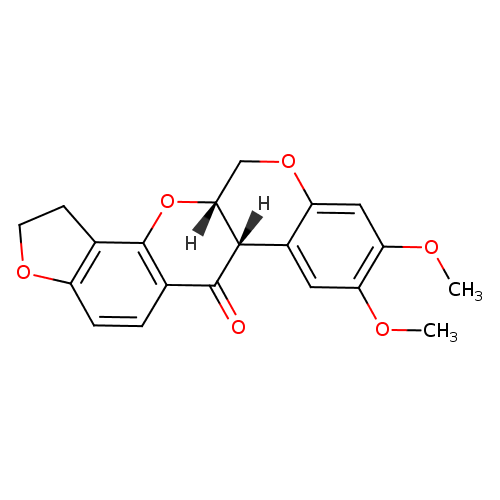
DescriptionRotenone is found in jicama. Rotenone is widely distributed in the Leguminosae (Papilionoideae) e.g. Pachyrrhizus erosus (yam bean).Rotenone is an odorless chemical that is used as a broad-spectrum insecticide, piscicide, and pesticide. It occurs naturally in the roots and stems of several plants such as the jicama vine plant. In mammals, including humans, it is linked to the development of Parkinson's disease. (Wikipedia) Rotenone has been shown to exhibit apoptotic, neuroprotectant and neuroprotective functions (1, 2, 2). Rotenone belongs to the family of Rotenoids. These are phenolic compounds containing aA cis-fused tetrahydrochromeno[3,4-b]chromenenucleus. Many rotenoids contain an additional ring, e.g rotenone[1]. (Reference: [1] IUPAC. Compendium of Chemical Terminology, 2nd ed. (the Gold Book). Compiled by A. D. McNaught and A. Wilkinson. Blackwell Scientific Publications, Oxford (1997). XML on-line corrected version: http://goldbook.iupac.org (2006-) created by M. Nic, J. Jirat, B. Kosata; updates compiled by A. Jenkins. ISBN 0-9678550-9-8. doi:10.1351/goldbook. (PAC, 1995, 67, 1307 (Glossary of class names of organic compounds and reactivity intermediates based on structure (IUPAC Recommendations 1995)) on page 1364)).
Contaminant Sources
  • FooDB Chemicals
  • HPV EPA Chemicals
  • My Exposome Chemicals
  • STOFF IDENT Compounds
  • T3DB toxins
  • ToxCast & Tox21 Chemicals
Contaminant Type
  • Aromatic Hydrocarbon
  • Ester
  • Ether
  • Food Toxin
  • Household Toxin
  • Human Neurotoxin
  • Lachrymator
  • Metabolite
  • Organic Compound
  • Pesticide
  • Synthetic Compound
Chemical Structure
Thumb
SynonymsNot Available
Chemical FormulaC20H18O6
Average Molecular Mass354.353 g/mol
Monoisotopic Mass354.110 g/mol
CAS Registry Number83-79-4
IUPAC Name(1S,6R,13S)-16,17-dimethoxy-6-(prop-1-en-2-yl)-2,7,20-trioxapentacyclo[11.8.0.0^{3,11}.0^{4,8}.0^{14,19}]henicosa-3,8,10,14(19),15,17-hexaen-12-one
Traditional Name(1S,13S)-16,17-dimethoxy-2,7,20-trioxapentacyclo[11.8.0.0³,¹¹.0⁴,⁸.0¹⁴,¹⁹]henicosa-3(11),4(8),9,14,16,18-hexaen-12-one
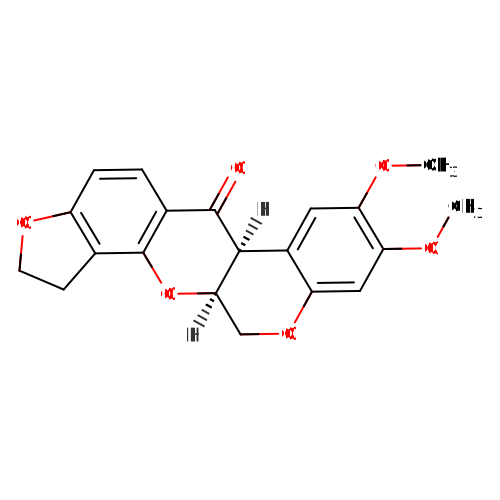
SMILES[H][C@@]12COC3=CC(OC)=C(OC)C=C3[C@]1([H])C(=O)C1=C(O2)C2=C(OCC2)C=C1
InChI IdentifierInChI=1S/C20H18O6/c1-22-15-7-12-14(8-16(15)23-2)25-9-17-18(12)19(21)11-3-4-13-10(5-6-24-13)20(11)26-17/h3-4,7-8,17-18H,5-6,9H2,1-2H3/t17-,18+/m1/s1
InChI KeyNZVPMEQJVQAGNB-MSOLQXFVSA-N
Chemical Taxonomy
Description belongs to the class of organic compounds known as rotenones. These are rotenoids with a structure based on a 6a,12a-dihydrochromeno[3,4-b]chromen-12(6H)-one skeleton.
KingdomOrganic compounds
Super ClassPhenylpropanoids and polyketides
ClassIsoflavonoids
Sub ClassRotenoids
Direct ParentRotenones
Alternative Parents
Substituents
  • Rotenone or derivatives
  • Isoflavanone
  • Isoflavan
  • Chromone
  • 1-benzopyran
  • Benzopyran
  • Chromane
  • Coumaran
  • Aryl alkyl ketone
  • Aryl ketone
  • Anisole
  • Alkyl aryl ether
  • Benzenoid
  • Ketone
  • Oxacycle
  • Organoheterocyclic compound
  • Ether
  • Organic oxygen compound
  • Organic oxide
  • Hydrocarbon derivative
  • Organooxygen compound
  • Aromatic heteropolycyclic compound
Molecular FrameworkAromatic heteropolycyclic compounds
External DescriptorsNot Available
Biological Properties
StatusDetected and Not Quantified
OriginExogenous
Cellular Locations
  • Membrane
Biofluid LocationsNot Available
Tissue LocationsNot Available
PathwaysNot Available
Applications
Biological Roles
Chemical Roles
Physical Properties
StateSolid
AppearanceWhite powder.
Experimental Properties
PropertyValue
Melting Point163°C
Boiling PointNot Available
Solubility0.0002 mg/mL at 20°C
Predicted Properties
PropertyValueSource
Water Solubility0.029 g/LALOGPS
logP2.86ALOGPS
logP2.29ChemAxon
logS-4.1ALOGPS
pKa (Strongest Acidic)11.83ChemAxon
pKa (Strongest Basic)-4.2ChemAxon
Physiological Charge0ChemAxon
Hydrogen Acceptor Count6ChemAxon
Hydrogen Donor Count0ChemAxon
Polar Surface Area63.22 ŲChemAxon
Rotatable Bond Count2ChemAxon
Refractivity92.6 m³·mol⁻¹ChemAxon
Polarizability36.65 ųChemAxon
Number of Rings5ChemAxon
Bioavailability1ChemAxon
Rule of FiveYesChemAxon
Ghose FilterYesChemAxon
Veber's RuleNoChemAxon
MDDR-like RuleNoChemAxon
Spectra
Spectra
Spectrum TypeDescriptionSplash KeyView
Predicted LC-MS/MSPredicted LC-MS/MS Spectrum - 10V, Positivesplash10-0a4i-0229000000-e277e2f496a284eb64beSpectrum
Predicted LC-MS/MSPredicted LC-MS/MS Spectrum - 20V, Positivesplash10-002r-0429000000-b466fb7507142120ac63Spectrum
Predicted LC-MS/MSPredicted LC-MS/MS Spectrum - 40V, Positivesplash10-029l-3910000000-3c9fe1bdf8c6525aafdbSpectrum
Predicted LC-MS/MSPredicted LC-MS/MS Spectrum - 10V, Negativesplash10-0udi-0009000000-dc7694b924a53389d89aSpectrum
Predicted LC-MS/MSPredicted LC-MS/MS Spectrum - 20V, Negativesplash10-0udr-0129000000-825a572b1f9f9805cbbeSpectrum
Predicted LC-MS/MSPredicted LC-MS/MS Spectrum - 40V, Negativesplash10-0670-2954000000-271a430514ff45344d1bSpectrum
Toxicity Profile
Route of ExposureNot Available
Mechanism of ToxicityRotenone works by interfering with the electron transport chain in mitochondria. Specifically, it inhibits the transfer of electrons from iron-sulfur centers in complex I to ubiquinone. This prevents NADH from being converted into usable cellular energy (ATP). (3)
MetabolismNot Available
Toxicity ValuesNot Available
Lethal DoseNot Available
Carcinogenicity (IARC Classification)No indication of carcinogenicity to humans (not listed by IARC).
Uses/SourcesRotenone is used in solution as a pesticide and insecticide. It is commonly used in powdered or emulsified liquid form in fisheries management to remove unwanted fish species, such as the eradication of exotic fish from non-native habitats. People catch fish by extracting rotenone from plants and releasing it into water. Poisoned fish come to the surface and are easily caught. This method was first practiced by various indigenous tribes who smashed the roots. Fish caught this way can be eaten because rotenone is very poorly absorbed by the gastrointestinal tract of humans, whereas it is lethal to fish because it readily enters the blood stream of the fish through the gills. Small-scale sampling with rotenone is used by fish researchers studying the biodiversity of marine fishes to collect cryptic, or hidden, fishes, which represent an important component of shoreline fish communities. Rotenone is the most effective tool available because only small quantities are necessary. It has only minor and transient environmental side-effects. Rotenone is also used in powdered form to reduce parasitic mites on chickens and other fowl. In the United States and in Canada, all uses of Rotenone except as a piscicide are being phased out. (3)
Minimum Risk LevelNot Available
Health EffectsStudies with primary cultures of rat neurons and microglia have shown low doses of rotenone (below 10 nM) to induce oxidative damage and death of dopaminergic neurons and it is these neurons in the substantia nigra that die in Parkinson's disease. Injecting rotenone into rats causes symptoms of Parkinson's disease to develop. The study does not directly suggest that rotenone exposure is responsible for Parkinson's disease in humans. (3) Rotenone dust is highly irritating to the eyes (causing conjunctivitis), skin (causing contact dermatitis), upper respiratory tract (causing rhinitis), and throat (linked with pharyngitis) (4)
SymptomsAcute poisoning in animals is characterized by an initial respiratory stimulation followed by respiratory depression, ataxia, convulsions, and death from respiratory arrest. (4)
TreatmentSince rotenone is unstable in light and heat, its toxicity can be lost after 2 or 3 days. (4)

Concentrations
Not Available
DrugBank IDNot Available
HMDB IDNot Available
FooDB IDNot Available
Phenol Explorer IDNot Available
KNApSAcK IDNot Available
BiGG IDNot Available
BioCyc IDNot Available
METLIN IDNot Available
PDB IDNot Available
Wikipedia LinkRotenone
Chemspider IDNot Available
ChEBI IDNot Available
PubChem Compound ID21596348
Kegg Compound IDNot Available
YMDB IDNot Available
ECMDB IDNot Available
References
Synthesis ReferenceNot Available
MSDSNot Available
General ReferencesNot Available