Record Information
Version1.0
Creation Date2009-05-25 21:11:21 UTC
Update Date2026-05-14 17:45:34 UTC
Accession NumberCHEM000701
Identification
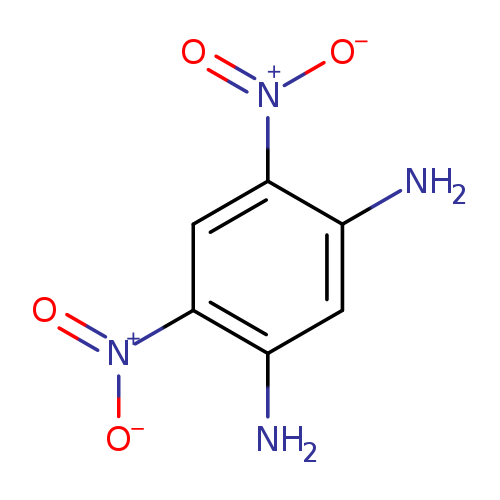
Common Name1,3-Dinitrobenzene
ClassSmall Molecule
Description1,3-Dinitrobenzene (1,3-DNB) is a synthetic substance that is used in explosives. Nitrite is a toxic compound known to cause methemoglobinemia. (6, 5)
Contaminant Sources
  • Clean Air Act Chemicals
  • HPV EPA Chemicals
  • Suspected Compounds
  • T3DB toxins
  • ToxCast & Tox21 Chemicals
Contaminant Type
  • Amine
  • Aromatic Hydrocarbon
  • Explosive Agent
  • Human Neurotoxin
  • Industrial/Workplace Toxin
  • Nitrate
  • Organic Compound
  • Synthetic Compound
Chemical Structure
Thumb
SynonymsNot Available
Chemical FormulaC6H6N4O4
Average Molecular Mass198.136 g/mol
Monoisotopic Mass198.039 g/mol
CAS Registry Number99-65-0
IUPAC Name1,3-dinitrobenzene
Traditional Name4,6-dinitrobenzene-1,3-diamine
SMILESNC1=CC(N)=C(C=C1[N+]([O-])=O)[N+]([O-])=O
InChI IdentifierInChI=1S/C6H6N4O4/c7-3-1-4(8)6(10(13)14)2-5(3)9(11)12/h1-2H,7-8H2
InChI KeyDFBUFGZWPXQRJV-UHFFFAOYSA-N
Chemical Taxonomy
Description belongs to the class of organic compounds known as dinitroanilines. These are organic compounds containing an aniline moiety, which is substituted at 2 positions by a nitro group.
KingdomOrganic compounds
Super ClassBenzenoids
ClassBenzene and substituted derivatives
Sub ClassAniline and substituted anilines
Direct ParentDinitroanilines
Alternative Parents
Substituents
  • Dinitroaniline
  • Nitrobenzene
  • Nitroaromatic compound
  • C-nitro compound
  • Organic nitro compound
  • Organic oxoazanium
  • Allyl-type 1,3-dipolar organic compound
  • Propargyl-type 1,3-dipolar organic compound
  • Organic 1,3-dipolar compound
  • Organic nitrogen compound
  • Organic zwitterion
  • Primary amine
  • Organonitrogen compound
  • Amine
  • Organic oxygen compound
  • Organopnictogen compound
  • Organic oxide
  • Hydrocarbon derivative
  • Aromatic homomonocyclic compound
Molecular FrameworkAromatic homomonocyclic compounds
External DescriptorsNot Available
Biological Properties
StatusDetected and Not Quantified
OriginExogenous
Cellular Locations
  • Cytoplasm
  • Extracellular
Biofluid LocationsNot Available
Tissue LocationsNot Available
PathwaysNot Available
ApplicationsNot Available
Biological Roles
Chemical RolesNot Available
Physical Properties
StateSolid
AppearanceYellow solid.
Experimental Properties
PropertyValue
Melting Point90°C
Boiling PointNot Available
Solubility0.533 mg/mL at 25°C [SPANGGORD,RJ et al. (1980)]
Predicted Properties
PropertyValueSource
Water Solubility0.18 g/LALOGPS
logP1.18ALOGPS
logP1.5ChemAxon
logS-3ALOGPS
pKa (Strongest Acidic)13.86ChemAxon
pKa (Strongest Basic)-2.9ChemAxon
Physiological Charge0ChemAxon
Hydrogen Acceptor Count6ChemAxon
Hydrogen Donor Count2ChemAxon
Polar Surface Area143.68 ŲChemAxon
Rotatable Bond Count2ChemAxon
Refractivity50.11 m³·mol⁻¹ChemAxon
Polarizability16.31 ųChemAxon
Number of Rings1ChemAxon
Bioavailability1ChemAxon
Rule of FiveYesChemAxon
Ghose FilterYesChemAxon
Veber's RuleNoChemAxon
MDDR-like RuleNoChemAxon
Spectra
Spectra
Spectrum TypeDescriptionSplash KeyView
Predicted LC-MS/MSPredicted LC-MS/MS Spectrum - 10V, Positivesplash10-0002-0900000000-d0da97c87af62b76ad50Spectrum
Predicted LC-MS/MSPredicted LC-MS/MS Spectrum - 20V, Positivesplash10-006y-0900000000-7cd28fa04d83f5ef3930Spectrum
Predicted LC-MS/MSPredicted LC-MS/MS Spectrum - 40V, Positivesplash10-00ry-0900000000-e04318ea9f6067a3305eSpectrum
Predicted LC-MS/MSPredicted LC-MS/MS Spectrum - 10V, Negativesplash10-0002-0900000000-47416b6028f6eee611f1Spectrum
Predicted LC-MS/MSPredicted LC-MS/MS Spectrum - 20V, Negativesplash10-0002-0900000000-58a12a85abaa30bee99cSpectrum
Predicted LC-MS/MSPredicted LC-MS/MS Spectrum - 40V, Negativesplash10-000e-1900000000-9432f54780cfbfa8ffbfSpectrum
Toxicity Profile
Route of ExposureOral (5) ; inhalation (5) ; dermal (5)
Mechanism of ToxicityIn the red blood cell, 1,3-DNB induces formation of methemoglobin, leading to cyanosis. Reduction of the nitrogroup(s) of 1,3-DNB produces reactive nitroaromatic radical anions which redox cycle to produce other reactive, toxic species such as superoxide anion. Redox cycling of these intermediates probably causes the methemoglobinemia. In the male reproductive system, 1,3-DNB causes disruption of spermatogenesis resulting in hypospermia, poor sperm quality, and infertility. Reduction of 1,3-DNB to reactive species such as nitrosonitrobenzene is believed to damage Sertoli cells. (5)
Metabolism1,3-Dinitrobenzene is absorbed via oral, inhalation, and dermal routes and is believed to be able to penetrate the red blood cell membrane. The metabolism of 1,3-DNB includes both oxidative and reductive biotransformations, followed by conjugation. The main metabolites are 3-aminoacetanilide, 4-acetamidophenylsulfate, 1,3-diacetamidobenzene, and 3-nitroaniline-N-glucuronide. The main route of excretion of 1,3-DNB metabolites is the urine. (5)
Toxicity ValuesLD50: 59 mg/kg (Oral, Rat) (5) LD50: 1990 mg/kg (Dermal, Rabbit) (5) LD50: 10 mg/kg (Intravenous, Dog) (8) LD50: 28 mg/kg (Intraperitoneal, Rat) (8)
Lethal DoseNot Available
Carcinogenicity (IARC Classification)No indication of carcinogenicity (not listed by IARC). (3)
Uses/Sources1,3-Dinitrobenzene is used in explosives. Waste discharges from army ammunitions plants or other chemical manufacturers are the primary sources for release into the air, water, and soil. (5)
Minimum Risk LevelAcute Oral: 0.008 mg/kg/day (2) Intermediate Oral: 0.0005 mg/kg/day (2)
Health EffectsChronic exposure to 1,3-dinitrobenzene can cause a reduction (or loss) in the number of red blood cells (anemia). It may also cause behavioral changes and male reproductive system damage. (5)
SymptomsExposure to high concentrations of 1,3-dinitrobenzene can reduce the ability of blood to carry oxygen and can cause your skin to become bluish in color. Other symptoms of 1,3-dinitrobenzene exposure include headache, nausea, and dizziness.(5)
TreatmentTreatment is mainly symptomatic and may include gastric lavage and/or the administration of activated charcoal. Benzodiazepine may be administered if seizures occur. If methemoglobinemia is evident, 1 to 2 mg/kg of 1% methylene blue should be administered via IV. (9)

Concentrations
Not Available
DrugBank IDNot Available
HMDB IDNot Available
FooDB IDNot Available
Phenol Explorer IDNot Available
KNApSAcK IDNot Available
BiGG IDNot Available
BioCyc IDNot Available
METLIN IDNot Available
PDB IDNot Available
Wikipedia Link1,3-Dinitrobenzene
Chemspider IDNot Available
ChEBI IDNot Available
PubChem Compound ID291796
Kegg Compound IDNot Available
YMDB IDNot Available
ECMDB IDNot Available
References
Synthesis ReferenceNot Available
MSDSNot Available
General ReferencesNot Available