Record Information
Version1.0
Creation Date2009-03-27 01:31:59 UTC
Update Date2026-04-05 16:44:29 UTC
Accession NumberCHEM000667
Identification
Common NameZinc pyrithione
ClassSmall Molecule
DescriptionZinc pyrithione is a chemical compound of zinc. It is used as an antifungal and antibacterial agent. Zinc is a metallic element with the atomic number 30. It is found in nature most often as the mineral sphalerite. Though excess zinc in harmful, in smaller amounts it is an essential element for life, as it is a cofactor for over 300 enzymes and is found in just as many transcription factors. (2, 3, 4)
Contaminant Sources
  • HPV EPA Chemicals
  • STOFF IDENT Compounds
  • T3DB toxins
  • ToxCast & Tox21 Chemicals
Contaminant Type
  • Aromatic Hydrocarbon
  • Household Toxin
  • Industrial/Workplace Toxin
  • Organic Compound
  • Organometallic
  • Synthetic Compound
  • Zinc Compound
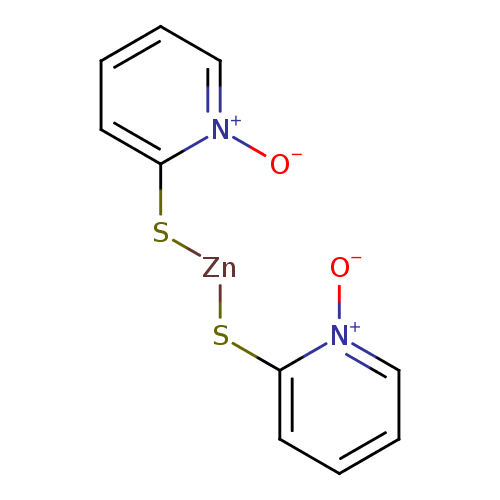
Chemical Structure
Thumb
Synonyms
ValueSource
(T-4)-Bis(1-hydroxy-2(1H)-pyridinethionato-O,S)zincChEBI
Bis(1-hydroxy-2(1H)-pyridinethionato)zincChEBI
Bis(2-pyridinethiol-1-oxide)zincChEBI
Bis(2-pyridylthio)zinc 1,1'-dioxideChEBI
Pyrithion-zinkChEBI
Pyrithione zincChEBI
Zinc pyridinethioneChEBI
Chemical FormulaC10H8N2O2S2Zn
Average Molecular Mass317.722 g/mol
Monoisotopic Mass315.932 g/mol
CAS Registry Number13463-41-7
IUPAC Namebis[(1-oxidopyridin-1-ium-2-yl)sulfanyl]zinc
Traditional Namebis[(1-oxidopyridin-1-ium-2-yl)sulfanyl]zinc
SMILES[O-][N+]1=CC=CC=C1S[Zn]SC1=CC=CC=[N+]1[O-]
InChI IdentifierInChI=1S/2C5H5NOS.Zn/c2*7-6-4-2-1-3-5(6)8;/h2*1-4,8H;/q;;+2/p-2
InChI KeyOTPSWLRZXRHDNX-UHFFFAOYSA-L
Chemical Taxonomy
Description belongs to the class of organic compounds known as pyridinium derivatives. Pyridinium derivatives are compounds containing a pyridinium ring, which is the cationic form of pyridine.
KingdomOrganic compounds
Super ClassOrganoheterocyclic compounds
ClassPyridines and derivatives
Sub ClassPyridinium derivatives
Direct ParentPyridinium derivatives
Alternative Parents
Substituents
  • Pyridinium
  • Heteroaromatic compound
  • Azacycle
  • Organic metal salt
  • Organic transition metal salt
  • Sulfenyl compound
  • Organic nitrogen compound
  • Organic oxygen compound
  • Organopnictogen compound
  • Organic oxide
  • Hydrocarbon derivative
  • Organic salt
  • Organosulfur compound
  • Organonitrogen compound
  • Aromatic heteromonocyclic compound
Molecular FrameworkAromatic heteromonocyclic compounds
External Descriptors
Biological Properties
StatusDetected and Not Quantified
OriginExogenous
Cellular Locations
  • Cytoplasm
  • Extracellular
Biofluid LocationsNot Available
Tissue LocationsNot Available
PathwaysNot Available
ApplicationsNot Available
Biological RolesNot Available
Chemical RolesNot Available
Physical Properties
StateSolid
AppearanceColorless soild.
Experimental Properties
PropertyValue
Melting PointNot Available
Boiling PointNot Available
SolubilityNot Available
Predicted Properties
PropertyValueSource
Water Solubility0.068 g/LALOGPS
logP0.6ALOGPS
logP-0.73ChemAxon
logS-3.7ALOGPS
pKa (Strongest Basic)0.5ChemAxon
Physiological Charge0ChemAxon
Hydrogen Acceptor Count2ChemAxon
Hydrogen Donor Count0ChemAxon
Polar Surface Area50.92 ŲChemAxon
Rotatable Bond Count4ChemAxon
Refractivity63.97 m³·mol⁻¹ChemAxon
Polarizability25.82 ųChemAxon
Number of Rings2ChemAxon
Bioavailability1ChemAxon
Rule of FiveYesChemAxon
Ghose FilterNoChemAxon
Veber's RuleNoChemAxon
MDDR-like RuleNoChemAxon
Spectra
Spectra
Spectrum TypeDescriptionSplash KeyView
Predicted LC-MS/MSPredicted LC-MS/MS Spectrum - 10V, Positivesplash10-00kr-0097000000-02bf33f2bf4a9e5381d4Spectrum
Predicted LC-MS/MSPredicted LC-MS/MS Spectrum - 20V, Positivesplash10-014i-1059000000-320a10a81cae2a1305e1Spectrum
Predicted LC-MS/MSPredicted LC-MS/MS Spectrum - 40V, Positivesplash10-0udi-4190000000-7285758091d99f2d238bSpectrum
Predicted LC-MS/MSPredicted LC-MS/MS Spectrum - 10V, Negativesplash10-03di-0009000000-b67fb3bbc7b620d80415Spectrum
Predicted LC-MS/MSPredicted LC-MS/MS Spectrum - 20V, Negativesplash10-03di-0029000000-539f5a41cc3b8d4cf365Spectrum
Predicted LC-MS/MSPredicted LC-MS/MS Spectrum - 40V, Negativesplash10-03di-1029000000-4e91c0f61080adfb87ffSpectrum
Toxicity Profile
Route of ExposureInhalation (3) ; oral (3) ; dermal (3)
Mechanism of ToxicityAnaemia results from the excessive absorption of zinc suppressing copper and iron absorption, most likely through competitive binding of intestinal mucosal cells. Unbalanced levels of copper and zinc binding to Cu,Zn-superoxide dismutase has been linked to amyotrophic lateral sclerosis (ALS). Stomach acid dissolves metallic zinc to give corrosive zinc chloride, which can cause damage to the stomach lining. Metal fume fever is thought to be an immune response to inhaled zinc. (2, 3, 1)
MetabolismZinc can enter the body through the lungs, skin, and gastrointestinal tract. Intestinal absorption of zinc is controlled by zinc carrier protein CRIP. Zinc also binds to metallothioneins, which help prevent absorption of excess zinc. Zinc is widely distributed and found in all tissues and tissues fluids, concentrating in the liver, gastrointestinal tract, kidney, skin, lung, brain, heart, and pancreas. In the bloodstream zinc is found bound to carbonic anhydrase in erythrocytes, as well as bound to albumin, _2-macroglobulin, and amino acids in the the plasma. Albumin and amino acid bound zinc can diffuse across tissue membranes. Zinc is excreted in the urine and faeces. (3)
Toxicity ValuesLD50: 177 mg/kg (Oral, Rat) (7) LD50: 100 mg/kg (Dermal, Rabbit) (7) LC50: 140 mg/m3 over 4 hours (Inhalation, Rat) (7)
Lethal DoseNot Available
Carcinogenicity (IARC Classification)No indication of carcinogenicity to humans (not listed by IARC).
Uses/SourcesZinc pyrithione is used as an antifungal and antibacterial agent. (4)
Minimum Risk LevelIntermediate Oral: 0.3 mg/kg/day (6) Chronic Oral: 0.3 mg/kg/day (6)
Health EffectsChronic exposure to zinc causes anemia, atazia, lethargy, and decreases the level of good cholesterol in the body. It is also believed to cause pancreatic and reproductive damage. (3)
SymptomsIngestion of large doses of zinc causes stomach cramps, nausea, and vomiting. Acute inhalation of large amounts of zinc causes metal fume fever, which is characterized by chills, fever, headache, weakness, dryness of the nose and throat, chest pain, and coughing. Dermal contact with zinc results in skin irritation. (3)
TreatmentZinc poisoning is treated symptomatically, often by administering fluids such as water or milk, or with gastric lavage. (3)

Concentrations
Not Available
DrugBank IDDB06815
HMDB IDNot Available
FooDB IDNot Available
Phenol Explorer IDNot Available
KNApSAcK IDNot Available
BiGG IDNot Available
BioCyc IDNot Available
METLIN IDNot Available
PDB IDNot Available
Wikipedia LinkPyrithione_Zinc
Chemspider IDNot Available
ChEBI ID32076
PubChem Compound ID26041
Kegg Compound IDNot Available
YMDB IDNot Available
ECMDB IDNot Available
References
Synthesis ReferenceNot Available
MSDSNot Available
General ReferencesNot Available