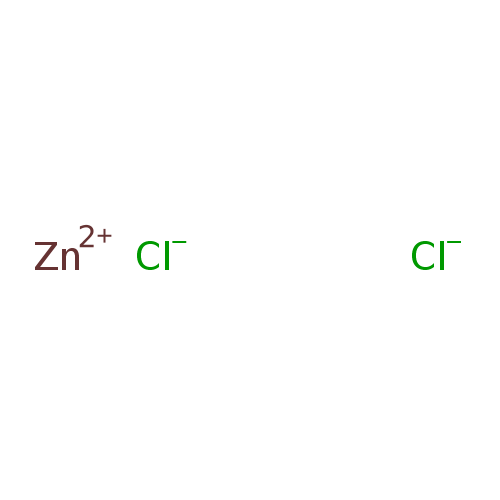
Zinc chloride is a nutrient supplement A number of salts containing the tetrachlorozincate anion, ZnCl2 4, are known. Caulton's reagent, V2Cl3(thf)6Zn2Cl6 is an example of a salt containing Zn2Cl2 6. The compound Cs3ZnCl5 contains tetrahedral ZnCl2 4 and Cl anions. No compounds containing the ZnCl4 6 ion have been characterized. Four crystalline forms, (polymorphs) , of ZnCl2 are known, and in each case the Zn2+ ions are trigonal planar coordinated to four chloride ions. The pure anhydrous orthorhombic form rapidly changes to one of the other forms on exposure to the atmosphere and a possible explanation is that the presence of OH facilitates the rearrangement. Rapid cooling of molten ZnCl2 gives a glass, that is, a rigid amorphous solid and this ability has been related to the structure in the melt. Zinc chloride belongs to the family of Transition Metal Chlorides. These are inorganic compounds in which the largest halogen atom is Chlorine, and the heaviest metal atom is a transition metal.
belongs to the class of inorganic compounds known as transition metal chlorides. These are inorganic compounds in which the largest halogen atom is Chlorine, and the heaviest metal atom is a transition metal.
Anaemia results from the excessive absorption of zinc suppressing copper and iron absorption, most likely through competitive binding of intestinal mucosal cells. Unbalanced levels of copper and zinc binding to Cu,Zn-superoxide dismutase has been linked to amyotrophic lateral sclerosis (ALS). Stomach acid dissolves metallic zinc to give corrosive zinc chloride, which can cause damage to the stomach lining. Metal fume fever is thought to be an immune response to inhaled zinc. (2, 3, 1)
Metabolism
Zinc can enter the body through the lungs, skin, and gastrointestinal tract. Intestinal absorption of zinc is controlled by zinc carrier protein CRIP. Zinc also binds to metallothioneins, which help prevent absorption of excess zinc. Zinc is widely distributed and found in all tissues and tissues fluids, concentrating in the liver, gastrointestinal tract, kidney, skin, lung, brain, heart, and pancreas. In the bloodstream zinc is found bound to carbonic anhydrase in erythrocytes, as well as bound to albumin, _2-macroglobulin, and amino acids in the the plasma. Albumin and amino acid bound zinc can diffuse across tissue membranes. Zinc is excreted in the urine and faeces. (3)
Chronic exposure to zinc causes anemia, atazia, lethargy, and decreases the level of good cholesterol in the body. It is also believed to cause pancreatic and reproductive damage. (3)
Symptoms
Ingestion of large doses of zinc causes stomach cramps, nausea, and vomiting. Acute inhalation of large amounts of zinc causes metal fume fever, which is characterized by chills, fever, headache, weakness, dryness of the nose and throat, chest pain, and coughing. Dermal contact with zinc results in skin irritation. (3)
Treatment
Zinc poisoning is treated symptomatically, often by administering fluids such as water or milk, or with gastric lavage. (3)