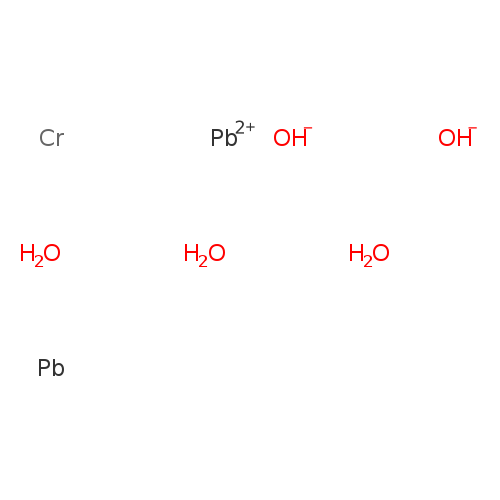
Lead chromate oxide, chrome orange, also known as chrome red, is an orange pigment which consists of lead(II) chromate and lead(II) oxide. (PbCrO4 and PbO). Chrome orange can be made by precipitating lead(II) together with chromate in a basic solution or by treating chrome yellow with lye. It is toxic both from the contained lead and from the contained hexavalent chromium.
-lead(2+) ion chromium trihydric acid plumbane dihydroxide
Generator
Λ²-lead(2+) ion chromium trihydric acid plumbane dihydroxide
Generator
Chemical Formula
CrH8O5Pb2
Average Molecular Mass
554.500 g/mol
Monoisotopic Mass
555.931 g/mol
CAS Registry Number
18454-12-1
IUPAC Name
λ²-lead(2+) ion chromium trihydrate plumbane dihydroxide
Traditional Name
λ²-lead(2+) ion chromium trihydrate plumbane dihydroxide
SMILES
O.O.O.[OH-].[OH-].[Cr].[Pb].[Pb++]
InChI Identifier
InChI=1S/Cr.5H2O.2Pb/h;5*1H2;;/q;;;;;;;+2/p-2
InChI Key
SYTWDFGCDDRXAA-UHFFFAOYSA-L
Chemical Taxonomy
Description
belongs to the class of inorganic compounds known as transition metal hydroxides. These are inorganic compounds in which the largest oxoanion is hydroxide, and in which the heaviest atom not in an oxoanion is a transition metal.
Lead mimics other biologically important metals, such as zinc, calcium, and iron, competing as cofactors for many of their respective enzymatic reactions. For example, lead has been shown to competitively inhibit calcium's binding of calmodulin, interferring with neurotransmitter release. It exhibits similar competitive inhibition at the NMDA receptor and protein kinase C, which impairs brain microvascular formation and function, as well as alters the blood-brain barrier. Lead also affects the nervous system by impairing regulation of dopamine synthesis and blocking evoked release of acetylcholine. However, it's main mechanism of action occurs by inhibiting delta-aminolevulinic acid dehydratase, an enzyme vital in the biosynthesis of heme, which is a necesssary cofactor of hemoglobin. Hexavalent chromium's carcinogenic effects are caused by its metabolites, pentavalent and trivalent chromium. The DNA damage may be caused by hydroxyl radicals produced during reoxidation of pentavalent chromium by hydrogen peroxide molecules present in the cell. Trivalent chromium may also form complexes with peptides, proteins, and DNA, resulting in DNA-protein crosslinks, DNA strand breaks, DNA-DNA interstrand crosslinks, chromium-DNA adducts, chromosomal aberrations and alterations in cellular signaling pathways. It has been shown to induce carcinogenesis by overstimulating cellular regulatory pathways and increasing peroxide levels by activating certain mitogen-activated protein kinases. It can also cause transcriptional repression by cross-linking histone deacetylase 1-DNA methyltransferase 1 complexes to CYP1A1 promoter chromatin, inhibiting histone modification. Chromium may increase its own toxicity by modifying metal regulatory transcription factor 1, causing the inhibition of zinc-induced metallothionein transcription. (2, 9, 5, 6, 7, 14, 3, 4, 13)
Metabolism
Lead is absorbed following inhalation, oral, and dermal exposure. It is then distributed mainly to the bones and red blood cells. In the blood lead may be found bound to serum albumin or the metal-binding protein metallothionein. Organic lead is metabolized by cytochrome P-450 enzymes, whereas inorganic lead forms complexes with delta-aminolevulinic acid dehydratase. Lead is excreted mainly in the urine and faeces. Chromium is absorbed from oral, inhalation, or dermal exposure and distributes to nearly all tissues, with the highest concentrations found in kidney and liver. Bone is also a major storage site and may contribute to long-term retention. Hexavalent chromium's similarity to sulfate and chromate allow it to be transported into cells via sulfate transport mechanisms. Inside the cell, hexavalent chromium is reduced first to pentavalent chromium, then to trivalent chromium by many substances including ascorbate, glutathione, and nicotinamide adenine dinucleotide. Chromium is almost entirely excreted with the urine. (2, 9, 13)
Toxicity Values
Not Available
Lethal Dose
1 to 3 grams for an adult human (hexavalent chromium). (8)
Lead is a neurotoxin and has been known to cause brain damage and reduced cognitive capacity, especially in children. Lead exposure can result in nephropathy, as well as blood disorders such as high blood pressure and anemia. Lead also exhibits reproductive toxicity and can results in miscarriages and reduced sperm production. Hexavalent chromium is a known carcinogen. Chronic inhalation especially has been linked to lung cancer. Hexavalent chromium has also been know to cause reproductive and developmental defects. (2, 10)
Symptoms
Symptions of chronic lead poisoning include reduced cognitive abilities, nausea, abdominal pain, irritability, insomnia, metal taste in the mouth, excess lethargy or hyperactivity, chest pain, headache and, in extreme cases, seizures, comas, and death. There are also associated gastrointestinal problems, such as constipation, diarrhea, vomiting, poor appetite, weight loss, which are common in acute poisoning. Breathing hexavalent chromium can cause irritation to the lining of the nose, nose ulcers, runny nose, and breathing problems, such as asthma, cough, shortness of breath, or wheezing. Ingestion of hexavalent chromium causes irritation and ulcers in the stomach and small intestine, as well as anemia. Skin contact can cause skin ulcers. (9, 1, 10)
Treatment
Lead poisoning is usually treated with chelation therapy using DMSA, EDTA, or dimercaprol. There is no know antidote for chromium poisoning. Exposure is usually handled with symptomatic treatment. (9, 10)