Record Information
Version1.0
Creation Date2009-03-26 21:21:31 UTC
Update Date2026-04-05 20:36:05 UTC
Accession NumberCHEM000638
Identification
Common NameSodium dichromate
ClassSmall Molecule
DescriptionSodium dichromate is a chemical compound of sodium and hexavalent chromium. It is produced during the processing of chromium ore and may be used in organic synthesis. Hexavalent chromium refers to chemical compounds that contain the element chromium in the +6 oxidation state. Chromium(VI) is more toxic than other oxidation states of the chromium atom because of its greater ability to enter cells and higher redox potential. (6, 9)
Contaminant Sources
  • Clean Air Act Chemicals
  • DEA Chemicals
  • ECHA Toxic for reproduction
  • HPV EPA Chemicals
  • IARC Carcinogens Group 1
  • OECD HPV Chemicals
  • T3DB toxins
Contaminant Type
  • Chromium Compound
  • Industrial/Workplace Toxin
  • Inorganic Compound
  • Pollutant
  • Synthetic Compound
Chemical Structure
Thumb
Synonyms
ValueSource
Dichromium heptahydric acid disodiumGenerator
Chemical FormulaCr2H14Na2O7
Average Molecular Mass276.077 g/mol
Monoisotopic Mass275.935 g/mol
CAS Registry Number10588-01-9
IUPAC Namedichromium heptahydrate disodium
Traditional Namedichromium heptahydrate disodium
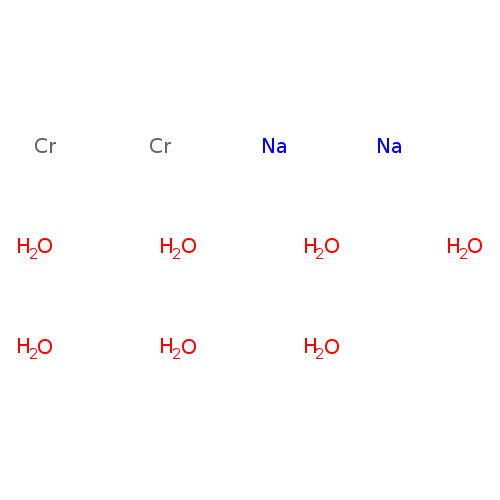
SMILESO.O.O.O.O.O.O.[Na].[Na].[Cr].[Cr]
InChI IdentifierInChI=1S/2Cr.2Na.7H2O/h;;;;7*1H2
InChI KeyDOQKPLCDSRESLL-UHFFFAOYSA-N
Chemical Taxonomy
Description belongs to the class of inorganic compounds known as transition metal oxides. These are inorganic compounds containing an oxygen atom of an oxidation state of -2, in which the heaviest atom bonded to the oxygen is a transition metal.
KingdomInorganic compounds
Super ClassMixed metal/non-metal compounds
ClassTransition metal organides
Sub ClassTransition metal oxides
Direct ParentTransition metal oxides
Alternative Parents
Substituents
  • Transition metal oxide
  • Inorganic oxide
  • Inorganic salt
Molecular FrameworkNot Available
External DescriptorsNot Available
Biological Properties
StatusDetected and Not Quantified
OriginExogenous
Cellular Locations
  • Cytoplasm
  • Extracellular
Biofluid LocationsNot Available
Tissue LocationsNot Available
PathwaysNot Available
ApplicationsNot Available
Biological RolesNot Available
Chemical RolesNot Available
Physical Properties
StateSolid
AppearanceOrange crystals.
Experimental Properties
PropertyValue
Melting PointNot Available
Boiling PointNot Available
SolubilityNot Available
Predicted Properties
PropertyValueSource
Water Solubility156 g/LALOGPS
logP-1.3ALOGPS
logP-0.16ChemAxon
logS0.18ALOGPS
Physiological Charge0ChemAxon
Hydrogen Acceptor Count0ChemAxon
Hydrogen Donor Count0ChemAxon
Polar Surface Area0 ŲChemAxon
Rotatable Bond Count0ChemAxon
Refractivity0 m³·mol⁻¹ChemAxon
Polarizability1.78 ųChemAxon
Number of Rings0ChemAxon
Bioavailability1ChemAxon
Rule of FiveYesChemAxon
Ghose FilterNoChemAxon
Veber's RuleYesChemAxon
MDDR-like RuleNoChemAxon
Spectra
Spectra
Spectrum TypeDescriptionSplash KeyView
Predicted LC-MS/MSPredicted LC-MS/MS Spectrum - 10V, Positivesplash10-004i-0090000000-98c1ba4ad0045b333831Spectrum
Predicted LC-MS/MSPredicted LC-MS/MS Spectrum - 20V, Positivesplash10-004i-0090000000-98c1ba4ad0045b333831Spectrum
Predicted LC-MS/MSPredicted LC-MS/MS Spectrum - 40V, Positivesplash10-004i-0090000000-98c1ba4ad0045b333831Spectrum
Predicted LC-MS/MSPredicted LC-MS/MS Spectrum - 10V, Negativesplash10-004i-0090000000-24408478f8afbd1a3fdcSpectrum
Predicted LC-MS/MSPredicted LC-MS/MS Spectrum - 20V, Negativesplash10-004i-0090000000-24408478f8afbd1a3fdcSpectrum
Predicted LC-MS/MSPredicted LC-MS/MS Spectrum - 40V, Negativesplash10-004i-0090000000-24408478f8afbd1a3fdcSpectrum
Toxicity Profile
Route of ExposureInhalation (6) ; oral (6) ; dermal (6)
Mechanism of ToxicityHexavalent chromium's carcinogenic effects are caused by its metabolites, pentavalent and trivalent chromium. The DNA damage may be caused by hydroxyl radicals produced during reoxidation of pentavalent chromium by hydrogen peroxide molecules present in the cell. Trivalent chromium may also form complexes with peptides, proteins, and DNA, resulting in DNA-protein crosslinks, DNA strand breaks, DNA-DNA interstrand crosslinks, chromium-DNA adducts, chromosomal aberrations and alterations in cellular signaling pathways. It has been shown to induce carcinogenesis by overstimulating cellular regulatory pathways and increasing peroxide levels by activating certain mitogen-activated protein kinases. It can also cause transcriptional repression by cross-linking histone deacetylase 1-DNA methyltransferase 1 complexes to CYP1A1 promoter chromatin, inhibiting histone modification. Chromium may increase its own toxicity by modifying metal regulatory transcription factor 1, causing the inhibition of zinc-induced metallothionein transcription. (1, 6, 2, 3, 4)
MetabolismChromium is absorbed from oral, inhalation, or dermal exposure and distributes to nearly all tissues, with the highest concentrations found in kidney and liver. Bone is also a major storage site and may contribute to long-term retention. Hexavalent chromium's similarity to sulfate and chromate allow it to be transported into cells via sulfate transport mechanisms. Inside the cell, hexavalent chromium is reduced first to pentavalent chromium, then to trivalent chromium by many substances including ascorbate, glutathione, and nicotinamide adenine dinucleotide. Chromium is almost entirely excreted with the urine. (1, 6)
Toxicity ValuesLD50: 51.10 mg/kg (Oral, Rat) (6) LD50: 1000 mg/kg (Dermal, Rabbit) (6) LC50: 124.42 mg/m3 over 4 hours (Inhalation, Rat) (6)
Lethal Dose1 to 3 grams for an adult human (hexavalent chromium). (5)
Carcinogenicity (IARC Classification)1, carcinogenic to humans. (8)
Uses/SourcesSodium dichromate is produced during the processing of chromium ore and may be used in organic synthesis. (9)
Minimum Risk LevelIntermediate Oral: 0.005 mg/kg/day (7) Chronic Oral: 0.001 mg/kg/day (7)
Health EffectsHexavalent chromium is a known carcinogen. Chronic inhalation especially has been linked to lung cancer. Hexavalent chromium has also been know to cause reproductive and developmental defects. (1)
SymptomsBreathing hexavalent chromium can cause irritation to the lining of the nose, nose ulcers, runny nose, and breathing problems, such as asthma, cough, shortness of breath, or wheezing. Ingestion of hexavalent chromium causes irritation and ulcers in the stomach and small intestine, as well as anemia. Skin contact can cause skin ulcers. (6)
TreatmentThere is no know antidote for chromium poisoning. Exposure is usually handled with symptomatic treatment. (6)

Concentrations
Not Available
DrugBank IDNot Available
HMDB IDNot Available
FooDB IDNot Available
Phenol Explorer IDNot Available
KNApSAcK IDNot Available
BiGG IDNot Available
BioCyc IDNot Available
METLIN IDNot Available
PDB IDNot Available
Wikipedia LinkNot Available
Chemspider IDNot Available
ChEBI IDNot Available
PubChem Compound ID101614879
Kegg Compound IDNot Available
YMDB IDNot Available
ECMDB IDNot Available
References
Synthesis ReferenceNot Available
MSDSNot Available
General ReferencesNot Available