Record Information
Version1.0
Creation Date2009-03-22 21:45:58 UTC
Update Date2026-04-06 11:55:30 UTC
Accession NumberCHEM000606
Identification
Common NameMethylcobalamin
ClassSmall Molecule
DescriptionThe name vitamin B12 is used in two different ways. In a broad sense it refers to a group of cobalt-containing compounds known as cobalamins - cyanocobalamin (an artifact formed as a result of the use of cyanide in the purification procedures), hydroxocobalamin and the two coenzyme forms of B12, methylcobalamin (MeB12) and 5-deoxyadenosylcobalamin (adenosylcobalamin - AdoB12). In a more specific way, the term B12 is used to refer to only one of these forms, cyanocobalamin, which is the principal B12 form used for foods and in nutritional supplements. B12 cannot be made by plants or by animals, as the only type of organisms that have the enzymes required for the synthesis of B12 are bacteria and archaea. The total synthesis of B12 was reported in 1973 by Robert Burns Woodward, and remains one of the classic feats of total synthesis. Cyanocobalamin is a vitamin commonly known as vitamin B12 (or B12 for short).
Contaminant Sources
  • FooDB Chemicals
  • IARC Carcinogens Group 2B
  • T3DB toxins
  • ToxCast & Tox21 Chemicals
Contaminant Type
  • Aromatic Hydrocarbon
  • Cobalt Compound
  • Food Toxin
  • Metabolite
  • Natural Compound
  • Organic Compound
  • Organometallic
  • Pollutant
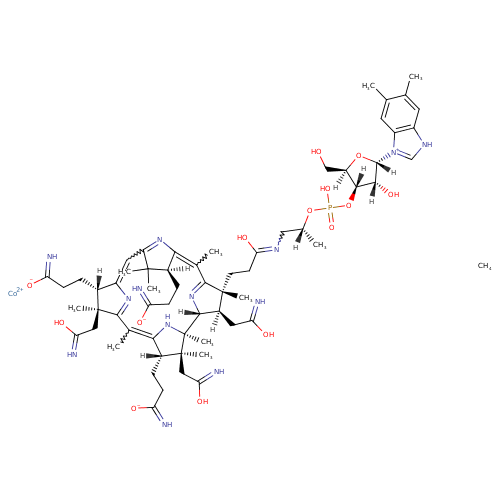
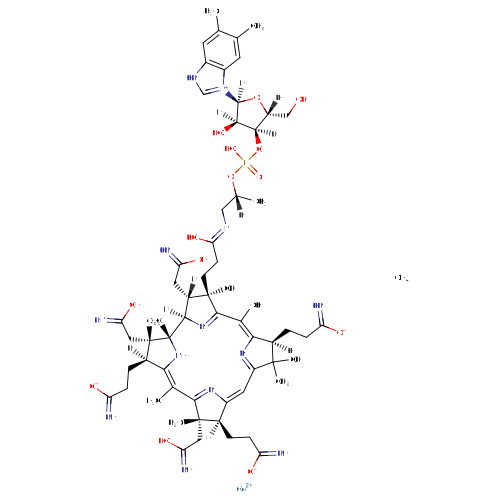
Chemical Structure
Thumb
SynonymsNot Available
Chemical FormulaC63H92CoN13O14P
Average Molecular Mass1345.413 g/mol
Monoisotopic Mass1344.596 g/mol
CAS Registry Number13422-55-4
IUPAC Nameλ²-cobalt(2+) ion 1-[(2S,3R,4S,5R)-3-hydroxy-4-{[hydroxy({[(2R)-1-({1-hydroxy-3-[(1R,2R,3R,4R,8S,13S,14S,18S,19S)-8,13,18-tris(2-carboximidatoethyl)-3,14,19-tris[(C-hydroxycarbonimidoyl)methyl]-1,4,6,9,9,14,16,19-octamethyl-20,21,22,23-tetraazapentacyclo[15.2.1.1²,⁵.1⁷,¹⁰.1¹²,¹⁵]tricosa-5(23),6,10(22),11,15(21),16-hexaen-4-yl]propylidene}amino)propan-2-yl]oxy})phosphoryl]oxy}-5-(hydroxymethyl)oxolan-2-yl]-5,6-dimethyl-3H-1λ⁵,3-benzodiazol-1-ylium methane
Traditional Nameλ²-cobalt(2+) ion 1-[(2S,3R,4S,5R)-3-hydroxy-4-{[hydroxy([(2R)-1-({1-hydroxy-3-[(1R,2R,3R,4R,8S,13S,14S,18S,19S)-8,13,18-tris(2-carboximidatoethyl)-3,14,19-tris(C-hydroxycarbonimidoylmethyl)-1,4,6,9,9,14,16,19-octamethyl-20,21,22,23-tetraazapentacyclo[15.2.1.1²,⁵.1⁷,¹⁰.1¹²,¹⁵]tricosa-5(23),6,10(22),11,15(21),16-hexaen-4-yl]propylidene}amino)propan-2-yl]oxy)phosphoryl]oxy}-5-(hydroxymethyl)oxolan-2-yl]-5,6-dimethyl-3H-1λ⁵,3-benzodiazol-1-ylium methane
SMILESC.[Co++].[H][C@@](C)(CN=C(O)CC[C@@]1(C)C2=N[C@]([H])([C@]1([H])CC(O)=N)[C@]1(C)NC(=C(C)C3=NC(=CC4=NC(=C2C)[C@@]([H])(CCC([O-])=N)C4(C)C)[C@@]([H])(CCC([O-])=N)[C@]3(C)CC(O)=N)[C@@]([H])(CCC([O-])=N)[C@]1(C)CC(O)=N)OP(O)(=O)O[C@]1([H])[C@@]([H])(CO)O[C@]([H])([N+]2=CNC3=C2C=C(C)C(C)=C3)[C@]1([H])O
InChI IdentifierInChI=1S/C62H90N13O14P.CH4.Co/c1-29-20-39-40(21-30(29)2)75(28-70-39)57-52(84)53(41(27-76)87-57)89-90(85,86)88-31(3)26-69-49(83)18-19-59(8)37(22-46(66)80)56-62(11)61(10,25-48(68)82)36(14-17-45(65)79)51(74-62)33(5)55-60(9,24-47(67)81)34(12-15-43(63)77)38(71-55)23-42-58(6,7)35(13-16-44(64)78)50(72-42)32(4)54(59)73-56;;/h20-21,23,28,31,34-37,41,52-53,56-57,76,84H,12-19,22,24-27H2,1-11H3,(H15,63,64,65,66,67,68,69,71,72,73,74,77,78,79,80,81,82,83,85,86);1H4;/q;;+2/p-2/t31-,34-,35-,36-,37+,41-,52-,53-,56-,57+,59-,60+,61+,62+;;/m1../s1
InChI KeyMBBCHOKVOPWOEW-WZHZPDAFSA-L
Chemical Taxonomy
Description belongs to the class of organic compounds known as cobalamin derivatives. These are organic compounds containing a corrin ring, a cobalt atom, an a nucleotide moiety. Cobalamin Derivatives are actually derived from vitamin B12.
KingdomOrganic compounds
Super ClassOrganoheterocyclic compounds
ClassTetrapyrroles and derivatives
Sub ClassCorrinoids
Direct ParentCobalamin derivatives
Alternative Parents
Substituents
  • Cobalamin
  • Metallotetrapyrrole skeleton
  • 1-ribofuranosylbenzimidazole
  • Pentose phosphate
  • N-glycosyl compound
  • Glycosyl compound
  • Monosaccharide phosphate
  • Pentose monosaccharide
  • Benzimidazole
  • Phosphoethanolamine
  • Dialkyl phosphate
  • Phosphoric acid ester
  • Fatty amide
  • Fatty acyl
  • Monosaccharide
  • N-substituted imidazole
  • Organic phosphoric acid derivative
  • Alkyl phosphate
  • Benzenoid
  • Azole
  • Tetrahydrofuran
  • Imidazole
  • Pyrrolidine
  • Heteroaromatic compound
  • Pyrroline
  • Carboxamide group
  • Ketimine
  • Secondary carboxylic acid amide
  • Secondary alcohol
  • Primary carboxylic acid amide
  • Propargyl-type 1,3-dipolar organic compound
  • Carboxylic acid derivative
  • Oxacycle
  • Carbene-type 1,3-dipolar compound
  • Organic 1,3-dipolar compound
  • Azacycle
  • Organic transition metal salt
  • Carbonyl group
  • Organic cobalt salt
  • Imine
  • Organic salt
  • Organonitrogen compound
  • Hydrocarbon derivative
  • Organic oxide
  • Organopnictogen compound
  • Organooxygen compound
  • Alcohol
  • Organic zwitterion
  • Organic nitrogen compound
  • Organic oxygen compound
  • Primary alcohol
  • Aromatic heteropolycyclic compound
Molecular FrameworkNot Available
External DescriptorsNot Available
Biological Properties
StatusDetected and Not Quantified
OriginEndogenous
Cellular Locations
  • Cell surface
  • Cytoplasm
  • Cytosol
  • Endoplasmic reticulum
  • Extracellular
  • Lysosome
  • Microsome
  • Mitochondrion
  • Nerve Fiber
  • Plasma Membrane
  • Tubulin
Biofluid LocationsNot Available
Tissue Locations
  • Fibroblasts
  • Myelin
Pathways
NameSMPDB LinkKEGG Link
ApoptosisNot Availablemap04210
Circadian rhythmNot Availablemap04710
Tyrosine MetabolismSMP00006 map00350
Sulfur metabolismNot Availablemap00920
Nitrogen MetabolismNot AvailableNot Available
Gastric acid secretionNot Availablemap04971
Fatty acid MetabolismSMP00051 map00071
EndocytosisNot Availablemap04144
Bile secretionNot Availablemap04976
ApplicationsNot Available
Biological Roles
Chemical RolesNot Available
Physical Properties
StateSolid
AppearanceWhite powder.
Experimental Properties
PropertyValue
Melting PointNot Available
Boiling PointNot Available
SolubilityNot Available
Predicted Properties
PropertyValueSource
Water Solubility0.036 g/LALOGPS
logP2.68ALOGPS
logP1.11ChemAxon
logS-4.6ALOGPS
pKa (Strongest Acidic)1.81ChemAxon
Physiological Charge2ChemAxon
Hydrogen Acceptor Count23ChemAxon
Hydrogen Donor Count15ChemAxon
Polar Surface Area479.79 ŲChemAxon
Rotatable Bond Count26ChemAxon
Refractivity430.84 m³·mol⁻¹ChemAxon
Polarizability133.34 ųChemAxon
Number of Rings8ChemAxon
Bioavailability0ChemAxon
Rule of FiveNoChemAxon
Ghose FilterNoChemAxon
Veber's RuleNoChemAxon
MDDR-like RuleYesChemAxon
Spectra
SpectraNot Available
Toxicity Profile
Route of ExposureInhalation (11) ; oral (11) ; dermal (11)
Mechanism of ToxicityCobalt is believed to exhibit its toxicity through a oxidant-based and free radical-based processes. It produces oxygen radicals and may be oxidized to ionic cobalt, causing increased lipid peroxidation, DNA damage, and inducing certain enzymes that lead to cell apoptosis. Cobalt has also been shown to block inorganic calcium channels, possibly impairing neurotransmission. Cobalt can also chelate lipoic acids, impairing oxidation of pyruvate or fatty acids. In addition, cobalt may inhibit DNA repair by interacting with zinc finger DNA repair proteins, and has also been shown to inhibit heme synthesis and glucose metabolism. Cobalt may activate specific helper T-lymphocyte cells and interact directly with immunologic proteins, such as antibodies (IgA and IgE) or Fc receptors, resulting in immunosensitization. (11)
MetabolismCobalt is absorbed though the lungs, gastrointestinal tract, and skin. Since it is a component of the vitamin B12 (cyanocobalamin), it is distributed to most tissues of the body. It is transported in the blood, often bound to albumin, with the highest levels being found in the liver and kidney. Cobalt is excreted mainly in the urine and faeces. (11)
Toxicity ValuesNot Available
Lethal DoseNot Available
Carcinogenicity (IARC Classification)2B, possibly carcinogenic to humans. (14)
Uses/SourcesMethylcobalamin is a form of vitamin B12. (15)
Minimum Risk LevelChronic Inhalation: 0.0001 mg/m3 (13) Intermediate Oral: 0.01 mg/kg/day (13)
Health EffectsExposure to high amount of cobalt can cause heart, lung, kidney, and liver damage. Skin contact is known to result in contact dermatitis. Cobalt may also have mutagenic and carcinogenic effects. (11, 12)
SymptomsCobalt inhalation can cause asthma-like breathing problems. Skin contact is known to result in contact dermatitis, which is characterized by irritation and rashes. Ingesting large amounts of cobalt may cause nausea and vomiting. (16)
TreatmentTreatment of cobalt poisoning is symptomatic. (11)

Concentrations
Not Available
DrugBank IDNot Available
HMDB IDNot Available
FooDB IDNot Available
Phenol Explorer IDNot Available
KNApSAcK IDNot Available
BiGG IDNot Available
BioCyc IDNot Available
METLIN IDNot Available
PDB IDNot Available
Wikipedia LinkNot Available
Chemspider IDNot Available
ChEBI IDNot Available
PubChem Compound IDNot Available
Kegg Compound IDNot Available
YMDB IDNot Available
ECMDB IDNot Available
References
Synthesis ReferenceNot Available
MSDSLink
General ReferencesNot Available