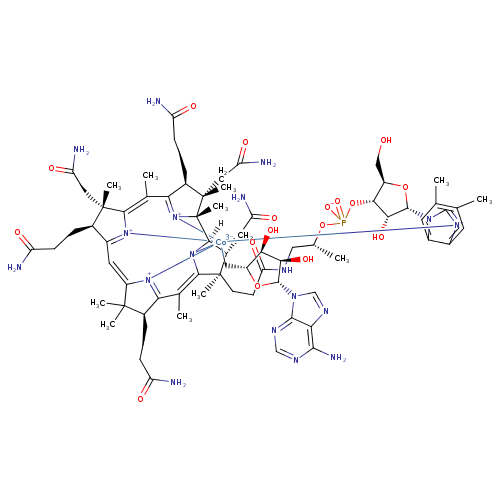
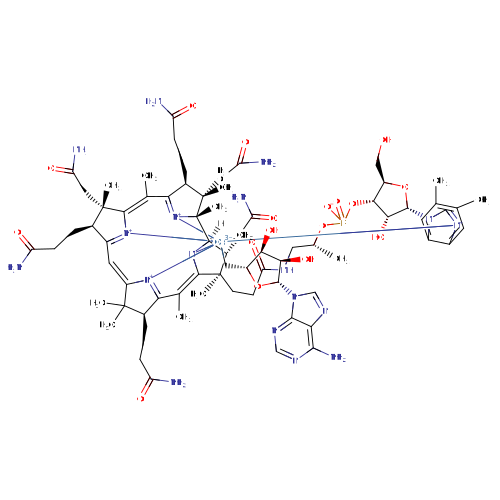
Adenosylcobalamin is one of two metabolically active forms synthesized upon ingestion of vitamin B12 and is the predominant form in the liver; it acts as a coenzyme in the reaction catalyzed by methylmalonyl-CoA mutase. A cobalamin (cbl) derivative in which the substituent is deoxyadenosyl. It is one of two metabolically active forms synthesized upon ingestion of vitamin B12 and is the predominant form in the liver; it acts as a coenzyme in the reaction catalyzed by methylmalonyl-CoA mutase (MCM; E.C. 5.4.99.2). Inborn errors of vitamin B12 metabolism are autosomal recessive disorders and have been classified into nine distinct complementation classes. Disorders affecting adenosylcobalamin cause methylmalonic acidemia and metabolic acidosis. Methylmalonyl-CoA mutase catalyzes the conversion of L-methylmalonyl-CoA to succinyl-CoA and uses adenosylcobalamin (AdoCbl) as a cofactor. Cbl must be transported into mitochondria, reduced and adenosylated before it can be utilized by MCM. (2).
belongs to the class of organic compounds known as cobalamin derivatives. These are organic compounds containing a corrin ring, a cobalt atom, an a nucleotide moiety. Cobalamin Derivatives are actually derived from vitamin B12.
Cobalt is believed to exhibit its toxicity through a oxidant-based and free radical-based processes. It produces oxygen radicals and may be oxidized to ionic cobalt, causing increased lipid peroxidation, DNA damage, and inducing certain enzymes that lead to cell apoptosis. Cobalt has also been shown to block inorganic calcium channels, possibly impairing neurotransmission. Cobalt can also chelate lipoic acids, impairing oxidation of pyruvate or fatty acids. In addition, cobalt may inhibit DNA repair by interacting with zinc finger DNA repair proteins, and has also been shown to inhibit heme synthesis and glucose metabolism. Cobalt may activate specific helper T-lymphocyte cells and interact directly with immunologic proteins, such as antibodies (IgA and IgE) or Fc receptors, resulting in immunosensitization. (3)
Metabolism
Cobalt is absorbed though the lungs, gastrointestinal tract, and skin. Since it is a component of the vitamin B12 (cyanocobalamin), it is distributed to most tissues of the body. It is transported in the blood, often bound to albumin, with the highest levels being found in the liver and kidney. Cobalt is excreted mainly in the urine and faeces. (3)
Exposure to high amount of cobalt can cause heart, lung, kidney, and liver damage. Skin contact is known to result in contact dermatitis. Cobalt may also have mutagenic and carcinogenic effects. (3, 4)
Symptoms
Cobalt inhalation can cause asthma-like breathing problems. Skin contact is known to result in contact dermatitis, which is characterized by irritation and rashes. Ingesting large amounts of cobalt may cause nausea and vomiting. (9)