Record Information
Version1.0
Creation Date2009-03-06 18:59:16 UTC
Update Date2026-03-31 17:55:07 UTC
Accession NumberCHEM000562
Identification
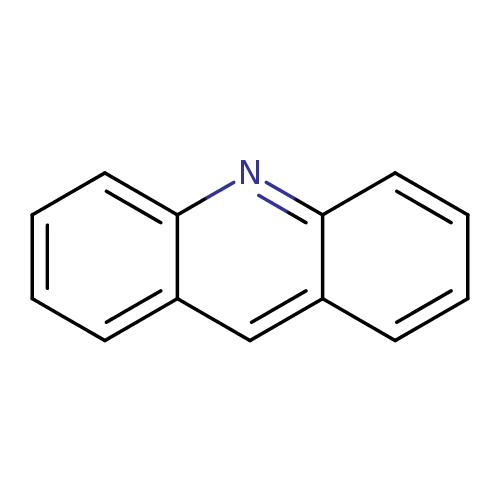
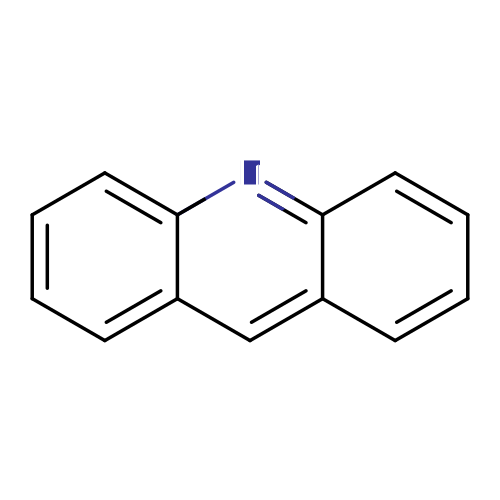
Common NameAcridine
ClassSmall Molecule
DescriptionAcridine is one of over 100 different polycyclic aromatic hydrocarbons (PAHs). PAHs are chemicals that are formed during the incomplete burning organic substances, such as fossil fuels. They are usually found as a mixture containing two or more of these compounds. (4)
Contaminant Sources
  • STOFF IDENT Compounds
  • Suspected Compounds
  • T3DB toxins
Contaminant Type
  • Aromatic Hydrocarbon
  • Food Toxin
  • Natural Compound
  • Organic Compound
  • Pollutant
  • Polycyclic Aromatic Hydrocarbon
Chemical Structure
Thumb
Synonyms
ValueSource
10-AzaanthraceneChEBI
2,3,5,6-DibenzopyridineChEBI
2,3-BenzoquinolineChEBI
9-AzaanthraceneChEBI
AcrydineChEBI
AkridinChEBI
Benzo[b]quinolineChEBI
Dibenzo[b,e]pyridineChEBI
Chemical FormulaC13H9N
Average Molecular Mass179.217 g/mol
Monoisotopic Mass179.073 g/mol
CAS Registry Number260-94-6
IUPAC Nameacridine
Traditional Nameacridine
SMILESC1=CC2=CC3=CC=CC=C3N=C2C=C1
InChI IdentifierInChI=1S/C13H9N/c1-3-7-12-10(5-1)9-11-6-2-4-8-13(11)14-12/h1-9H
InChI KeyDZBUGLKDJFMEHC-UHFFFAOYSA-N
Chemical Taxonomy
Description belongs to the class of organic compounds known as acridines. These are organic compounds containing the acridine moiety, a linear tricyclic heterocycle which consists of two benzene rings joined by a pyridine ring.
KingdomOrganic compounds
Super ClassOrganoheterocyclic compounds
ClassQuinolines and derivatives
Sub ClassBenzoquinolines
Direct ParentAcridines
Alternative Parents
Substituents
  • Acridine
  • Benzenoid
  • Pyridine
  • Heteroaromatic compound
  • Azacycle
  • Organic nitrogen compound
  • Organopnictogen compound
  • Hydrocarbon derivative
  • Organonitrogen compound
  • Aromatic heteropolycyclic compound
Molecular FrameworkAromatic heteropolycyclic compounds
External Descriptors
Biological Properties
StatusDetected and Not Quantified
OriginExogenous
Cellular Locations
  • Membrane
Biofluid LocationsNot Available
Tissue LocationsNot Available
PathwaysNot Available
ApplicationsNot Available
Biological Roles
Chemical RolesNot Available
Physical Properties
StateSolid
AppearanceColorless solid.
Experimental Properties
PropertyValue
Melting Point108°C
Boiling PointNot Available
Solubility0.0384 mg/mL at 25°C [BANWART,WL et al. (1982)]
Predicted Properties
PropertyValueSource
Water Solubility0.039 g/LALOGPS
logP3.51ALOGPS
logP3.51ChemAxon
logS-3.7ALOGPS
pKa (Strongest Basic)6.15ChemAxon
Physiological Charge0ChemAxon
Hydrogen Acceptor Count1ChemAxon
Hydrogen Donor Count0ChemAxon
Polar Surface Area12.89 ŲChemAxon
Rotatable Bond Count0ChemAxon
Refractivity56.06 m³·mol⁻¹ChemAxon
Polarizability20.01 ųChemAxon
Number of Rings3ChemAxon
Bioavailability1ChemAxon
Rule of FiveYesChemAxon
Ghose FilterYesChemAxon
Veber's RuleYesChemAxon
MDDR-like RuleNoChemAxon
Spectra
Spectra
Spectrum TypeDescriptionSplash KeyView
Predicted GC-MSPredicted GC-MS Spectrum - GC-MS (Non-derivatized) - 70eV, Positivesplash10-004i-0900000000-60709f13538ebb5bf03cSpectrum
Predicted GC-MSPredicted GC-MS Spectrum - GC-MS (Non-derivatized) - 70eV, PositiveNot AvailableSpectrum
LC-MS/MSLC-MS/MS Spectrum - 50V, Positivesplash10-0fb9-0900000000-e0c1bf58e0cb2bf829acSpectrum
LC-MS/MSLC-MS/MS Spectrum - 40V, Positivesplash10-003r-0900000000-eae554919803e4683fdbSpectrum
LC-MS/MSLC-MS/MS Spectrum - 30V, Positivesplash10-001i-0900000000-9e670fdb36b28daad5dcSpectrum
LC-MS/MSLC-MS/MS Spectrum - 10V, Positivesplash10-001i-0900000000-8173a227a1d988a8e1a0Spectrum
LC-MS/MSLC-MS/MS Spectrum - 20V, Positivesplash10-001i-0900000000-422dd5d409aa20c1ff0eSpectrum
LC-MS/MSLC-MS/MS Spectrum - 35V, Positivesplash10-001i-0900000000-a5b0ca159a9258ef014dSpectrum
Predicted LC-MS/MSPredicted LC-MS/MS Spectrum - 10V, Positivesplash10-001i-0900000000-05d700c59ef99ce33b11Spectrum
Predicted LC-MS/MSPredicted LC-MS/MS Spectrum - 20V, Positivesplash10-001i-0900000000-2356d93638ed7ee93521Spectrum
Predicted LC-MS/MSPredicted LC-MS/MS Spectrum - 40V, Positivesplash10-001i-0900000000-11523a8602aa0962e990Spectrum
Predicted LC-MS/MSPredicted LC-MS/MS Spectrum - 10V, Negativesplash10-004i-0900000000-594469afea8b2ce91c8cSpectrum
Predicted LC-MS/MSPredicted LC-MS/MS Spectrum - 20V, Negativesplash10-004i-0900000000-594469afea8b2ce91c8cSpectrum
Predicted LC-MS/MSPredicted LC-MS/MS Spectrum - 40V, Negativesplash10-004i-0900000000-72311cdd3bfe34545a89Spectrum
Predicted LC-MS/MSPredicted LC-MS/MS Spectrum - 10V, Positivesplash10-001i-0900000000-9417270887d6a1e93e91Spectrum
Predicted LC-MS/MSPredicted LC-MS/MS Spectrum - 20V, Positivesplash10-001i-0900000000-9417270887d6a1e93e91Spectrum
Predicted LC-MS/MSPredicted LC-MS/MS Spectrum - 40V, Positivesplash10-001i-0900000000-063b6148248bc2509b93Spectrum
Predicted LC-MS/MSPredicted LC-MS/MS Spectrum - 10V, Negativesplash10-004i-0900000000-8c0deb449c1b4d81b5d9Spectrum
Predicted LC-MS/MSPredicted LC-MS/MS Spectrum - 20V, Negativesplash10-004i-0900000000-8c0deb449c1b4d81b5d9Spectrum
Predicted LC-MS/MSPredicted LC-MS/MS Spectrum - 40V, Negativesplash10-004i-0900000000-8c0deb449c1b4d81b5d9Spectrum
MSMass Spectrum (Electron Ionization)splash10-004i-3900000000-cea0879ccb7e90ce2a83Spectrum
1D NMR1H NMR SpectrumNot AvailableSpectrum
1D NMR13C NMR SpectrumNot AvailableSpectrum
Toxicity Profile
Route of ExposureOral (4) ; inhalation (4)
Mechanism of ToxicityThe ability of PAH's to bind to blood proteins such as albumin allows them to be transported throughout the body. Many PAH's induce the expression of cytochrome P450 enzymes, especially CYP1A1, CYP1A2, and CYP1B1, by binding to the aryl hydrocarbon receptor or glycine N-methyltransferase protein. These enzymes metabolize PAH's into their toxic intermediates. The reactive metabolites of PAHs (epoxide intermediates, dihydrodiols, phenols, quinones, and their various combinations) covalently bind to DNA and other cellular macromolecules, initiating mutagenesis and carcinogenesis. (4, 5, 2, 3)
MetabolismPAH metabolism occurs in all tissues, usually by cytochrome P-450 and its associated enzymes. PAHs are metabolized into reactive intermediates, which include epoxide intermediates, dihydrodiols, phenols, quinones, and their various combinations. The phenols, quinones, and dihydrodiols can all be conjugated to glucuronides and sulfate esters; the quinones also form glutathione conjugates. (4)
Toxicity ValuesLD50: 400 mg/kg (Subcutaneous, Mouse) (6) LD50: 500 mg/kg (Oral, Mouse) (6) LD50: 100 mg/kg (Intravenous, Rabbit) (6)
Lethal DoseNot Available
Carcinogenicity (IARC Classification)Not listed by IARC. IARC has evaluated related PAHs (7).
Uses/SourcesPAHs are released into the environment via the combustion of fossil fuels, coke oven emissions and vehicle exhausts, as well as naturally from forest fires and vocanic eruptions. PAHs from these sources may contaminate nearly water systems. They are also found in coal tar and charbroiled food. (4)
Minimum Risk LevelNot Available
Health EffectsPAHs are carcinogens and have been associated with the increased risk of skin, respiratory tract, bladder, stomach, and kidney cancers. They may also cause reproductive effects and depress the immune system. (4)
SymptomsAcute exposure to PAHs causes irritation and inflammation of the skin and lung tissue. (1)
TreatmentThere is no know antidote for PAHs. Exposure is usually handled with symptomatic treatment. (4)
Concentrations
Not Available
DrugBank IDNot Available
HMDB IDHMDB0247968
FooDB IDNot Available
Phenol Explorer IDNot Available
KNApSAcK IDC00002180
BiGG IDNot Available
BioCyc IDNot Available
METLIN IDNot Available
PDB IDNot Available
Wikipedia LinkAcridine
Chemspider ID8860
ChEBI ID36420
PubChem Compound ID9215
Kegg Compound IDC20141
YMDB IDNot Available
ECMDB IDNot Available
References
Synthesis ReferenceNot Available
MSDSNot Available
General References
1. https://www.ncbi.nlm.nih.gov/pubmed/?term=11924543
2. https://www.ncbi.nlm.nih.gov/pubmed/?term=24416442
3. Barupal DK, Fiehn O: Generating the Blood Exposome Database Using a Comprehensive Text Mining and Database Fusion Approach. Environ Health Perspect. 2019 Sep;127(9):97008. doi: 10.1289/EHP4713. Epub 2019 Sep 26.