Record Information
Version1.0
Creation Date2009-03-06 18:58:45 UTC
Update Date2016-11-09 01:08:14 UTC
Accession NumberCHEM000366
Identification
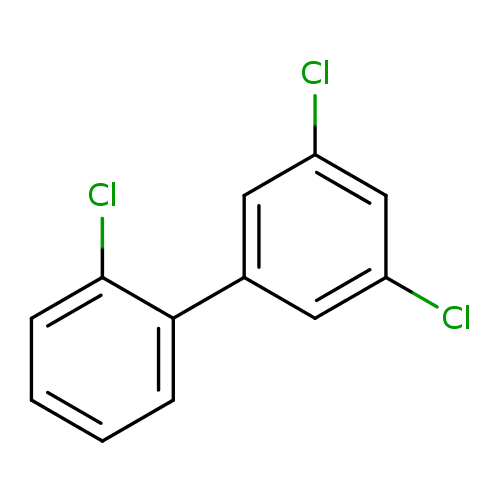
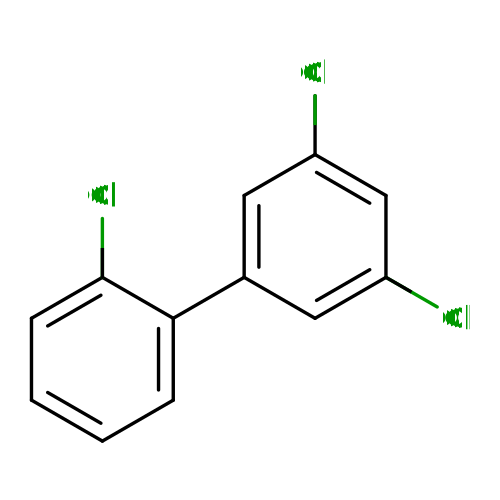
Common Name2,3',5'-Trichlorobiphenyl
ClassSmall Molecule
Description2,3',5'-Trichlorobiphenyl is one of 209 polychlorinated biphenyls (PCBs). PCBs are a group of synthetic organic compounds with 1-10 chlorine atoms attached to biphenyl. They were manufactured as commercial mixtures but banned in the 1970's because they were found to bioaccumulate and cause harmful health effects. However, PCBs do not break down readily and are still found in the environment. (6)
Contaminant Sources
  • HPV EPA Chemicals
  • IARC Carcinogens Group 1
  • My Exposome Chemicals
  • T3DB toxins
Contaminant Type
  • Aromatic Hydrocarbon
  • Coolant
  • Industrial/Workplace Toxin
  • Organic Compound
  • Organochloride
  • Plasticizer
  • Pollutant
  • Polychlorinated Biphenyl
  • Synthetic Compound
Chemical Structure
Thumb
SynonymsNot Available
Chemical FormulaC12H7Cl3
Average Molecular Mass257.543 g/mol
Monoisotopic Mass255.961 g/mol
CAS Registry Number37680-68-5
IUPAC Name1,3-dichloro-5-(2-chlorophenyl)benzene
Traditional Name2',3,5-trichlorobiphenyl
SMILESClC1=CC(=CC(Cl)=C1)C1=CC=CC=C1Cl
InChI IdentifierInChI=1S/C12H7Cl3/c13-9-5-8(6-10(14)7-9)11-3-1-2-4-12(11)15/h1-7H
InChI KeyGXVMAQACUOSFJF-UHFFFAOYSA-N
Chemical Taxonomy
Description belongs to the class of organic compounds known as polychlorinated biphenyls. These are organic compounds containing at least two chlorine atoms attached to either benzene ring of the biphenyl moiety.
KingdomOrganic compounds
Super ClassBenzenoids
ClassBenzene and substituted derivatives
Sub ClassBiphenyls and derivatives
Direct ParentPolychlorinated biphenyls
Alternative Parents
Substituents
  • Polychlorinated biphenyl
  • 1,3-dichlorobenzene
  • Halobenzene
  • Chlorobenzene
  • Aryl halide
  • Aryl chloride
  • Hydrocarbon derivative
  • Organochloride
  • Organohalogen compound
  • Aromatic homomonocyclic compound
Molecular FrameworkAromatic homomonocyclic compounds
External DescriptorsNot Available
Biological Properties
StatusDetected and Not Quantified
OriginExogenous
Cellular Locations
  • Membrane
Biofluid LocationsNot Available
Tissue LocationsNot Available
PathwaysNot Available
ApplicationsNot Available
Biological RolesNot Available
Chemical RolesNot Available
Physical Properties
StateSolid
AppearanceOily liquids or solids that are colorless to light yellow.
Experimental Properties
PropertyValue
Melting PointNot Available
Boiling PointNot Available
Solubility0.000129 mg/mL at 25°C [PATIL,GS (1991)]
Predicted Properties
PropertyValueSource
Water Solubility0.00013 g/LALOGPS
logP5.7ALOGPS
logP5.43ChemAxon
logS-6.3ALOGPS
Physiological Charge0ChemAxon
Hydrogen Acceptor Count0ChemAxon
Hydrogen Donor Count0ChemAxon
Polar Surface Area0 ŲChemAxon
Rotatable Bond Count1ChemAxon
Refractivity65.61 m³·mol⁻¹ChemAxon
Polarizability24.5 ųChemAxon
Number of Rings2ChemAxon
Bioavailability1ChemAxon
Rule of FiveNoChemAxon
Ghose FilterYesChemAxon
Veber's RuleYesChemAxon
MDDR-like RuleNoChemAxon
Spectra
Spectra
Spectrum TypeDescriptionSplash KeyView
Predicted LC-MS/MSPredicted LC-MS/MS Spectrum - 10V, Positivesplash10-0a4i-0090000000-1b2f0b5667ae97406454Spectrum
Predicted LC-MS/MSPredicted LC-MS/MS Spectrum - 20V, Positivesplash10-0a4i-0090000000-8b2bbbde7675f8a617ddSpectrum
Predicted LC-MS/MSPredicted LC-MS/MS Spectrum - 40V, Positivesplash10-0a4i-1490000000-12cb457e1c5d59b76354Spectrum
Predicted LC-MS/MSPredicted LC-MS/MS Spectrum - 10V, Negativesplash10-0udi-0090000000-86ac14a5119da1b634b5Spectrum
Predicted LC-MS/MSPredicted LC-MS/MS Spectrum - 20V, Negativesplash10-0udi-0090000000-e24aafbb150d51f47c47Spectrum
Predicted LC-MS/MSPredicted LC-MS/MS Spectrum - 40V, Negativesplash10-0udi-0390000000-5f09fc49dca029488904Spectrum
MSMass Spectrum (Electron Ionization)splash10-0a4i-3690000000-c0d5e32dcd26720da113Spectrum
Toxicity Profile
Route of ExposureOral (6) ; inhalation (6) ; dermal (6)
Mechanism of ToxicityThe mechanism of action varies with the specific PCB. Dioxin-like PCBs bind to the aryl hydrocarbon receptor, which disrupts cell function by altering the transcription of genes, mainly be inducing the expression of hepatic Phase I and Phase II enzymes, especially of the cytochrome P450 family. Most of the toxic effects of PCBs are believed to be results of Ah receptor binding. Other PBCs are believed to interfere with calcium channels and/or change brain dopamine levels. PCBs can also cause endocrine disurption by altering the production of thyroid hormones and binding to estrogen receptors, which can stimulate the growth of certain cancer cells and produce other estrogenic effects, such as reproductive dysfunction. They will bioaccumulate by binding to receptor proteins such as uteroglobin. (1, 2, 4, 5)
MetabolismPCBs are absorbed via inhalation, oral, and dermal routes of exposure. They are trasported in the blood, often bound to albumin. Due to their lipophilic nature they tend to accumulate in lipid-rich tissues, such as the liver, adipose, and skin. Metabolism of PCBs is very slow and varies based on the degree and position of chlorination. PCBs are metabolized by the microsomal monooxygenase system catalyzed by cytochrome P-450 enzymes to polar metabolites that can undergo conjugation with glutathione and glucuronic acid. The major metabolites are hydroxylated products which are excreted in the bile and faeces. The slow metabolism of PCBs means they tend to accumulate in body tissues. (6, 9)
Toxicity ValuesLD50: 1010 mg/kg (Oral, Rat) (10) LD50: 880 mg/kg (Intraperitoneal, Mouse) (10)
Lethal DoseNot Available
Carcinogenicity (IARC Classification)1, carcinogenic to humans. (8)
Uses/SourcesPCBs were used as coolants and lubricants in transformers, capacitors, and other electrical devices (such as fluorescent lights and refridgerators) produced before 1977. PCBs may contaminate the air and water near hazardous waste sites. In addition, PCBs bioaccumulate in the environment and may be found in fish, meat, and dairy products. (6)
Minimum Risk LevelIntermediate Oral: 0.03 ug/kg/day (7)
Health EffectsThe most common health effects of PCBs are skin conditions such as chloracne and rashes. Chronic PCB exposure has also been shown to cause liver, stomach and kidney, damage, jaundice, edema, anemia, changes in the immune system, behavioral alterations, and impaired reproduction. (6)
SymptomsChronic PCB exposure results in symptoms such as abdominal pain, nausea, vomiting, diarrhea, headache, dizziness, depression, nervousness, dermal and ocular lesions, fatigue, irregular menstrual cycles and a lowered immune response. (1)
TreatmentThere are no specific treatments for PCB poisoning, since it is not usually recognized until after substantial chronic exposure. Only preventing further exposure and treating the observed symptoms can be done. Acute inhalation can be treated by administering oxygen. (6)

Concentrations
Not Available
DrugBank IDNot Available
HMDB IDNot Available
FooDB IDNot Available
Phenol Explorer IDNot Available
KNApSAcK IDNot Available
BiGG IDNot Available
BioCyc IDNot Available
METLIN IDNot Available
PDB IDNot Available
Wikipedia LinkNot Available
Chemspider IDNot Available
ChEBI IDNot Available
PubChem Compound ID37805
Kegg Compound IDNot Available
YMDB IDNot Available
ECMDB IDNot Available
References
Synthesis ReferenceNot Available
MSDSNot Available
General ReferencesNot Available