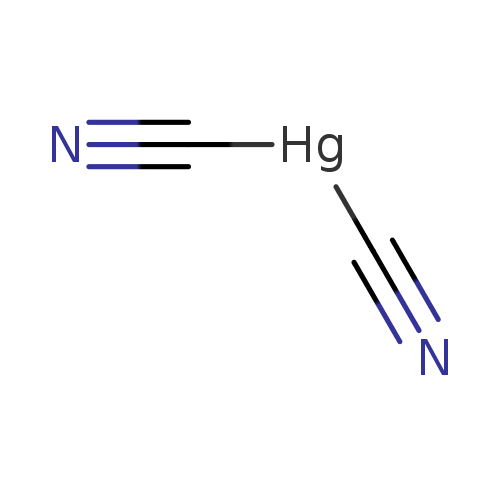
Mercuric cyanide is a chemical compound of mercury and cyanide used as a laboratory reagent and occasionally as an antiseptic in veterinary medicine. Mercury is a heavy, silvery d-block metal and one of six elements that are liquid at or near room temperature and pressure. It is a naturally occuring substance, and combines with other elements such as chlorine, sulfur, or oxygen to form inorganic mercury compounds (salts). Mercury also combines with carbon to make organic mercury compounds. (7, 14)
belongs to the class of organic compounds known as transition metal cyanide salts. These are organic compounds containing a transition metal and a cyanide ion [C-]#N.
High-affinity binding of the divalent mercuric ion to thiol or sulfhydryl groups of proteins is believed to be the major mechanism for the activity of mercury. Through alterations in intracellular thiol status, mercury can promote oxidative stress, lipid peroxidation, mitochondrial dysfunction, and changes in heme metabolism. Mercury is known to bind to microsomal and mitochondrial enzymes, resulting in cell injury and death. For example, mercury is known to inhibit aquaporins, halting water flow across the cell membrane. It also inhibits the protein LCK, which causes decreased T-cell signalling and immune system depression. Mercury is also believed to inhibit neuronal excitability by acting on the postsynaptic neuronal membrane. It also affects the nervous system by inhibiting protein kinase C and alkaline phosphatase, which impairs brain microvascular formation and function, as well as alters the blood-brain barrier. Mercury also produces an autoimmune response, likely by modification of major histocompatibility complex (MHC) class II molecules, self peptides, T-cell receptors, or cell-surface adhesion molecules.Organic nitriles decompose into cyanide ions both in vivo and in vitro. Consequently the primary mechanism of toxicity for organic nitriles is their production of toxic cyanide ions or hydrogen cyanide. Cyanide is an inhibitor of cytochrome c oxidase in the fourth complex of the electron transport chain (found in the membrane of the mitochondria of eukaryotic cells). It complexes with the ferric iron atom in this enzyme. The binding of cyanide to this cytochrome prevents transport of electrons from cytochrome c oxidase to oxygen. As a result, the electron transport chain is disrupted and the cell can no longer aerobically produce ATP for energy. Tissues that mainly depend on aerobic respiration, such as the central nervous system and the heart, are particularly affected. Cyanide is also known produce some of its toxic effects by binding to catalase, glutathione peroxidase, methemoglobin, hydroxocobalamin, phosphatase, tyrosinase, ascorbic acid oxidase, xanthine oxidase, succinic dehydrogenase, and Cu/Zn superoxide dismutase. Cyanide binds to the ferric ion of methemoglobin to form inactive cyanmethemoglobin. (8, 4, 5, 6, 12)
Metabolism
Mercury is absorbed mainly via ingestion and inhalation, then distributed throughout the body via the bloodstream, where a portion binds to sulfhydryl groups on haemoglobin. Mercury can undergo oxidation to mercuric mercury, which takes place via the catalase-hydrogen peroxide pathway. The mercury atom is able to diffuse down the cleft in the catalase enzyme to reach the active site where the heme ring is located. Oxidation most likely occurs in all tissue, as the catalase hydrogen peroxide pathway is ubiquitous. Following oxidation, mercury tends to accumulate in the kidneys. Mercury is excreted mainly by exhalation and in the faeces. Cyanide is rapidly alsorbed through oral, inhalation, and dermal routes and distributed throughout the body. Cyanide is mainly metabolized into thiocyanate by either rhodanese or 3-mercaptopyruvate sulfur transferase. Cyanide metabolites are excreted in the urine. (2, 8, 11)
Mercury mainly affects the nervous system. Exposure to high levels of metallic, inorganic, or organic mercury can permanently damage the brain, kidneys, and developing fetus. Effects on brain functioning may result in irritability, shyness, tremors, changes in vision or hearing, and memory problems. Acrodynia, a type of mercury poisoning in children, is characterized by pain and pink discoloration of the hands and feet. Mercury poisoning can also cause Hunter-Russell syndrome and Minamata disease. Exposure to high levels of cyanide for a short time harms the brain and heart and can even cause coma, seizures, apnea, cardiac arrest and death. Chronic inhalation of cyanide causes breathing difficulties, chest pain, vomiting, blood changes, headaches, and enlargement of the thyroid gland. Skin contact with cyanide salts can irritate and produce sores. (8, 11, 12)
Symptoms
Common symptoms include peripheral neuropathy (presenting as paresthesia or itching, burning or pain), skin discoloration (pink cheeks, fingertips and toes), edema (swelling), and desquamation (dead skin peels off in layers). Cyanide poisoning is identified by rapid, deep breathing and shortness of breath, general weakness, giddiness, headaches, vertigo, confusion, convulsions/seizures and eventually loss of consciousness. (1, 11, 12)
Treatment
Mercury poisoning is treated by immediate decontamination and chelation therapy using DMSA, DMPS, DPCN, or dimercaprol. Antidotes to cyanide poisoning include hydroxocobalamin and sodium nitrite, which release the cyanide from the cytochrome system, and rhodanase, which is an enzyme occurring naturally in mammals that combines serum cyanide with thiosulfate, producing comparatively harmless thiocyanate. Oxygen therapy can also be administered. (3, 12)