Record Information
Version1.0
Creation Date2009-03-06 18:58:35 UTC
Update Date2016-11-09 01:08:13 UTC
Accession NumberCHEM000297
Identification
Common NameMercury(I) acetate
ClassSmall Molecule
DescriptionMercury(I) acetate is a chemical compound of mercury. Mercury is a heavy, silvery d-block metal and one of six elements that are liquid at or near room temperature and pressure. It is a naturally occuring substance, and combines with other elements such as chlorine, sulfur, or oxygen to form inorganic mercury compounds (salts). Mercury also combines with carbon to make organic mercury compounds. (7)
Contaminant Sources
  • T3DB toxins
Contaminant Type
  • Industrial/Workplace Toxin
  • Mercury Compound
  • Organic Compound
  • Organometallic
  • Pollutant
  • Synthetic Compound
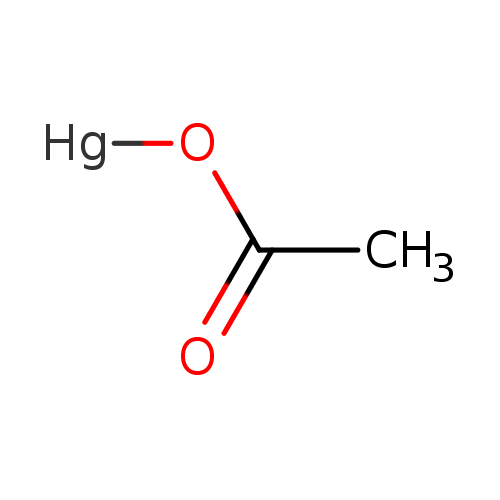
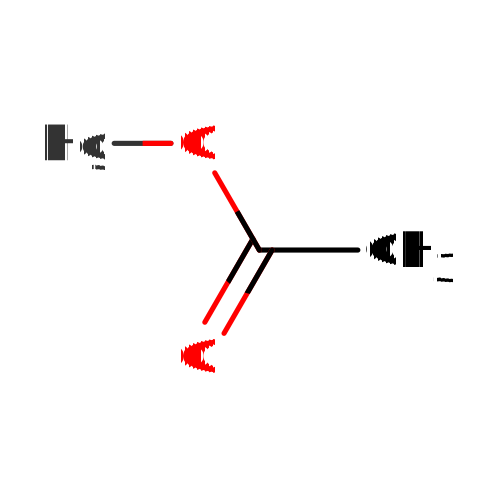
Chemical Structure
Thumb
Synonyms
ValueSource
Mercury(I) acetic acidGenerator
Chemical FormulaC2H3HgO2
Average Molecular Mass259.630 g/mol
Monoisotopic Mass260.984 g/mol
CAS Registry Number631-60-7
IUPAC Namemercurio acetate
Traditional Namemercurous acetate
SMILESCC(=O)O[Hg]
InChI IdentifierInChI=1S/C2H4O2.Hg/c1-2(3)4;/h1H3,(H,3,4);/q;+1/p-1
InChI KeyWRYNUJYAXVDTCB-UHFFFAOYSA-M
Chemical Taxonomy
Description belongs to the class of organic compounds known as acetate salts. These are organic compounds containing acetic acid as its acid component.
KingdomOrganic compounds
Super ClassOrganic acids and derivatives
ClassCarboxylic acids and derivatives
Sub ClassCarboxylic acid derivatives
Direct ParentAcetate salts
Alternative Parents
Substituents
  • Acetate salt
  • Organic transition metal salt
  • Monocarboxylic acid or derivatives
  • Carboxylic acid
  • Organic oxygen compound
  • Organic oxide
  • Hydrocarbon derivative
  • Organic salt
  • Organooxygen compound
  • Carbonyl group
  • Aliphatic acyclic compound
Molecular FrameworkAliphatic acyclic compounds
External DescriptorsNot Available
Biological Properties
StatusDetected and Not Quantified
OriginExogenous
Cellular Locations
  • Cytoplasm
  • Extracellular
Biofluid LocationsNot Available
Tissue LocationsNot Available
PathwaysNot Available
ApplicationsNot Available
Biological RolesNot Available
Chemical RolesNot Available
Physical Properties
StateSolid
AppearanceNo data.
Experimental Properties
PropertyValue
Melting PointNot Available
Boiling PointNot Available
SolubilityNot Available
Predicted Properties
PropertyValueSource
Water Solubility137 g/LALOGPS
logP-0.64ALOGPS
logP-0.76ChemAxon
logS-0.28ALOGPS
pKa (Strongest Basic)-6.6ChemAxon
Physiological Charge0ChemAxon
Hydrogen Acceptor Count1ChemAxon
Hydrogen Donor Count0ChemAxon
Polar Surface Area26.3 ŲChemAxon
Rotatable Bond Count1ChemAxon
Refractivity11.72 m³·mol⁻¹ChemAxon
Polarizability6.86 ųChemAxon
Number of Rings0ChemAxon
Bioavailability1ChemAxon
Rule of FiveYesChemAxon
Ghose FilterNoChemAxon
Veber's RuleYesChemAxon
MDDR-like RuleNoChemAxon
Spectra
Spectra
Spectrum TypeDescriptionSplash KeyView
Predicted LC-MS/MSPredicted LC-MS/MS Spectrum - 10V, Positivesplash10-03di-1090000000-1ee17ec8819db783dfd8Spectrum
Predicted LC-MS/MSPredicted LC-MS/MS Spectrum - 20V, Positivesplash10-03dl-0090000000-8e07c45c9039910f0858Spectrum
Predicted LC-MS/MSPredicted LC-MS/MS Spectrum - 40V, Positivesplash10-00kf-9050000000-210727166626c3a564b5Spectrum
Predicted LC-MS/MSPredicted LC-MS/MS Spectrum - 10V, Negativesplash10-0a4i-0090000000-9fd54ba5ff805984ab2dSpectrum
Predicted LC-MS/MSPredicted LC-MS/MS Spectrum - 20V, Negativesplash10-0a4l-1090000000-eebda9ca70e4295b2ff1Spectrum
Predicted LC-MS/MSPredicted LC-MS/MS Spectrum - 40V, Negativesplash10-0006-2090000000-6830bb78d1356100644fSpectrum
Toxicity Profile
Route of ExposureOral (8) ; inhalation (8); dermal (8)
Mechanism of ToxicityHigh-affinity binding of the divalent mercuric ion to thiol or sulfhydryl groups of proteins is believed to be the major mechanism for the activity of mercury. Through alterations in intracellular thiol status, mercury can promote oxidative stress, lipid peroxidation, mitochondrial dysfunction, and changes in heme metabolism. Mercury is known to bind to microsomal and mitochondrial enzymes, resulting in cell injury and death. For example, mercury is known to inhibit aquaporins, halting water flow across the cell membrane. It also inhibits the protein LCK, which causes decreased T-cell signalling and immune system depression. Mercury is also believed to inhibit neuronal excitability by acting on the postsynaptic neuronal membrane. It also affects the nervous system by inhibiting protein kinase C and alkaline phosphatase, which impairs brain microvascular formation and function, as well as alters the blood-brain barrier. Mercury also produces an autoimmune response, likely by modification of major histocompatibility complex (MHC) class II molecules, self peptides, T-cell receptors, or cell-surface adhesion molecules. (8, 4, 5, 6)
MetabolismMercury is absorbed mainly via ingestion and inhalation, then distributed throughout the body via the bloodstream, where a portion binds to sulfhydryl groups on haemoglobin. Mercury can undergo oxidation to mercuric mercury, which takes place via the catalase-hydrogen peroxide pathway. The mercury atom is able to diffuse down the cleft in the catalase enzyme to reach the active site where the heme ring is located. Oxidation most likely occurs in all tissue, as the catalase hydrogen peroxide pathway is ubiquitous. Following oxidation, mercury tends to accumulate in the kidneys. Mercury is excreted mainly by exhalation and in the faeces. (2, 8)
Toxicity ValuesLD50: 23 900 ug/kg (Oral, Mouse) (13) LD50: 40900 ug/kg (Oral, Rat) (13) LD50: 570 mg/kg (Dermal, Rat) (13)
Lethal Dose1 gram for an adult human (average for inorganic mercurials). (14)
Carcinogenicity (IARC Classification)No indication of carcinogenicity (not listed by IARC). (12)
Uses/SourcesNo data.
Minimum Risk LevelChronic Inhalation: 0.0002 mg/m3 (11)
Health EffectsMercury mainly affects the nervous system. Exposure to high levels of metallic, inorganic, or organic mercury can permanently damage the brain, kidneys, and developing fetus. Effects on brain functioning may result in irritability, shyness, tremors, changes in vision or hearing, and memory problems. Acrodynia, a type of mercury poisoning in children, is characterized by pain and pink discoloration of the hands and feet. Mercury poisoning can also cause Hunter-Russell syndrome and Minamata disease. (8)
SymptomsCommon symptoms include peripheral neuropathy (presenting as paresthesia or itching, burning or pain), skin discoloration (pink cheeks, fingertips and toes), edema (swelling), and desquamation (dead skin peels off in layers). (1)
TreatmentMercury poisoning is treated by immediate decontamination and chelation therapy using DMSA, DMPS, DPCN, or dimercaprol. (3)

Concentrations
Not Available
DrugBank IDNot Available
HMDB IDNot Available
FooDB IDNot Available
Phenol Explorer IDNot Available
KNApSAcK IDNot Available
BiGG IDNot Available
BioCyc IDNot Available
METLIN IDNot Available
PDB IDNot Available
Wikipedia LinkNot Available
Chemspider IDNot Available
ChEBI IDNot Available
PubChem Compound ID61181
Kegg Compound IDNot Available
YMDB IDNot Available
ECMDB IDNot Available
References
Synthesis ReferenceNot Available
MSDSNot Available
General ReferencesNot Available