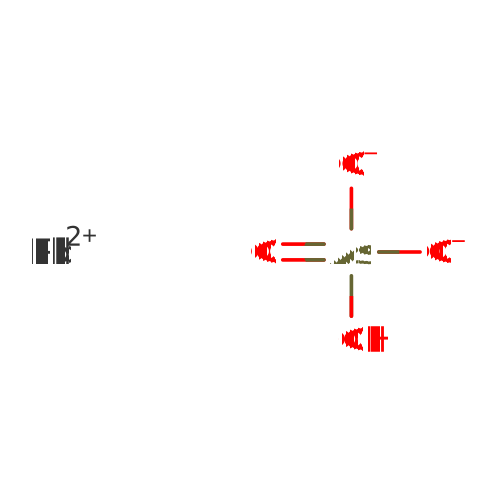
Lead arsenate is a chemical compound of lead and arsenic. It is derived from arsenic acid and originally used as an insecticide against the codling moth and potato beetle. Today its use is officially banned. Arsenic is a chemical element that has the symbol As and atomic number 33. It is a poisonous metalloid that has many allotropic forms: yellow (molecular non-metallic) and several black and grey forms (metalloids) are a few that are seen. Three metalloidal forms of arsenic with different crystal structures are found free in nature (the minerals arsenopyrite and the much rarer arsenolamprite and pararsenolamprite), but it is more commonly found as a compound with other elements. (13, 11)
belongs to the class of inorganic compounds known as post-transition metal arsenates. These are inorganic compounds in which the largest oxoanion is arsenate, and in which the heaviest atom not in an oxoanion is a post-transition metal.
Arsenic and its metabolites disrupt ATP production through several mechanisms. At the level of the citric acid cycle, arsenic inhibits pyruvate dehydrogenase and by competing with phosphate it uncouples oxidative phosphorylation, thus inhibiting energy-linked reduction of NAD+, mitochondrial respiration, and ATP synthesis. Hydrogen peroxide production is also increased, which might form reactive oxygen species and oxidative stress. Arsenic's carginogenicity is influenced by the arsenical binding of tubulin, which results in aneuploidy, polyploidy and mitotic arrests. The binding of other arsenic protein targets may also cause altered DNA repair enzyme activity, altered DNA methylation patterns and cell proliferation. Lead mimics other biologically important metals, such as zinc, calcium, and iron, competing as cofactors for many of their respective enzymatic reactions. For example, lead has been shown to competitively inhibit calcium's binding of calmodulin, interferring with neurotransmitter release. It exhibits similar competitive inhibition at the NMDA receptor and protein kinase C, which impairs brain microvascular formation and function, as well as alters the blood-brain barrier. Lead also affects the nervous system by impairing regulation of dopamine synthesis and blocking evoked release of acetylcholine. However, it's main mechanism of action occurs by inhibiting delta-aminolevulinic acid dehydratase, an enzyme vital in the biosynthesis of heme, which is a necesssary cofactor of hemoglobin. (12, 14, 1, 2, 3, 10)
Metabolism
Lead and arsenic are absorbed following inhalation, oral, and dermal exposure. Arsenic is then distributed throughout the body, where it is reduced into arsenite if necessary, then methylated into monomethylarsenic (MMA) and dimethylarsenic acid (DMA) by arsenite methyltransferase. Arsenic and its metabolites are primarily excreted in the urine. Arsenic is known to induce the metal-binding protein metallothionein, which decreases the toxic effects of arsenic and other metals by binding them and making them biologically inactive, as well as acting as an antioxidant. Lead is distributed mainly to the bones and red blood cells. In the blood lead may be found bound to serum albumin or the metal-binding protein metallothionein. Organic lead is metabolized by cytochrome P-450 enzymes, whereas inorganic lead forms complexes with delta-aminolevulinic acid dehydratase. Lead is excreted mainly in the urine and faeces. (10, 5)
Arsenic poisoning can lead to death from multi-system organ failure, probably from necrotic cell death, not apoptosis. Arsenic is also a known carcinogen, esepcially in skin, liver, bladder and lung cancers. Lead is a neurotoxin and has been known to cause brain damage and reduced cognitive capacity, especially in children. Lead exposure can result in nephropathy, as well as blood disorders such as high blood pressure and anemia. Lead also exhibits reproductive toxicity and can results in miscarriages and reduced sperm production. (12, 5, 6)
Symptoms
Exposure to lower levels of arsenic can cause nausea and vomiting, decreased production of red and white blood cells, abnormal heart rhythm, damage to blood vessels, and a sensation of burn (12).
Treatment
Both arsenic and poisoning can be treated by chelation therapy, using chelating agents such as dimercaprol, EDTA or DMSA. Charcoal tablets may also be used for less severe cases. In addition, maintaining a diet high in sulfur helps eliminate arsenic from the body. (5)