Record Information
Version1.0
Creation Date2009-03-06 18:58:23 UTC
Update Date2026-03-26 23:14:18 UTC
Accession NumberCHEM000225
Identification
Common Name2,6-Dinitrotoluene
ClassSmall Molecule
Description2,6-Dinitrotoluene is one of the six dinitrotoluene isomers. Dinitrotoluene (DNT) or Dinitro is an explosive with the formula C6H3(CH3)(NO2)2. At room temperature it is a pale yellow to orange crystalline solid. It is a high explosive and one of the precursors for trinitrotoluene (TNT), which is synthesized through three separate nitrations of toluene. The first product is mononitrotoluene, DNT is the second, and TNT is the third and final product. (2)
Contaminant Sources
  • Clean Air Act Chemicals
  • HPV EPA Chemicals
  • IARC Carcinogens Group 2B
  • STOFF IDENT Compounds
  • T3DB toxins
  • ToxCast & Tox21 Chemicals
Contaminant Type
  • Aromatic Hydrocarbon
  • Explosive Agent
  • Industrial/Workplace Toxin
  • Nitrite
  • Organic Compound
  • Plasticizer
  • Pollutant
  • Synthetic Compound
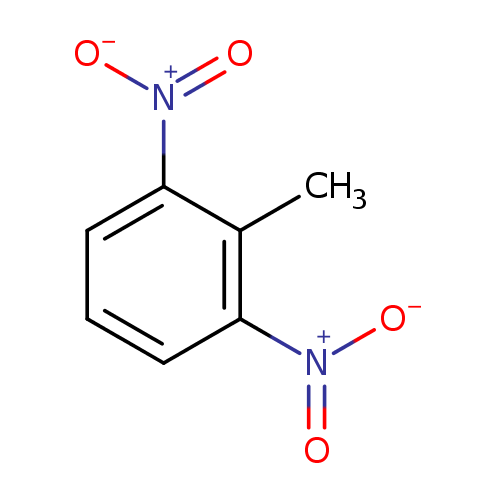
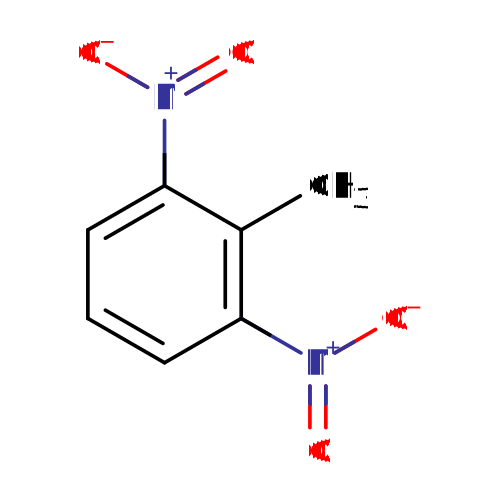
Chemical Structure
Thumb
Synonyms
ValueSource
1-Methyl-2,6-dinitrobenzeneChEBI
2,6-DinitromethylbenzeneChEBI
2,6-DNTChEBI
DNTHMDB
Chemical FormulaC7H6N2O4
Average Molecular Mass182.134 g/mol
Monoisotopic Mass182.033 g/mol
CAS Registry Number606-20-2
IUPAC Name2-methyl-1,3-dinitrobenzene
Traditional Name2,6-dinitrotoluene
SMILESCC1=C(C=CC=C1[N+]([O-])=O)[N+]([O-])=O
InChI IdentifierInChI=1S/C7H6N2O4/c1-5-6(8(10)11)3-2-4-7(5)9(12)13/h2-4H,1H3
InChI KeyXTRDKALNCIHHNI-UHFFFAOYSA-N
Chemical Taxonomy
Description belongs to the class of organic compounds known as dinitrotoluenes. These are organic aromatic compounds containing a benzene that carries a single methyl group and exactly two nitro groups.
KingdomOrganic compounds
Super ClassBenzenoids
ClassBenzene and substituted derivatives
Sub ClassToluenes
Direct ParentDinitrotoluenes
Alternative Parents
Substituents
  • Dinitrotoluene
  • Nitrobenzene
  • Nitroaromatic compound
  • C-nitro compound
  • Organic nitro compound
  • Organic oxoazanium
  • Allyl-type 1,3-dipolar organic compound
  • Propargyl-type 1,3-dipolar organic compound
  • Organic 1,3-dipolar compound
  • Organic nitrogen compound
  • Hydrocarbon derivative
  • Organic oxide
  • Organonitrogen compound
  • Organopnictogen compound
  • Organic oxygen compound
  • Aromatic homomonocyclic compound
Molecular FrameworkAromatic homomonocyclic compounds
External Descriptors
Biological Properties
StatusDetected and Not Quantified
OriginExogenous
Cellular Locations
  • Membrane
Biofluid LocationsNot Available
Tissue LocationsNot Available
PathwaysNot Available
ApplicationsNot Available
Biological Roles
Chemical RolesNot Available
Physical Properties
StateSolid
AppearanceWhite powder.
Experimental Properties
PropertyValue
Melting Point66°C
Boiling PointNot Available
SolubilityNot Available
Predicted Properties
PropertyValueSource
Water Solubility0.12 g/LALOGPS
logP1.81ALOGPS
logP2.37ChemAxon
logS-3.2ALOGPS
Physiological Charge0ChemAxon
Hydrogen Acceptor Count4ChemAxon
Hydrogen Donor Count0ChemAxon
Polar Surface Area91.64 ŲChemAxon
Rotatable Bond Count2ChemAxon
Refractivity45.75 m³·mol⁻¹ChemAxon
Polarizability15.45 ųChemAxon
Number of Rings1ChemAxon
Bioavailability1ChemAxon
Rule of FiveYesChemAxon
Ghose FilterNoChemAxon
Veber's RuleNoChemAxon
MDDR-like RuleNoChemAxon
Spectra
Spectra
Spectrum TypeDescriptionSplash KeyView
Predicted GC-MSPredicted GC-MS Spectrum - GC-MS (Non-derivatized) - 70eV, Positivesplash10-0032-9400000000-187f76ebf7bf7a3b53eeSpectrum
Predicted GC-MSPredicted GC-MS Spectrum - GC-MS (Non-derivatized) - 70eV, PositiveNot AvailableSpectrum
Predicted LC-MS/MSPredicted LC-MS/MS Spectrum - 10V, Positivesplash10-001i-0900000000-cdceb2b78695e9fc3548Spectrum
Predicted LC-MS/MSPredicted LC-MS/MS Spectrum - 20V, Positivesplash10-056r-0900000000-7963147e1fc7b2b2f671Spectrum
Predicted LC-MS/MSPredicted LC-MS/MS Spectrum - 40V, Positivesplash10-057i-1900000000-af99bdbd9be26e87e708Spectrum
Predicted LC-MS/MSPredicted LC-MS/MS Spectrum - 10V, Negativesplash10-001i-0900000000-516591494f516055d4c0Spectrum
Predicted LC-MS/MSPredicted LC-MS/MS Spectrum - 20V, Negativesplash10-001i-0900000000-5fc7b4abdf242577d41eSpectrum
Predicted LC-MS/MSPredicted LC-MS/MS Spectrum - 40V, Negativesplash10-00ai-1900000000-83598c0a5f572aec6db0Spectrum
MSMass Spectrum (Electron Ionization)splash10-02vl-9400000000-c50d5d0c3a8c5a66e6b1Spectrum
1D NMR1H NMR SpectrumNot AvailableSpectrum
1D NMR13C NMR SpectrumNot AvailableSpectrum
Toxicity Profile
Route of ExposureDermal (6) ; eye contact (6) ; inhalation (6) ; oral (6)
Mechanism of ToxicityDinitrotoluene may cause conversion of oxyhemoglobin to methemoglobin via oxidation of iron(II) to iron(III) by its metabolites. High levels of methemoglobin are removed by catabolism, leading to the development of anemia. Some metabolites of dinitrotoluene are also transported back from the bile to the liver, where the amine group is N-hydroxylated by cytochrome P-450 to form an unstable sulfate conjugate. The sulfate conjugate is degraded into carbonium or nitrenium ions. These ions covalently bind to hepatic macromolecules (DNA, RNA), leading to mutations and subsequently liver tumors. They also bind to DNA of the lung and the intestine. (3)
MetabolismThe metabolism of 2,6-DNT occurs in the liver and also in the intestine by microflora. Both oxidized and reduced metabolites are excreted in the urine after oral administration of the compound. Oxidative metabolism by cytochrome P450 predominates in the liver, leading to the formation of dinitrobenzyl alcohol which is either converted to glucuronide conjugate or further oxidized to dinitrobenzoic acid. Dinitrobenzyl alcohol glucuronide is partially excreted into the bile, followed by metabolism by gut microflora and enterohepatic cycling (nitroreductase). Thus, 2,6-DNT appears to be first metabolized by the liver with the metabolites being excreted into the bile; the biliary metabolites are hydrolyzed and further metabolized in the intestine; after reabsorption and circulation back to the liver, a portion of the metabolites (2-amino-6-nitrobenzyl) are oxidized to a hydroxylamine by hepatic enzymes. The hydroxylamine is then conjugated with sulfate by hepatic sulfotransferase. The unstable N-sulfate decomposes to form an electrophilic nitrenium ion, which can react with cellular nucleophiles such as DNA. 2,6-Dinitrobenzyl alcohol glucuronide, 2-amino-6-nitrotoluene, and 2,6-dinitrobenzaldehyde can be detected in the bile. Some amounts of 2,6-dinitrobenzylalcohol and 2-amino-6nitrobenzyl alcohol can also be found. (3)
Toxicity ValuesLD50: 180-795 mg/kg/day (Oral, Rat) (3)
Lethal DoseNot Available
Carcinogenicity (IARC Classification)2B, possibly carcinogenic to humans. (1)
Uses/SourcesIt is a high explosive and one of the precursors for trinitrotoluene (TNT), which is synthesized through three separate nitrations of toluene. 2,6-Dinitrotoluene can affect the body if it is inhaled, comes in contact with the eyes or skin, is swallowed, or is absorbed through the skin. Even a small amount absorbed from clothes or shoes may cause toxic symptoms. It is assumed that oral ingestion could be a secondary route for occupationally exposed humans. (2, 6)
Minimum Risk LevelIntermediate Oral: 0.004 mg/kg/day (Dog) (511)
Health Effects2,6-Dinitrotoluene poisoning may cause methemoglobinemia, anemia, leukopenia, and liver necrosis. Liver injury may be more common than cyanosis. (3)
SymptomsSymptoms of 2,4-dinitrotoluene poisoning include blue lips or finger nails, blue skin, vertigo, fatigue, dizziness, weakness, nausea, vomiting, dyspnea, arthralgia, insomnia, tremor, paralysis, unconsciousness, chest pain, shortness of breath, palpitation, anorexia, and loss of weight. (7, 4)
TreatmentFollowing oral exposure, immediately dilute with 4 to 8 ounces (120 to 240 mL) of water or milk (not to exceed 4 ounces/120 mL in a child). Administer charcoal as a slurry. Gastric lavage and oxygen administration is recommended. Following inhalation exposure, move patient to fresh air. Monitor for respiratory distress. If cough or difficulty breathing develops, evaluate for respiratory tract irritation, bronchitis, or pneumonitis. Administer oxygen and assist ventilation as required. Treat bronchospasm with inhaled beta2 agonist and oral or parenteral corticosteroids. Following eyes exposure, irrigate exposed eyes with copious amounts of room temperature water for at least 15 minutes. Following dermal exposure, remove contaminated clothing and wash exposed area thoroughly with soap and water, and administer a benzodiazepine IV in case of irritation. In all those cases, a physician may need to examine the area if irritation or pain persists. (5)

Concentrations
Not Available
DrugBank IDNot Available
HMDB IDHMDB0245521
FooDB IDNot Available
Phenol Explorer IDNot Available
KNApSAcK IDNot Available
BiGG IDNot Available
BioCyc IDCPD-9133
METLIN IDNot Available
PDB IDNot Available
Wikipedia Link2,4-Dinitrotoluene
Chemspider ID11320
ChEBI ID957
PubChem Compound ID11813
Kegg Compound IDC11008
YMDB IDNot Available
ECMDB IDNot Available
References
Synthesis ReferenceNot Available
MSDSNot Available
General References
1. https://www.ncbi.nlm.nih.gov/pubmed/?term=22155124
2. Barupal DK, Fiehn O: Generating the Blood Exposome Database Using a Comprehensive Text Mining and Database Fusion Approach. Environ Health Perspect. 2019 Sep;127(9):97008. doi: 10.1289/EHP4713. Epub 2019 Sep 26.