Record Information
Version1.0
Creation Date2009-03-06 18:58:22 UTC
Update Date2026-05-14 17:18:11 UTC
Accession NumberCHEM000219
Identification
Common NameN,N-Dimethylformamide
ClassSmall Molecule
DescriptionN,N-Dimethylformamide (DMF) is a clear liquid that has been widely used in industries as a solvent, an additive, or an intermediate because of its extensive miscibility with water and most common organic solvents. Its health effects include hepatotoxicity and male reproductoxicity, possibly linked with mitochondrial DNA (mtDNA) alterations including mtDNA common deletion (delta-mtDNA4977) and mtDNA copy number; during the biotransformation of DMF in the body, free radicals are formed, including hydroxyl radicals. The world-wide consumption of DMF in 2001 was approximately 285,000 metric tonnes and most of that was used as an industrial solvent. Overexposure to DMF could result in hepatotoxicity, alcohol intolerance, possible embryotoxicity and teratogenicity in humans and animals, and decline of human sperm motility. Based on its wide application and a wide range of toxic effects, DMF has been selected as one of the four priority compounds for human field studies by the National Toxicology Program (NTP) of the US National Institute of Environmental Health Sciences (NIEHS). The current permissible exposure limit for DMF in the working environment is 10 ppm in both USA and Taiwan. The concentrations of two major DMF metabolites in urine, N-methylformamide (U-NMF) of 15 mg/L and N-acetyl-S-(N-methylcarbamoyl) cysteine (U-AMCC) of 40 mg/L, were recommended as the biological exposure indices (BEIs) by the American Conference of Governmental Industrial Hygienists for DMF exposure in workplace. (2).
Contaminant Sources
  • Clean Air Act Chemicals
  • FooDB Chemicals
  • HMDB Contaminants - Urine
  • HPV EPA Chemicals
  • IARC Carcinogens Group 2A
  • IARC Carcinogens Group 3
  • OECD HPV Chemicals
  • STOFF IDENT Compounds
  • T3DB toxins
  • ToxCast & Tox21 Chemicals
Contaminant Type
  • Amide
  • Amine
  • Food Toxin
  • Human Neurotoxin
  • Industrial/Workplace Toxin
  • Metabolite
  • Organic Compound
  • Pollutant
  • Solvent
  • Synthetic Compound
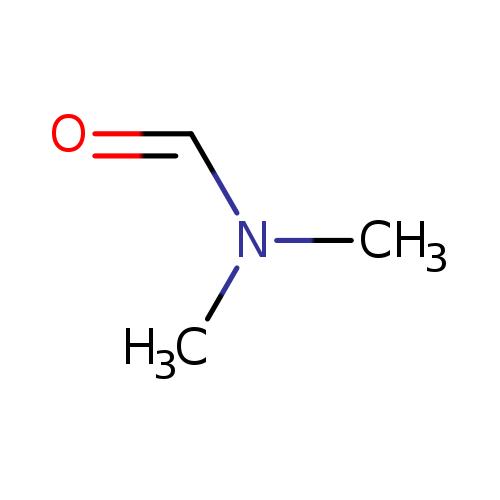
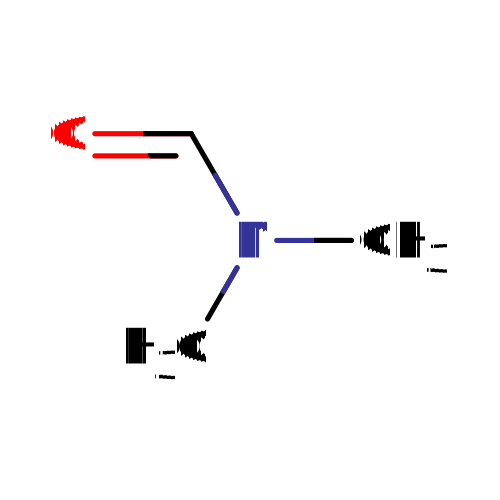
Chemical Structure
Thumb
Synonyms
ValueSource
DimethylformamideChEBI
DMFChEBI
N,N-DimethylmethanamideChEBI
N-FormyldimethylamineChEBI
Dimethyl formamideHMDB
Dimethyl-formamideHMDB
Dimethylamid kyseliny mravenciHMDB
DimethylforamideHMDB
DimethylformamidHMDB
DimetilformamideHMDB
DimetylformamiduHMDB
DwumetyloformamidHMDB
FormyldimethylamineHMDB
N,N- Dimethyl formamideHMDB
N,N- DimethylformamideHMDB
N,N-Dimethyl-formamideHMDB
N,N DimethylformamideHMDB
Chemical FormulaC3H7NO
Average Molecular Mass73.094 g/mol
Monoisotopic Mass73.053 g/mol
CAS Registry Number1968-12-02
IUPAC NameN,N-dimethylformamide
Traditional Namedimethylformamide
SMILESCN(C)C=O
InChI IdentifierInChI=1S/C3H7NO/c1-4(2)3-5/h3H,1-2H3
InChI KeyZMXDDKWLCZADIW-UHFFFAOYSA-N
Chemical Taxonomy
Description belongs to the class of organic compounds known as tertiary carboxylic acid amides. Tertiary carboxylic acid amides are compounds containing an amide derivative of carboxylic acid, with the general structure RN(R1)C(R2)=O (R1-R2 any atom but H).
KingdomOrganic compounds
Super ClassOrganic acids and derivatives
ClassCarboxylic acids and derivatives
Sub ClassCarboxylic acid derivatives
Direct ParentTertiary carboxylic acid amides
Alternative Parents
Substituents
  • Tertiary carboxylic acid amide
  • Organic nitrogen compound
  • Organic oxygen compound
  • Organopnictogen compound
  • Organic oxide
  • Hydrocarbon derivative
  • Organooxygen compound
  • Organonitrogen compound
  • Carbonyl group
  • Aliphatic acyclic compound
Molecular FrameworkAliphatic acyclic compounds
External Descriptors
Biological Properties
StatusDetected and Not Quantified
OriginExogenous
Cellular Locations
  • Cytoplasm
  • Extracellular
Biofluid LocationsNot Available
Tissue LocationsNot Available
PathwaysNot Available
Applications
Biological Roles
Chemical Roles
Physical Properties
StateLiquid
AppearanceNot Available
Experimental Properties
PropertyValue
Melting Point-60.4°C
Boiling Point153°C (307.4°F)
Solubility1000 mg/mL at 25°C
Predicted Properties
PropertyValueSource
Water Solubility725 g/LALOGPS
logP-0.77ALOGPS
logP-0.63ChemAxon
logS1ALOGPS
pKa (Strongest Basic)-1.3ChemAxon
Physiological Charge0ChemAxon
Hydrogen Acceptor Count1ChemAxon
Hydrogen Donor Count0ChemAxon
Polar Surface Area20.31 ŲChemAxon
Rotatable Bond Count0ChemAxon
Refractivity19.77 m³·mol⁻¹ChemAxon
Polarizability7.69 ųChemAxon
Number of Rings0ChemAxon
Bioavailability1ChemAxon
Rule of FiveYesChemAxon
Ghose FilterNoChemAxon
Veber's RuleYesChemAxon
MDDR-like RuleNoChemAxon
Spectra
Spectra
Spectrum TypeDescriptionSplash KeyView
Predicted GC-MSPredicted GC-MS Spectrum - GC-MS (Non-derivatized) - 70eV, Positivesplash10-006x-9000000000-34e0d5dce52ab7332a48Spectrum
Predicted GC-MSPredicted GC-MS Spectrum - GC-MS (Non-derivatized) - 70eV, PositiveNot AvailableSpectrum
LC-MS/MSLC-MS/MS Spectrum - Quattro_QQQ 10V, Positive (Annotated)splash10-00di-9000000000-2fc3e0f8da9a647359faSpectrum
LC-MS/MSLC-MS/MS Spectrum - Quattro_QQQ 25V, Positive (Annotated)splash10-001l-9000000000-f4fe42c25bc21b32c720Spectrum
LC-MS/MSLC-MS/MS Spectrum - Quattro_QQQ 40V, Positive (Annotated)splash10-000x-9000000000-c16bd85f59063ed223cdSpectrum
LC-MS/MSLC-MS/MS Spectrum - LC-ESI-QTOF (UPLC Q-Tof Premier, Waters) , Positivesplash10-00di-9000000000-cc68a0ecc7c49de9adf0Spectrum
LC-MS/MSLC-MS/MS Spectrum - LC-ESI-QTOF (UPLC Q-Tof Premier, Waters) 30V, Positivesplash10-00di-9000000000-9f91c0e4ecf9323c5268Spectrum
LC-MS/MSLC-MS/MS Spectrum - LC-ESI-QTOF , positivesplash10-00di-9000000000-cc68a0ecc7c49de9adf0Spectrum
LC-MS/MSLC-MS/MS Spectrum - LC-ESI-QTOF , positivesplash10-00di-9000000000-9f91c0e4ecf9323c5268Spectrum
LC-MS/MSLC-MS/MS Spectrum - 35V, Positivesplash10-006y-9000000000-5543ffa660a73e2f60aeSpectrum
LC-MS/MSLC-MS/MS Spectrum - 30V, Positivesplash10-00di-9000000000-9f91c0e4ecf9323c5268Spectrum
Predicted LC-MS/MSPredicted LC-MS/MS Spectrum - 10V, Positivesplash10-00di-9000000000-7021cfe3ddcd7eead969Spectrum
Predicted LC-MS/MSPredicted LC-MS/MS Spectrum - 20V, Positivesplash10-00di-9000000000-ceda884adf62fcbbade6Spectrum
Predicted LC-MS/MSPredicted LC-MS/MS Spectrum - 40V, Positivesplash10-00di-9000000000-dfa16f4b703eedcce213Spectrum
Predicted LC-MS/MSPredicted LC-MS/MS Spectrum - 10V, Negativesplash10-00di-9000000000-20383304fc1b3341c39dSpectrum
Predicted LC-MS/MSPredicted LC-MS/MS Spectrum - 20V, Negativesplash10-00di-9000000000-4add65e7ea3604d5d1fcSpectrum
Predicted LC-MS/MSPredicted LC-MS/MS Spectrum - 40V, Negativesplash10-05fr-9000000000-a05f660af113d947481eSpectrum
Predicted LC-MS/MSPredicted LC-MS/MS Spectrum - 10V, Negativesplash10-00di-9000000000-bc974757d0839ce6b57cSpectrum
Predicted LC-MS/MSPredicted LC-MS/MS Spectrum - 20V, Negativesplash10-00di-9000000000-bc974757d0839ce6b57cSpectrum
Predicted LC-MS/MSPredicted LC-MS/MS Spectrum - 40V, Negativesplash10-0006-9000000000-33646a67bc59fe05be54Spectrum
Predicted LC-MS/MSPredicted LC-MS/MS Spectrum - 10V, Positivesplash10-00di-9000000000-ca67ae001025b0816d1cSpectrum
Predicted LC-MS/MSPredicted LC-MS/MS Spectrum - 20V, Positivesplash10-00dm-9000000000-c1637e5f95671002e1bcSpectrum
Predicted LC-MS/MSPredicted LC-MS/MS Spectrum - 40V, Positivesplash10-00di-9000000000-78ef7927403f69155f40Spectrum
MSMass Spectrum (Electron Ionization)splash10-006x-9000000000-039511887fde37138176Spectrum
1D NMR1H NMR SpectrumNot AvailableSpectrum
1D NMR13C NMR SpectrumNot AvailableSpectrum
2D NMR[1H,13C] 2D NMR SpectrumNot AvailableSpectrum
Toxicity Profile
Route of ExposureOral ; inhalation ; dermal
Mechanism of ToxicityWhile the mechanism of action of dimethyl formamide has not bee fully elucidated, thiocarbamate pesticides have been shown to inhibit aldehyde dehydrogenases. (1)
MetabolismDimethyl formamide may be absorbed following ingestion, inhalation, and dermal exposure, and is distributed evenly throughout the body. Metabolism takes place in the liver via microsomal enzyme systems, producing N-hydroxymethyl- N-methylformamide (DMF-OH) as the main urinary metabolite.
Toxicity ValuesLD50: 2800 mg/kg (Oral, Rat) (7) LD50: 1400 mg/kg (Intraperitoneal, Rat) (7) LD50: 3800 mg/kg (Subcutaneous, Rat) (7) LD50: 2000 mg/kg (Intravenous, Rat) (7)
Lethal Dose10 grams for an adult human. (8)
Carcinogenicity (IARC Classification)3, not classifiable as to its carcinogenicity to humans. (4)
Uses/SourcesDimethyl formamide (DMF) is commonly used as a solvent for chemical reactions. (5)
Minimum Risk LevelNot Available
Health EffectsDimethyl formamide is a known hepatatotoxin. It may also cause birth defects, kidney damage, and temporary alcohol intolerance. (5)
SymptomsSymptoms of dimethyl formamide exposure may include abdominal pain, nausea, vomiting, dizziness, fatigue, headache, loss of appetite, and temporary alcohol intolerance. (5)
TreatmentAs there is no antidote for dimethyl formamide poisoning, treatment is mainly supportive and symptomatic. (8)
Concentrations
Not Available
DrugBank IDDB01844
HMDB IDHMDB0001888
FooDB IDFDB004724
Phenol Explorer IDNot Available
KNApSAcK IDNot Available
BiGG IDNot Available
BioCyc IDCPD-581
METLIN IDNot Available
PDB IDNot Available
Wikipedia LinkDimethylformamide
Chemspider ID5993
ChEBI ID17741
PubChem Compound ID6228
Kegg Compound IDC03134
YMDB IDYMDB01396
ECMDB IDM2MDB005291
References
Synthesis Reference

Masao Saito, Kinichi Mizuno, Yuzi Onda, Tetsuo Aoyama, Kumiko Kato, “Process for producing dimethylformamide.” U.S. Patent US4218398, issued August, 1933.

MSDSLink
General References
1. Shieh DB, Chen CC, Shih TS, Tai HM, Wei YH, Chang HY: Mitochondrial DNA alterations in blood of the humans exposed to N,N-dimethylformamide. Chem Biol Interact. 2007 Feb 20;165(3):211-9. Epub 2006 Dec 20.
2. Redlich CA, Beckett WS, Sparer J, Barwick KW, Riely CA, Miller H, Sigal SL, Shalat SL, Cullen MR: Liver disease associated with occupational exposure to the solvent dimethylformamide. Ann Intern Med. 1988 May;108(5):680-6.
3. https://www.ncbi.nlm.nih.gov/pubmed/?term=18666198
4. https://www.ncbi.nlm.nih.gov/pubmed/?term=19608215
5. https://www.ncbi.nlm.nih.gov/pubmed/?term=3824392