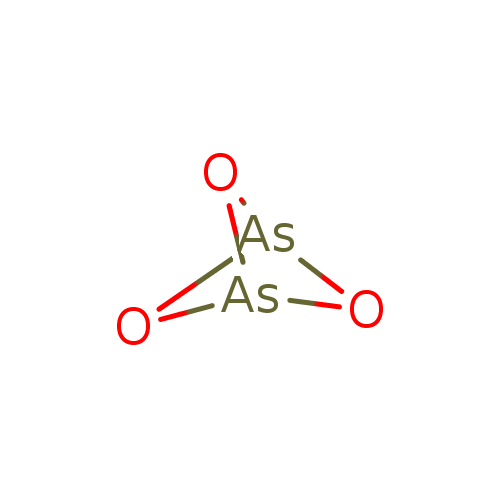
Arsenic trioxide is a chemotheraputic agent of idiopathic function used to treat leukemia that is unresponsive to first line agents. It is suspected that arsenic trisulfide induces cancer cells to undergo apoptosis. Due to the toxic nature of arsenic, this drug carries significant health risks. The enzyme thioredoxin reductase has recently been identified as a target for arsenic trioxide.
belongs to the class of inorganic compounds known as miscellaneous arsenites. These are inorganic compounds in which the largest metallic oxoanion is arsenite, to which either no atom or a non metal atom is bonded.
The mechanism of action of Arsenic Trioxide is not completely understood. Arsenic trioxide causes morphological changes and DNA fragmentation characteristic of apoptosis in NB4 human promyelocytic leukemia cells in vitro. Arsenic trioxide also causes damage or degradation of the fusion protein PML/RAR-alpha. It is suspected that arsenic trioxide induces cancer cells to undergo apoptosis. Arsenic and its metabolites disrupt ATP production through several mechanisms. At the level of the citric acid cycle, arsenic inhibits pyruvate dehydrogenase and by competing with phosphate it uncouples oxidative phosphorylation, thus inhibiting energy-linked reduction of NAD+, mitochondrial respiration, and ATP synthesis. Hydrogen peroxide production is also increased, which might form reactive oxygen species and oxidative stress. Arsenic's carginogenicity is influenced by the arsenical binding of tubulin, which results in aneuploidy, polyploidy and mitotic arrests. The binding of other arsenic protein targets may also cause altered DNA repair enzyme activity, altered DNA methylation patterns and cell proliferation. (11, 3)
Metabolism
Arsenic is mainly absorbed by inhalation or ingestion, and to a lesser extent by dermal exposure. It is then distributed throughout the body, where it is reduced into arsenite if necessary, then methylated into monomethylarsenic (MMA) and dimethylarsenic acid (DMA) by arsenite methyltransferase. Arsenic and its metabolites are primarily excreted in the urine. Arsenic is known to induce the metal-binding protein metallothionein, which decreases the toxic effects of arsenic and other metals by binding them and making them biologically inactive, as well as acting as an antioxidant. (6) The metabolism of arsenic trioxide involves reduction of pentavalent arsenic to trivalent arsenic by arsenate reductase and methylation of trivalent arsenic to monomethylarsonic acid and monomethylarsonic acid to dimethylarsinic acid by methyltransferases. The main site of methylation reactions appears to be the liver. Arsenic is stored mainly in liver, kidney, heart, lung, hair and nails.
Route of Elimination: Trivalent arsenic is mostly methylated in humans and excreted in urine.
Arsenic trioxide is a byproduct of certain kinds of ore processing. It is the starting point for the manufacture of many arsenic-based products, including pesticides, pharamaceuticals, alloys, and semiconductors. It is also used as a wood preservative and decolorizing agent. (10) It is also use for induction of remission and consolidation in patients with acute promyelocytic leukemia (APL), and whose APL is characterized by the presence of the t(15;17) translocation or PML/RAR-alpha gene expression.
Arsenic poisoning can lead to death from multi-system organ failure, probably from necrotic cell death, not apoptosis. Arsenic is also a known carcinogen, especially in skin, liver, bladder and lung cancers. (11, 6)
Symptoms
Symptoms of overdose include convulsions, muscle weakness and confusion. Exposure to lower levels of arsenic can cause nausea and vomiting, decreased production of red and white blood cells, abnormal heart rhythm, and damage to blood vessels.
Treatment
Arsenic poisoning can be treated by chelation therapy, using chelating agents such as dimercaprol, EDTA or DMSA. Charcoal tablets may also be used for less severe cases. In addition, maintaining a diet high in sulfur helps eliminate arsenic from the body. (6)