Record Information
Version1.0
Creation Date2009-03-06 18:58:17 UTC
Update Date2026-05-14 17:49:17 UTC
Accession NumberCHEM000183
Identification
Common Name1,4-Dioxane
ClassSmall Molecule
Description1,4-Dioxane (commonly referred to as simply ‘dioxane’) is used as a solvent in the manufacture of other chemicals and as a laboratory reagent. It is a trace contaminant of some chemicals used in cosmetics, detergents, and shampoos. (4)
Contaminant Sources
  • Clean Air Act Chemicals
  • HPV EPA Chemicals
  • IARC Carcinogens Group 2B
  • OECD HPV Chemicals
  • STOFF IDENT Compounds
  • T3DB toxins
  • ToxCast & Tox21 Chemicals
Contaminant Type
  • Cosmetic Toxin
  • Ether
  • Household Toxin
  • Industrial/Workplace Toxin
  • Lachrymator
  • Organic Compound
  • PMT
  • Pollutant
  • Solvent
  • Synthetic Compound
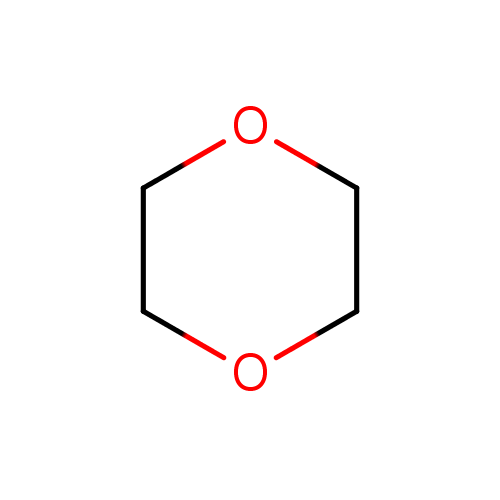
Chemical Structure
Thumb
Synonyms
ValueSource
1,4-DIETHYLENE dioxideChEBI
1,4-DioxacyclohexaneChEBI
1,4-DioxanChEBI
Di(ethylene oxide)ChEBI
Dioxan-1,4ChEBI
Dioxane-1,4ChEBI
Glycol ethylene etherChEBI
p-DioxaneChEBI
Tetrahydro-1,4-dioxinChEBI
Tetrahydro-p-dioxinChEBI
Tetrahydro-para-dioxinChEBI
DioxaneMeSH
Diethylene etherMeSH
DioxanMeSH
Chemical FormulaC4H8O2
Average Molecular Mass88.105 g/mol
Monoisotopic Mass88.052 g/mol
CAS Registry Number123-91-1
IUPAC Name1,4-dioxane
Traditional Namedioxane
SMILESC1COCCO1
InChI IdentifierInChI=1S/C4H8O2/c1-2-6-4-3-5-1/h1-4H2
InChI KeyRYHBNJHYFVUHQT-UHFFFAOYSA-N
Chemical Taxonomy
Description belongs to the class of organic compounds known as 1,4-dioxanes. These are organic compounds containing 1,4-dioxane, an aliphatic six-member ring with two oxygen atoms in ring positions 1 and 4.
KingdomOrganic compounds
Super ClassOrganoheterocyclic compounds
ClassDioxanes
Sub Class1,4-dioxanes
Direct Parent1,4-dioxanes
Alternative Parents
Substituents
  • Para-dioxane
  • Oxacycle
  • Ether
  • Dialkyl ether
  • Organic oxygen compound
  • Hydrocarbon derivative
  • Organooxygen compound
  • Aliphatic heteromonocyclic compound
Molecular FrameworkAliphatic heteromonocyclic compounds
External Descriptors
Biological Properties
StatusDetected and Not Quantified
OriginExogenous
Cellular Locations
  • Cytoplasm
  • Extracellular
Biofluid LocationsNot Available
Tissue LocationsNot Available
PathwaysNot Available
Applications
Biological Roles
Chemical Roles
Physical Properties
StateLiquid
Appearance1,4-Dioxane is a colorless volatile liquid with a faint pleasant odor and mixes easily with water. (4)
Experimental Properties
PropertyValue
Melting Point11.8°C
Boiling Point101.1 °C
Solubility1000 mg/mL at 20 °C [RIDDICK,JA et al. (1986)]
Predicted Properties
PropertyValueSource
Water Solubility283 g/LALOGPS
logP-0.23ALOGPS
logP-0.094ChemAxon
logS0.51ALOGPS
pKa (Strongest Basic)-3.9ChemAxon
Physiological Charge0ChemAxon
Hydrogen Acceptor Count2ChemAxon
Hydrogen Donor Count0ChemAxon
Polar Surface Area18.46 ŲChemAxon
Rotatable Bond Count0ChemAxon
Refractivity22.09 m³·mol⁻¹ChemAxon
Polarizability8.97 ųChemAxon
Number of Rings1ChemAxon
Bioavailability1ChemAxon
Rule of FiveYesChemAxon
Ghose FilterNoChemAxon
Veber's RuleYesChemAxon
MDDR-like RuleNoChemAxon
Spectra
Spectra
Spectrum TypeDescriptionSplash KeyView
GC-MSGC-MS Spectrum - EI-B (Non-derivatized)splash10-0570-9000000000-fdad6aa284c3554c651bSpectrum
Predicted GC-MSPredicted GC-MS Spectrum - GC-MS (Non-derivatized) - 70eV, Positivesplash10-056u-9000000000-ecaeff4720923991aaf7Spectrum
Predicted GC-MSPredicted GC-MS Spectrum - GC-MS (Non-derivatized) - 70eV, PositiveNot AvailableSpectrum
Predicted LC-MS/MSPredicted LC-MS/MS Spectrum - 10V, Positivesplash10-000i-9000000000-a45455298eba19de60adSpectrum
Predicted LC-MS/MSPredicted LC-MS/MS Spectrum - 20V, Positivesplash10-000i-9000000000-77a0261c34ff328faf53Spectrum
Predicted LC-MS/MSPredicted LC-MS/MS Spectrum - 40V, Positivesplash10-08fu-9000000000-f3d10a4316418b32ed1dSpectrum
Predicted LC-MS/MSPredicted LC-MS/MS Spectrum - 10V, Negativesplash10-000i-9000000000-7416375fa93c0232c2a5Spectrum
Predicted LC-MS/MSPredicted LC-MS/MS Spectrum - 20V, Negativesplash10-000i-9000000000-cde6a647139e5c454cdeSpectrum
Predicted LC-MS/MSPredicted LC-MS/MS Spectrum - 40V, Negativesplash10-056r-9000000000-5654a8542422e5b26444Spectrum
Predicted LC-MS/MSPredicted LC-MS/MS Spectrum - 10V, Positivesplash10-0002-9000000000-1cd14a6c0dba761ba726Spectrum
Predicted LC-MS/MSPredicted LC-MS/MS Spectrum - 20V, Positivesplash10-0a4m-9000000000-633cab61fb801edbb652Spectrum
Predicted LC-MS/MSPredicted LC-MS/MS Spectrum - 40V, Positivesplash10-052g-9000000000-4a133ce242a34983b4d0Spectrum
Predicted LC-MS/MSPredicted LC-MS/MS Spectrum - 10V, Negativesplash10-052o-9000000000-65decf9e96649a33752eSpectrum
Predicted LC-MS/MSPredicted LC-MS/MS Spectrum - 20V, Negativesplash10-06rf-9000000000-0632a2171f1de13ca240Spectrum
Predicted LC-MS/MSPredicted LC-MS/MS Spectrum - 40V, Negativesplash10-0006-9000000000-06f5fc3dedd188a15fe9Spectrum
MSMass Spectrum (Electron Ionization)splash10-004i-9000000000-fabd529b7bd7382fe095Spectrum
1D NMR1H NMR SpectrumNot AvailableSpectrum
1D NMR13C NMR SpectrumNot AvailableSpectrum
1D NMR1H NMR SpectrumNot AvailableSpectrum
1D NMR13C NMR SpectrumNot AvailableSpectrum
1D NMR1H NMR SpectrumNot AvailableSpectrum
1D NMR13C NMR SpectrumNot AvailableSpectrum
1D NMR1H NMR SpectrumNot AvailableSpectrum
1D NMR13C NMR SpectrumNot AvailableSpectrum
1D NMR1H NMR SpectrumNot AvailableSpectrum
1D NMR13C NMR SpectrumNot AvailableSpectrum
1D NMR1H NMR SpectrumNot AvailableSpectrum
1D NMR13C NMR SpectrumNot AvailableSpectrum
1D NMR1H NMR SpectrumNot AvailableSpectrum
1D NMR13C NMR SpectrumNot AvailableSpectrum
1D NMR1H NMR SpectrumNot AvailableSpectrum
1D NMR13C NMR SpectrumNot AvailableSpectrum
1D NMR1H NMR SpectrumNot AvailableSpectrum
1D NMR13C NMR SpectrumNot AvailableSpectrum
1D NMR1H NMR SpectrumNot AvailableSpectrum
1D NMR13C NMR SpectrumNot AvailableSpectrum
1D NMR1H NMR SpectrumNot AvailableSpectrum
Toxicity Profile
Route of ExposureOral (4) ; inhalation (4) ; dermal (4)
Mechanism of ToxicityThough the mechanism of toxicity of 1,4-dioxane has not yet been elucidated, it is known that its carcinogenic effects are caused by a non-genotoxic mechanism that is most likely cytotoxic in nature. (4, 6)
MetabolismExposure to 1,4-dioxane may occur by inhalation, ingestion, and to a lesser extent by dermal contact. 1,4-Dioxane is quickly absorbed and metabolized to beta-hydroxyethoxyacetic acid (HEAA) by mixed-function oxidase enzymes. HEAA can then be converted to 1,4-dioxane-2-one under acidic conditions. Both of these products are rapidly and extensively eliminated in the urine (>95%). Unchanged 1,4-dioxane can also be excreted in the urine and in exhaled air, but mainly after high-dose exposure. (4)
Toxicity ValuesLD50: 1550 mg/kg (Intravenous, Rabbit) (1) LD50: 4350 mg/kg (Subcutaneous, Mouse) (1) LD50: >8300 mg/kg (Dermal, Rabbit) (1) LD50: 2100 mg/kg (Oral, Dog) (1) LD50: 799 mg/kg (Intraperitoneal, Rat) (7) LC50: 46 g/m3 over 2 hours (Inhalation, Rat) (1)
Lethal Dose470 ppm for an adult human. (2)
Carcinogenicity (IARC Classification)2B, possibly carcinogenic to humans. (3)
Uses/Sources1,4-Dioxane is primarily used in solvent applications for the manufacturing sector; however, it is also found in fumigants and automotive coolant. 1,4-Dioxane is a byproduct of the ethoxylation process in cosmetics manufacturing, thus many products on the market today contain 1,4-dioxane in very small amounts. However, some cosmetics, detergents, and shampoos may contain 1,4-dioxane at levels higher than recommended by the FDA for other products. 1,4-Dioxane can also be found in tap water, so human exposure to 1,4-dioxane may also occur during activities such as showering, bathing, and laundering. (4, 5)
Minimum Risk LevelNot Available
Health Effects1,4-Dioxane for short period of time cause eye and nose irritation at low levels, and severe kidney and liver effects and possibly death at very high levels. For long-term exposure, studies in animals have shown that breathing vapors of 1,4-dioxane, swallowing liquid 1,4-dioxane or contaminated drinking water, or having skin contact with liquid 1,4-dioxane affects mainly the liver and kidneys. Studies in workers did not indicate whether 1,4-dioxane causes cancer, but animal studies suggest that it is a probable human carcinogen. (4)
Symptoms1,4-Dioxane causes eye and respiratory tract irritation. (5)
TreatmentNot Available
Concentrations
Not Available
DrugBank IDDB03316
HMDB IDHMDB0244216
FooDB IDNot Available
Phenol Explorer IDNot Available
KNApSAcK IDC00055321
BiGG IDNot Available
BioCyc IDNot Available
METLIN IDNot Available
PDB IDNot Available
Wikipedia Link1,4-Dioxane
Chemspider ID29015
ChEBI ID47032
PubChem Compound IDNot Available
Kegg Compound IDC14440
YMDB IDNot Available
ECMDB IDNot Available
References
Synthesis ReferenceNot Available
MSDSNot Available
General References
1. https://www.ncbi.nlm.nih.gov/pubmed/?term=14550759
2. https://www.ncbi.nlm.nih.gov/pubmed/?term=18044507
3. https://www.ncbi.nlm.nih.gov/pubmed/?term=20598439