Record Information
Version1.0
Creation Date2009-03-06 18:58:16 UTC
Update Date2026-08-23 09:04:40 UTC
Accession NumberCHEM000178
Identification
Common Name1,2,4-Trichlorobenzene
ClassSmall Molecule
Description1,2,4-Trichlorobenzene is an organochloride aromatic compound and one of the three isomeric forms of trichlorobenzene. Trichlorobenzene is used as a solvent. (4)
Contaminant Sources
  • Clean Air Act Chemicals
  • HPV EPA Chemicals
  • My Exposome Chemicals
  • OECD HPV Chemicals
  • STOFF IDENT Compounds
  • Sludge Chemicals
  • T3DB toxins
  • ToxCast & Tox21 Chemicals
Contaminant Type
  • Aromatic Hydrocarbon
  • Industrial/Workplace Toxin
  • Lachrymator
  • Organic Compound
  • Organochloride
  • PMT
  • Pesticide
  • Pollutant
  • Solvent
  • Synthetic Compound
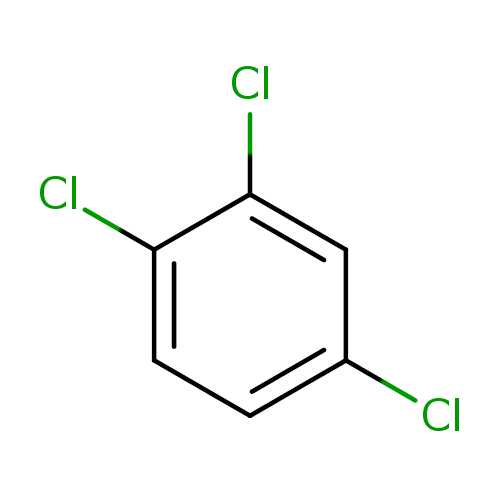
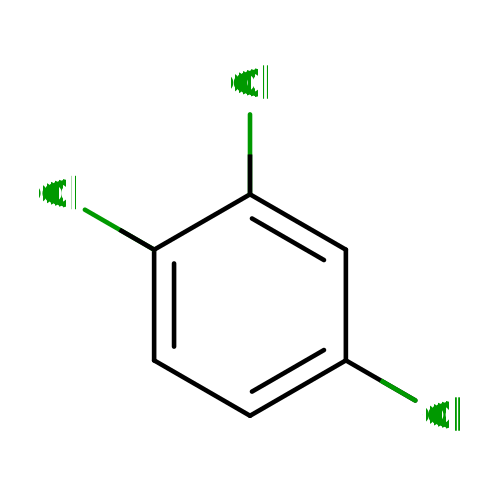
Chemical Structure
Thumb
Synonyms
ValueSource
1,2,4-TrichlorbenzolChEBI
1,2,5-TrichlorobenzeneChEBI
As-trichlorobenzeneChEBI
Trichlorobenzene aChEBI
Unsym-trichlorobenzeneChEBI
Chemical FormulaC6H3Cl3
Average Molecular Mass181.447 g/mol
Monoisotopic Mass179.930 g/mol
CAS Registry Number120-82-1
IUPAC Name1,2,4-trichlorobenzene
Traditional Name1,2, 4-trichlorobenzene
SMILESClC1=CC=C(Cl)C(Cl)=C1
InChI IdentifierInChI=1S/C6H3Cl3/c7-4-1-2-5(8)6(9)3-4/h1-3H
InChI KeyPBKONEOXTCPAFI-UHFFFAOYSA-N
Chemical Taxonomy
Description belongs to the class of organic compounds known as chlorobenzenes. Chlorobenzenes are compounds containing one or more chlorine atoms attached to a benzene moiety.
KingdomOrganic compounds
Super ClassBenzenoids
ClassBenzene and substituted derivatives
Sub ClassHalobenzenes
Direct ParentChlorobenzenes
Alternative Parents
Substituents
  • Chlorobenzene
  • Aryl halide
  • Aryl chloride
  • Hydrocarbon derivative
  • Organochloride
  • Organohalogen compound
  • Aromatic homomonocyclic compound
Molecular FrameworkAromatic homomonocyclic compounds
External Descriptors
Biological Properties
StatusDetected and Not Quantified
OriginExogenous
Cellular Locations
  • Membrane
Biofluid LocationsNot Available
Tissue LocationsNot Available
PathwaysNot Available
ApplicationsNot Available
Biological RolesNot Available
Chemical RolesNot Available
Physical Properties
StateSolid
AppearanceWhite crystals.
Experimental Properties
PropertyValue
Melting Point17°C
Boiling PointNot Available
Solubility0.049 mg/mL at 25 °C [SOUTHWORTH,GR & KELLER,JL (1986)]
Predicted Properties
PropertyValueSource
Water Solubility0.027 g/LALOGPS
logP4.08ALOGPS
logP3.79ChemAxon
logS-3.8ALOGPS
Physiological Charge0ChemAxon
Hydrogen Acceptor Count0ChemAxon
Hydrogen Donor Count0ChemAxon
Polar Surface Area0 ŲChemAxon
Rotatable Bond Count0ChemAxon
Refractivity40.47 m³·mol⁻¹ChemAxon
Polarizability15.44 ųChemAxon
Number of Rings1ChemAxon
Bioavailability1ChemAxon
Rule of FiveYesChemAxon
Ghose FilterNoChemAxon
Veber's RuleYesChemAxon
MDDR-like RuleNoChemAxon
Spectra
Spectra
Spectrum TypeDescriptionSplash KeyView
Predicted GC-MSPredicted GC-MS Spectrum - GC-MS (Non-derivatized) - 70eV, Positivesplash10-003r-2900000000-073481c62b708be88163Spectrum
Predicted GC-MSPredicted GC-MS Spectrum - GC-MS (Non-derivatized) - 70eV, PositiveNot AvailableSpectrum
Predicted LC-MS/MSPredicted LC-MS/MS Spectrum - 10V, Positivesplash10-001i-0900000000-72c4f920845f485f580cSpectrum
Predicted LC-MS/MSPredicted LC-MS/MS Spectrum - 20V, Positivesplash10-001i-0900000000-5660a94b26080f040978Spectrum
Predicted LC-MS/MSPredicted LC-MS/MS Spectrum - 40V, Positivesplash10-001i-0900000000-899f74e21948b9fd3a2dSpectrum
Predicted LC-MS/MSPredicted LC-MS/MS Spectrum - 10V, Negativesplash10-004i-0900000000-ba346e43f72739903752Spectrum
Predicted LC-MS/MSPredicted LC-MS/MS Spectrum - 20V, Negativesplash10-004i-0900000000-ba346e43f72739903752Spectrum
Predicted LC-MS/MSPredicted LC-MS/MS Spectrum - 40V, Negativesplash10-004i-1900000000-7addaeecd334f910883cSpectrum
Predicted LC-MS/MSPredicted LC-MS/MS Spectrum - 10V, Negativesplash10-004i-0900000000-c13ac7310423ef90149dSpectrum
Predicted LC-MS/MSPredicted LC-MS/MS Spectrum - 20V, Negativesplash10-004i-0900000000-c13ac7310423ef90149dSpectrum
Predicted LC-MS/MSPredicted LC-MS/MS Spectrum - 40V, Negativesplash10-004i-0900000000-c13ac7310423ef90149dSpectrum
Predicted LC-MS/MSPredicted LC-MS/MS Spectrum - 10V, Positivesplash10-001i-0900000000-0d665418e6e6f0a5dc77Spectrum
Predicted LC-MS/MSPredicted LC-MS/MS Spectrum - 20V, Positivesplash10-001i-0900000000-0d665418e6e6f0a5dc77Spectrum
Predicted LC-MS/MSPredicted LC-MS/MS Spectrum - 40V, Positivesplash10-001i-0900000000-0d665418e6e6f0a5dc77Spectrum
MSMass Spectrum (Electron Ionization)splash10-001i-2900000000-2b812a3ae463cff4e018Spectrum
1D NMR1H NMR SpectrumNot AvailableSpectrum
1D NMR13C NMR SpectrumNot AvailableSpectrum
Toxicity Profile
Route of ExposureOral (7) ; inhalation (7) ; dermal (7)
Mechanism of ToxicityTrichlorobenzene may uncouple mitochondrial oxidative phosphorylation, inducing potassium ion release and inhibiting respiratory control. It's metabolites may covalently bind to cellular proteins and alkylate DNA. (2, 3)
MetabolismTrichlorobenzene is absorbed via oral, inhalation, and dermal routes. It is believed to be metabolized via cytochrom p-450 enzymes into metabolites that include phenols, mercapturic acid, and catechols.(7)
Toxicity ValuesLD50: 756 mg/kg (Oral, Rat) (6)
Lethal DoseNot Available
Carcinogenicity (IARC Classification)No indication of carcinogenicity to humans (not listed by IARC).
Uses/SourcesTrichlorobenzene is used as a solvent in chemical manufacturing, as well as in dyes, dielectric fluid, synthetic transformer oils, lubricants, heat-transfer medium, and insecticides. (8)
Minimum Risk LevelNot Available
Health EffectsHigh levels of trichlorobenzene may damage the liver, kidney, and thyroid. (1)
SymptomsTrichlorobenzene irritates the eyes and respiratory tract. (5)
TreatmentNot Available
Concentrations
Not Available
DrugBank IDNot Available
HMDB IDHMDB0244142
FooDB IDNot Available
Phenol Explorer IDNot Available
KNApSAcK IDNot Available
BiGG IDNot Available
BioCyc ID124-TCB
METLIN IDNot Available
PDB IDNot Available
Wikipedia Link1,2,4-Trichlorobenzene
Chemspider ID13862559
ChEBI ID28222
PubChem Compound ID13
Kegg Compound IDC06594
YMDB IDNot Available
ECMDB IDM2MDB005367
References
Synthesis ReferenceNot Available
MSDSNot Available
General References
1. https://www.ncbi.nlm.nih.gov/pubmed/?term=16271379
2. Barupal DK, Fiehn O: Generating the Blood Exposome Database Using a Comprehensive Text Mining and Database Fusion Approach. Environ Health Perspect. 2019 Sep;127(9):97008. doi: 10.1289/EHP4713. Epub 2019 Sep 26.