Record Information
Version1.0
Creation Date2009-03-06 18:58:16 UTC
Update Date2026-08-22 09:55:22 UTC
Accession NumberCHEM000177
Identification
Common NameN-Nitrosodimethylamine
ClassSmall Molecule
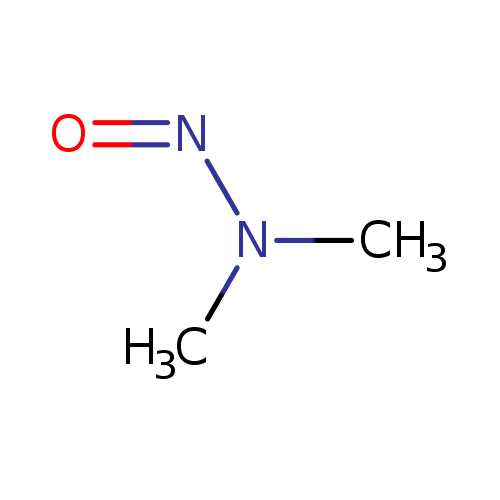
DescriptionN-Nitrosodimethylamine is found in pepper (Capsicum annuum). N-Nitrosodimethylamine is a food contaminant especially in cured meat products. N-Nitrosodimethylamine (NDMA), also known as dimethylnitrosamine (DMN), is a semi-volatile organic chemical that is highly toxic and is a suspected human carcinogen. The US Environmental Protection Agency has determined that the maximum admissible concentration of NDMA in drinking water is 7 ng L 1. The EPA has not yet set a regulatory maximum contaminant level (MCL) for drinking water. At high doses, it is a potent hepatotoxin that can cause fibrosis of the liver in rats. The induction of liver tumors in rats after chronic exposure to low doses is well-documented. Its toxic effects on humans are inferred from animal experiments but not well-established experimentally. NDMA is an industrial by-product or waste product of several industrial processes. It first came to attention as a groundwater contaminant in California in 1998 and 1999 at several sites that produced rocket fuel. Manufacturing of unsymmetrical dimethylhydrazine (UDMH), which is a component of rocket fuel that requires NDMA for its synthesis, proved to be the culprit in these cases. Of more general concern, water treatment via chlorination or chloramination of organic nitrogen-containing wastewater can lead to the production of NDMA at potentially harmful levels. Further, NDMA can form or be leached during treatment of water by anion exchange resins. Finally, NDMA is found at low levels in numerous items of human consumption including cured meat, fish, beer, and tobacco smoke It is, however, unlikely to bioaccumulate. N-nitrosodimethylamine belongs to the family of Nitrosamines. These are compounds containing the nitrosamine functional group, with the structure R2NNO.
Contaminant Sources
  • Clean Air Act Chemicals
  • Disinfection Byproducts
  • FooDB Chemicals
  • HPV EPA Chemicals
  • IARC Carcinogens Group 2A
  • My Exposome Chemicals
  • T3DB toxins
  • Tobacco Smoke Compounds
  • ToxCast & Tox21 Chemicals
Contaminant Type
  • Amine
  • Cigarette Toxin
  • Food Toxin
  • Household Toxin
  • Industrial By-product/Pollutant
  • Industrial/Workplace Toxin
  • Metabolite
  • Nitrite
  • Organic Compound
  • Pesticide
  • Pollutant
  • Synthetic Compound
Chemical Structure
Thumb
Synonyms
ValueSource
1,1-Dimethyl-2-oxohydrazineChEBI
DimethylnitrosamineChEBI
DimethylnitrosoamineChEBI
DMNChEBI
N,N-DimethylnitrosamineChEBI
N NitrosodimethylamineMeSH
Nitrosodimethylamine, ndmaMeSH
NitrosodimethylamineMeSH
NDMA nitrosodimethylamineMeSH
(CH3)2NNOHMDB
Dimethyl-nitrosamineHMDB
DimethylnitrosaminHMDB
DMNAHMDB
N, N-DimethylnitrosamineHMDB
N-Dimethyl-nitrosamineHMDB
N-DimethylnitrosoamineHMDB
N-Methyl-N-nitroso-methamineHMDB
N-Methyl-N-nitroso-methanamineHMDB
N-Methyl-N-nitrosomethanamineHMDB
N-Methyl-N-nitrosomethanamine, 9ciHMDB
N-NitroaodimethylamineHMDB
N-nitroso-DimethylamineHMDB
N-nitroso-N,N-DimethylamineHMDB
NDMAHMDB
Nitrous dimethylamideHMDB
Chemical FormulaC2H6N2O
Average Molecular Mass74.082 g/mol
Monoisotopic Mass74.048 g/mol
CAS Registry Number62-75-9
IUPAC NameN,N-dimethylnitrous amide
Traditional Namenitrosodimethylamine
SMILESCN(C)N=O
InChI IdentifierInChI=1S/C2H6N2O/c1-4(2)3-5/h1-2H3
InChI KeyUMFJAHHVKNCGLG-UHFFFAOYSA-N
Chemical Taxonomy
Description belongs to the class of organic compounds known as organic n-nitroso compounds. These are organic compounds containing a n-nitroso group -NN=O.
KingdomOrganic compounds
Super ClassOrganic nitrogen compounds
ClassOrganonitrogen compounds
Sub ClassOrganic nitroso compounds
Direct ParentOrganic N-nitroso compounds
Alternative Parents
Substituents
  • Organic n-nitroso compound
  • Organic oxygen compound
  • Organopnictogen compound
  • Organic oxide
  • Hydrocarbon derivative
  • Aliphatic acyclic compound
Molecular FrameworkAliphatic acyclic compounds
External Descriptors
Biological Properties
StatusDetected and Not Quantified
OriginExogenous
Cellular Locations
  • Cytoplasm
  • Extracellular
Biofluid LocationsNot Available
Tissue LocationsNot Available
PathwaysNot Available
ApplicationsNot Available
Biological Roles
Chemical RolesNot Available
Physical Properties
StateLiquid
AppearanceYellow liquid. (6)
Experimental Properties
PropertyValue
Melting Point< 25°C
Boiling Point154 °C
Solubility1000 mg/mL at 24°C
Predicted Properties
PropertyValueSource
Water Solubility106 g/LALOGPS
logP-0.53ALOGPS
logP0.039ChemAxon
logS0.15ALOGPS
pKa (Strongest Basic)3.52ChemAxon
Physiological Charge0ChemAxon
Hydrogen Acceptor Count2ChemAxon
Hydrogen Donor Count0ChemAxon
Polar Surface Area32.67 ŲChemAxon
Rotatable Bond Count1ChemAxon
Refractivity20.05 m³·mol⁻¹ChemAxon
Polarizability7.12 ųChemAxon
Number of Rings0ChemAxon
Bioavailability1ChemAxon
Rule of FiveYesChemAxon
Ghose FilterNoChemAxon
Veber's RuleYesChemAxon
MDDR-like RuleNoChemAxon
Spectra
Spectra
Spectrum TypeDescriptionSplash KeyView
Predicted GC-MSPredicted GC-MS Spectrum - GC-MS (Non-derivatized) - 70eV, Positivesplash10-0006-9000000000-6d29f9f7a8384c52f7b5Spectrum
Predicted GC-MSPredicted GC-MS Spectrum - GC-MS (Non-derivatized) - 70eV, PositiveNot AvailableSpectrum
LC-MS/MSLC-MS/MS Spectrum - LC-ESI-QFT , positivesplash10-004i-9000000000-2df59bc19d1d15592467Spectrum
LC-MS/MSLC-MS/MS Spectrum - LC-ESI-QFT , positivesplash10-004i-9000000000-744c0a10617e87137cd5Spectrum
LC-MS/MSLC-MS/MS Spectrum - LC-ESI-QFT , positivesplash10-004i-9000000000-f3f3d5174fd1edee28a6Spectrum
LC-MS/MSLC-MS/MS Spectrum - LC-ESI-QFT , positivesplash10-004i-9000000000-2df59bc19d1d15592467Spectrum
LC-MS/MSLC-MS/MS Spectrum - LC-ESI-QFT , positivesplash10-004i-9000000000-4d289a54c5a2591daa33Spectrum
LC-MS/MSLC-MS/MS Spectrum - 90V, Positivesplash10-004i-9000000000-5a8fb7bb4f334a3f8445Spectrum
LC-MS/MSLC-MS/MS Spectrum - 45V, Positivesplash10-004i-9000000000-d0dbc7bf8508475d923dSpectrum
LC-MS/MSLC-MS/MS Spectrum - 75V, Positivesplash10-004i-9000000000-744c0a10617e87137cd5Spectrum
Predicted LC-MS/MSPredicted LC-MS/MS Spectrum - 10V, Positivesplash10-004i-9000000000-05b7b59e6e0b8b9fc245Spectrum
Predicted LC-MS/MSPredicted LC-MS/MS Spectrum - 20V, Positivesplash10-004i-9000000000-3910f1d3f8050d839f82Spectrum
Predicted LC-MS/MSPredicted LC-MS/MS Spectrum - 40V, Positivesplash10-004l-9000000000-4ab1e2e6522e0f1a2eb3Spectrum
Predicted LC-MS/MSPredicted LC-MS/MS Spectrum - 10V, Negativesplash10-00di-9000000000-eea50ce8e07045a0ad14Spectrum
Predicted LC-MS/MSPredicted LC-MS/MS Spectrum - 20V, Negativesplash10-00di-9000000000-fed38e3c1ad8e9420fd6Spectrum
Predicted LC-MS/MSPredicted LC-MS/MS Spectrum - 40V, Negativesplash10-05fr-9000000000-0d360c627861df90248bSpectrum
Predicted LC-MS/MSPredicted LC-MS/MS Spectrum - 10V, Negativesplash10-00di-9000000000-87753cf4baa848fb8803Spectrum
Predicted LC-MS/MSPredicted LC-MS/MS Spectrum - 20V, Negativesplash10-00di-9000000000-87753cf4baa848fb8803Spectrum
Predicted LC-MS/MSPredicted LC-MS/MS Spectrum - 40V, Negativesplash10-05fu-9000000000-fa476a49943ea98d47ffSpectrum
Predicted LC-MS/MSPredicted LC-MS/MS Spectrum - 10V, Positivesplash10-004i-9000000000-777dda7ebfc4febb2166Spectrum
Predicted LC-MS/MSPredicted LC-MS/MS Spectrum - 20V, Positivesplash10-004i-9000000000-19ff9f5df3b310d929a0Spectrum
Predicted LC-MS/MSPredicted LC-MS/MS Spectrum - 40V, Positivesplash10-002f-9000000000-876fe1a3967818d2717cSpectrum
MSMass Spectrum (Electron Ionization)splash10-00dl-9000000000-25a83bcedddadb3e2b4eSpectrum
1D NMR1H NMR SpectrumNot AvailableSpectrum
1D NMR13C NMR SpectrumNot AvailableSpectrum
1D NMR1H NMR SpectrumNot AvailableSpectrum
1D NMR13C NMR SpectrumNot AvailableSpectrum
1D NMR1H NMR SpectrumNot AvailableSpectrum
1D NMR13C NMR SpectrumNot AvailableSpectrum
1D NMR1H NMR SpectrumNot AvailableSpectrum
1D NMR13C NMR SpectrumNot AvailableSpectrum
1D NMR1H NMR SpectrumNot AvailableSpectrum
1D NMR13C NMR SpectrumNot AvailableSpectrum
1D NMR1H NMR SpectrumNot AvailableSpectrum
1D NMR13C NMR SpectrumNot AvailableSpectrum
1D NMR1H NMR SpectrumNot AvailableSpectrum
1D NMR13C NMR SpectrumNot AvailableSpectrum
1D NMR1H NMR SpectrumNot AvailableSpectrum
1D NMR13C NMR SpectrumNot AvailableSpectrum
1D NMR1H NMR SpectrumNot AvailableSpectrum
1D NMR13C NMR SpectrumNot AvailableSpectrum
1D NMR1H NMR SpectrumNot AvailableSpectrum
1D NMR13C NMR SpectrumNot AvailableSpectrum
1D NMR1H NMR SpectrumNot AvailableSpectrum
1D NMR13C NMR SpectrumNot AvailableSpectrum
Toxicity Profile
Route of ExposureOral (6) ; inhalation (6) ; dermal (6)
Mechanism of ToxicityThe mechanism of NDMAinduced liver toxicity is not clearly understood but may be related to alkylation of cellular protein. (6)
MetabolismEvidence from in vitro and in vivo studies with rodents indicates that NDMA is metabolized by hydroxylation of the alpha-carbon, followed by formation of formaldehyde, molecular nitrogen and a methylating agent, which is considered to be the carcinogenic form. Recent evidence suggests that a significant proportion of NDMA is metabolized via a denitrosation mechanism. (6)
Toxicity ValuesNot Available
Lethal DoseNot Available
Carcinogenicity (IARC Classification)2A, probably carcinogenic to humans. (5)
Uses/SourcesThe general population might be exposed to NDMA from a wide variety of sources, including environmental, consumer, and occupational sources. The primary sources of human exposure to NDMA are tobacco smoke, chewing tobacco, diet (cured meats [particularly bacon], beer, fish, cheese, and other food items), toiletry and cosmetic products (for example, shampoos and cleansers), interior air of cars, and various other household goods, such as detergents and pesticides. In addition, NDMA can form in the stomach during digestion of alkylamine-containing foods. Alkylamines are naturally occurring compounds which are found in some drugs and in a variety of foods. Infants may be exposed to NDMA from the use of rubber baby bottle nipples and pacifiers which may contain very small amounts of NDMA, from ingestion of contaminated infant formulas, and from breast milk of some nursing mothers. Very low levels of NDMA have been found in some samples of human breast milk. Occupational exposure may happen in a large number of places including industries such as tanneries, pesticide manufacturing plants, rubber and tire manufacturing plants, alkylamine manufacture/use industries, fish processing industries, foundries, and dye manufacturing plants. Researchers making or handling NDMA may also be exposed to this compound if it passes through the rubber gloves they wear during laboratory work. (6)
Minimum Risk LevelNot Available
Health EffectsNDMA is very harmful to the liver of animals and humans. Moreover, although there are no reports of NDMA causing cancer in humans, it is reasonable to expect that exposure to NDMA by eating, drinking, or breathing could also cause cancer in humans. (6)
SymptomsNot Available
TreatmentNot Available
Concentrations
Not Available
DrugBank IDNot Available
HMDB IDHMDB0031419
FooDB IDFDB003496
Phenol Explorer IDNot Available
KNApSAcK IDNot Available
BiGG IDNot Available
BioCyc IDNot Available
METLIN IDNot Available
PDB IDNot Available
Wikipedia LinkN-Nitrosodimethylamine
Chemspider ID5894
ChEBI ID35807
PubChem Compound ID6124
Kegg Compound IDC14704
YMDB IDNot Available
ECMDB IDNot Available
References
Synthesis ReferenceNot Available
MSDSNot Available
General References
1. Godoy W, Albano RM, Moraes EG, Pinho PR, Nunes RA, Saito EH, Higa C, Filho IM, Kruel CD, Schirmer CC, Gurski R, Lang MA, Pinto LF: CYP2A6/2A7 and CYP2E1 expression in human oesophageal mucosa: regional and inter-individual variation in expression and relevance to nitrosamine metabolism. Carcinogenesis. 2002 Apr;23(4):611-6.
2. Lee MF, Liu ML, Cheng AC, Tsai ML, Ho CT, Liou WS, Pan MH: Pterostilbene inhibits dimethylnitrosamine-induced liver fibrosis in rats. Food Chem. 2013 Jun 1;138(2-3):802-7. doi: 10.1016/j.foodchem.2012.11.094. Epub 2012 Dec 1.
3. Lee MF, Tsai ML, Sun PP, Chien LL, Cheng AC, Ma NJ, Ho CT, Pan MH: Phyto-power dietary supplement potently inhibits dimethylnitrosamine-induced liver fibrosis in rats. Food Funct. 2013 Feb 26;4(3):470-5. doi: 10.1039/c2fo30306j.
4. Kao HW, Chen CL, Chang WY, Chen JT, Lin WJ, Liu RS, Wang HE: (18)F-FBHGal for asialoglycoprotein receptor imaging in a hepatic fibrosis mouse model. Bioorg Med Chem. 2013 Feb 15;21(4):912-21. doi: 10.1016/j.bmc.2012.12.022. Epub 2012 Dec 22.
5. Yannai, Shmuel. (2004) Dictionary of food compounds with CD-ROM: Additives, flavors, and ingredients. Boca Raton: Chapman & Hall/CRC.