Record Information
Version1.0
Creation Date2009-03-06 18:58:13 UTC
Update Date2026-05-14 19:38:59 UTC
Accession NumberCHEM000156
Identification
Common Name1,2-Dichlorobenzene
ClassSmall Molecule
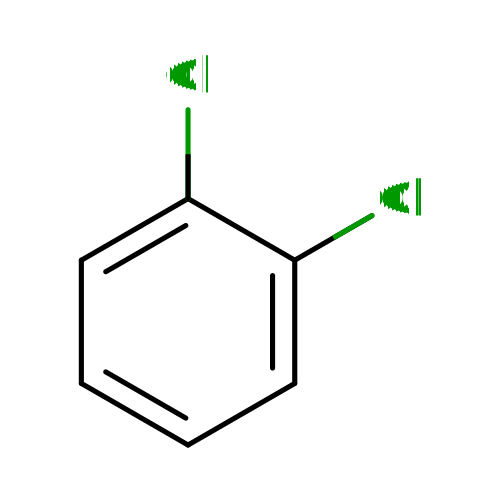
Description1,2-Dichlorobenzene (1,2-DCB), or ortho-dichlorobenzene, is an organic compound with the formula C6H4Cl2. This colourless liquid is poorly soluble in water but miscible with most organic solvents. 1,2-Dichlorobenzene contains two chlorine atoms connected to one benzene molecule. Most of the 1,2-DCB released into the environment is present as a vapor. 1,2-DCB can burn, but they do not burn easily. (4, 5)
Contaminant Sources
  • Clean Air Act Chemicals
  • HPV EPA Chemicals
  • IARC Carcinogens Group 3
  • My Exposome Chemicals
  • OECD HPV Chemicals
  • STOFF IDENT Compounds
  • Sludge Chemicals
  • T3DB toxins
  • ToxCast & Tox21 Chemicals
Contaminant Type
  • Aromatic Hydrocarbon
  • Food Toxin
  • Household Toxin
  • Industrial Precursor/Intermediate
  • Industrial/Workplace Toxin
  • Organic Compound
  • Organochloride
  • PMT
  • Pollutant
  • Solvent
  • Synthetic Compound
Chemical Structure
Thumb
Synonyms
ValueSource
1,2-DichlorbenzeneChEBI
2-DichlorobenzeneChEBI
O-DichlorbenzeneChEBI
O-DichlorbenzolChEBI
O-DichlorobenzeneChEBI
O-DichlorobenzolChEBI
ODBChEBI
ODCBChEBI
Ortho-dichlorobenzeneChEBI
OrthodichlorobenzolChEBI
Chemical FormulaC6H4Cl2
Average Molecular Mass147.002 g/mol
Monoisotopic Mass145.969 g/mol
CAS Registry Number95-50-1
IUPAC Name1,2-dichlorobenzene
Traditional Nameo-dichlorobenzene
SMILESClC1=CC=CC=C1Cl
InChI IdentifierInChI=1S/C6H4Cl2/c7-5-3-1-2-4-6(5)8/h1-4H
InChI KeyRFFLAFLAYFXFSW-UHFFFAOYSA-N
Chemical Taxonomy
Description belongs to the class of organic compounds known as dichlorobenzenes. Dichlorobenzenes are compounds containing a benzene with exactly two chlorine atoms attached to it.
KingdomOrganic compounds
Super ClassBenzenoids
ClassBenzene and substituted derivatives
Sub ClassHalobenzenes
Direct ParentDichlorobenzenes
Alternative Parents
Substituents
  • 1,2-dichlorobenzene
  • Aryl halide
  • Aryl chloride
  • Hydrocarbon derivative
  • Organochloride
  • Organohalogen compound
  • Aromatic homomonocyclic compound
Molecular FrameworkAromatic homomonocyclic compounds
External Descriptors
Biological Properties
StatusDetected and Not Quantified
OriginExogenous
Cellular Locations
  • Membrane
Biofluid LocationsNot Available
Tissue LocationsNot Available
PathwaysNot Available
ApplicationsNot Available
Biological Roles
Chemical RolesNot Available
Physical Properties
StateLiquid
AppearanceNot Available
Experimental Properties
PropertyValue
Melting Point−17.03 °C
Boiling Point180.5 °C
Solubility0.156 mg/mL at 25 °C [BANERJEE,S et al. (1980)]
Predicted Properties
PropertyValueSource
Water Solubility0.13 g/LALOGPS
logP3.45ALOGPS
logP3.18ChemAxon
logS-3ALOGPS
Physiological Charge0ChemAxon
Hydrogen Acceptor Count0ChemAxon
Hydrogen Donor Count0ChemAxon
Polar Surface Area0 ŲChemAxon
Rotatable Bond Count0ChemAxon
Refractivity35.67 m³·mol⁻¹ChemAxon
Polarizability13.14 ųChemAxon
Number of Rings1ChemAxon
Bioavailability1ChemAxon
Rule of FiveYesChemAxon
Ghose FilterNoChemAxon
Veber's RuleYesChemAxon
MDDR-like RuleNoChemAxon
Spectra
Spectra
Spectrum TypeDescriptionSplash KeyView
Predicted GC-MSPredicted GC-MS Spectrum - GC-MS (Non-derivatized) - 70eV, Positivesplash10-0002-4900000000-ed22e3b3735c8f886000Spectrum
Predicted GC-MSPredicted GC-MS Spectrum - GC-MS (Non-derivatized) - 70eV, PositiveNot AvailableSpectrum
Predicted LC-MS/MSPredicted LC-MS/MS Spectrum - 10V, Positivesplash10-0002-0900000000-52c3bd8205a4f0ead156Spectrum
Predicted LC-MS/MSPredicted LC-MS/MS Spectrum - 20V, Positivesplash10-0002-0900000000-e30f3ac9da5390f16fd0Spectrum
Predicted LC-MS/MSPredicted LC-MS/MS Spectrum - 40V, Positivesplash10-0002-2900000000-17e9afe7ecc2c63e69a0Spectrum
Predicted LC-MS/MSPredicted LC-MS/MS Spectrum - 10V, Negativesplash10-0006-0900000000-a7f5c62ca76e66384427Spectrum
Predicted LC-MS/MSPredicted LC-MS/MS Spectrum - 20V, Negativesplash10-0006-0900000000-a7f5c62ca76e66384427Spectrum
Predicted LC-MS/MSPredicted LC-MS/MS Spectrum - 40V, Negativesplash10-0006-2900000000-9a277937df8ee460120eSpectrum
Predicted LC-MS/MSPredicted LC-MS/MS Spectrum - 10V, Positivesplash10-0002-0900000000-a9d440f8a98d9647aefbSpectrum
Predicted LC-MS/MSPredicted LC-MS/MS Spectrum - 20V, Positivesplash10-0002-0900000000-b4e7aaf058572214ab34Spectrum
Predicted LC-MS/MSPredicted LC-MS/MS Spectrum - 40V, Positivesplash10-0002-4900000000-66deb994ab1f5d98c920Spectrum
Predicted LC-MS/MSPredicted LC-MS/MS Spectrum - 10V, Negativesplash10-0006-0900000000-49a9c8d124e4edc0341aSpectrum
Predicted LC-MS/MSPredicted LC-MS/MS Spectrum - 20V, Negativesplash10-0006-0900000000-49a9c8d124e4edc0341aSpectrum
Predicted LC-MS/MSPredicted LC-MS/MS Spectrum - 40V, Negativesplash10-000x-5900000000-2f0e2dd918e51872d249Spectrum
MSMass Spectrum (Electron Ionization)splash10-0002-2900000000-6f733f1aa31b3d6188f1Spectrum
1D NMR1H NMR SpectrumNot AvailableSpectrum
1D NMR13C NMR SpectrumNot AvailableSpectrum
Toxicity Profile
Route of ExposureInhalation (6) ; oral (6) ; dermal (6)
Mechanism of Toxicity1,2-DCB was found to covalently bind to DNA, RNA, and proteins of liver, kidney, lung, and stomach. (4)
MetabolismAfter absorption, 1,2-DCB ist distributed in blood, the urinary bladder, kidney, fat, and liver. The initial step in the metabolism of 1,2-DCB is metabolism by cytochrome P-450 isozymes, mainly P4502E1, to an active epoxide. This epoxide can either react directly with cellular components, be conjugated to glutathione or glucuronic acid, or be hydrolyzed to form 2,3-dichlorophenol or 3,4-dichlorophenol. The dichlorophenol metabolites can be further metabolized by conjugation with glutathione, glucuronic acid, or sulfate, or further oxidized to catechols. An additional oxidation to form dichlorohydroquinone metabolites has also been proposed. Microsomal studies have implicated cytochrome P-450, and particularly P4502E1, as a major component of 1,2-DCB metabolism, resulting in the formation of dichlorophenols, dichlorocatechols, and dichlorohydroquinones. 1,2-DCB is eliminated primarily in the urine as metabolites rather than as the parent compound. (4)
Toxicity ValuesLD50: 500 mg/kg (Oral, Rat) (4)
Lethal DoseNot Available
Carcinogenicity (IARC Classification)3, not classifiable as to its carcinogenicity to humans. (3)
Uses/SourcesExposure may result from breathing contaminated air, drinking contaminated water or eating contaminated food, and skin contact. (4)
Minimum Risk LevelAcute Oral: 0.7 mg/kg/day (Rat and Mouse) (2) Intermediate Oral: 0.6 mg/kg/day (Rat and Mouse) (2) Chronic Oral: 0.3 mg/kg/day (Rat and Mouse) (2)
Health EffectsInhaling the vapor or dusts of 1,2-DCB at very high concentrations could be very irritating to eyes and nose and cause burning and tearing of the eyes, coughing, difficult breathing, and an upset stomach. Ingestion of 1,2-DCB can cause effects in the kidneys and blood, and that 1,3-DCB caused thyroid and pituitary effects. (4)
SymptomsCough, drowsiness, sore throat and unconsciousness can result from inhalation. Burning sensation, diarrhoea, nausea and vomiting can follow ingestion. In case of dermal or eye exposure, redness and pain of the exposed surface can occur. Moreover, skin exposure can cause skin dryness. (6)
TreatmentFollowing oral exposure, administer charcoal as a slurry; administer oxygen to all cyanotic or symptomatic patients. In case of methemoglobinemia, administer 1 to 2 mg/kg of 1% methylene blue slowly IV in symptomatic patients; also consider adjunctive therapy. In case of inhalation exposure, move patient to fresh air; monitor for respiratory distress. If cough or difficulty breathing develops, evaluate for respiratory tract irritation, bronchitis, or pneumonitis. Administer oxygen and assist ventilation as required. Treat bronchospasm with inhaled beta2 agonist and oral or parenteral corticosteroids. Following eye exposure, irrigate exposed eyes with copious amounts of room temperature water for at least 15 minutes. Following dermal exposure, skin should be thoroughly washed with soap and water; contaminated clothing and shoes should be discarded. Administer 100 percent humidified supplemental oxygen with assisted ventilation as required. Treat for methemoglobinemia and sequelae. Signs and symptoms of methemoglobinemia may be delayed. (7)

Concentrations
Not Available
DrugBank IDNot Available
HMDB IDHMDB0244067
FooDB IDNot Available
Phenol Explorer IDNot Available
KNApSAcK IDNot Available
BiGG IDNot Available
BioCyc IDO-DICHLOROBENZENE
METLIN IDNot Available
PDB IDNot Available
Wikipedia Link1,2-Dichlorobenzene
Chemspider ID13837988
ChEBI ID35290
PubChem Compound ID7239
Kegg Compound IDC14328
YMDB IDNot Available
ECMDB IDNot Available
References
Synthesis ReferenceNot Available
MSDSNot Available
General References
1. https://www.ncbi.nlm.nih.gov/pubmed/?term=10048141
2. https://www.ncbi.nlm.nih.gov/pubmed/?term=10698672
3. https://www.ncbi.nlm.nih.gov/pubmed/?term=14168435
4. https://www.ncbi.nlm.nih.gov/pubmed/?term=15792297
5. https://www.ncbi.nlm.nih.gov/pubmed/?term=22165224
6. Barupal DK, Fiehn O: Generating the Blood Exposome Database Using a Comprehensive Text Mining and Database Fusion Approach. Environ Health Perspect. 2019 Sep;127(9):97008. doi: 10.1289/EHP4713. Epub 2019 Sep 26.