Record Information
Version1.0
Creation Date2009-03-06 18:58:11 UTC
Update Date2026-03-31 19:41:43 UTC
Accession NumberCHEM000146
Identification
Common Name1,4-Dichlorobenzene
ClassSmall Molecule
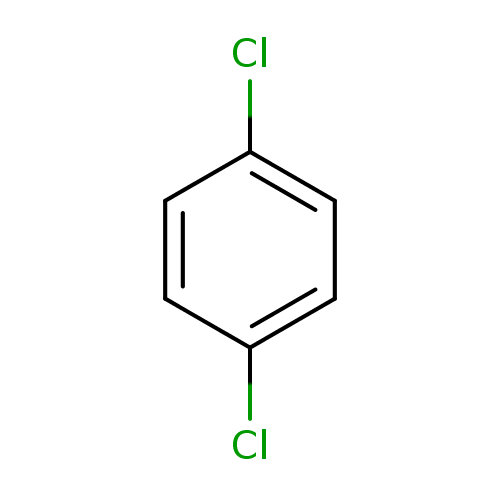
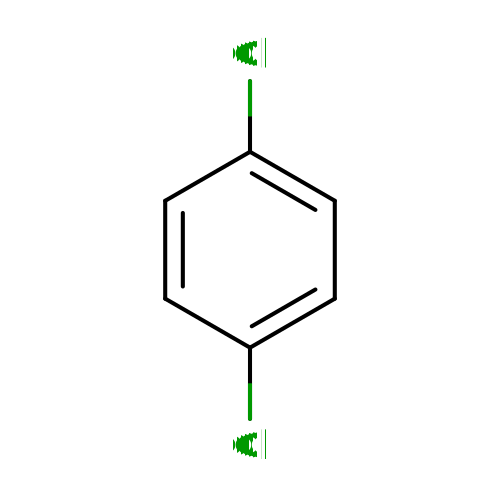
Description1,4-Dichlorobenzene (p-DCB, para-dichlorobenzene) is an organic compound with the formula C6H4Cl2. This colorless solid has a strong odor. In terms of its structure, the molecule consists of two chlorine atoms substituted for hydrogen at opposing sites on a benzene ring. p-DCB is used a pesticide and a deodorant, most familiarly in mothballs in which it is a replacement for the more traditional naphthalene. p-DCB is also used as a precursor in the production of the polymer poly(p-phenylene sulfide). Under California's Proposition 65, p-DCB is listed as known to the State to cause cancer.[8] A probable mechanism for the carcinogenic effects of mothballs and some types of air fresheners containing p-DCB has been identified.
Contaminant Sources
  • Clean Air Act Chemicals
  • HMDB Contaminants - Feces
  • HPV EPA Chemicals
  • IARC Carcinogens Group 2B
  • My Exposome Chemicals
  • OECD HPV Chemicals
  • STOFF IDENT Compounds
  • Sludge Chemicals
  • T3DB toxins
  • ToxCast & Tox21 Chemicals
Contaminant Type
  • Aromatic Hydrocarbon
  • Food Toxin
  • Household Toxin
  • Industrial Precursor/Intermediate
  • Industrial/Workplace Toxin
  • Lachrymator
  • Metabolite
  • Organic Compound
  • Organochloride
  • Pesticide
  • Pollutant
  • Synthetic Compound
Chemical Structure
Thumb
Synonyms
ValueSource
p-Chlorophenyl chlorideChEBI
p-DichlorbenzolChEBI
PARAChEBI
ParadichlorbenzolChEBI
ParadichlorobenzeneChEBI
PDCBChEBI
1, 4-DichlorobenzeneHMDB
1,4-ChlorobenzeneHMDB
1,4-DichloorbenzeenHMDB
1,4-Dichlor-benzolHMDB
1,4-Dichloro-benzeneHMDB
1,4-Dichlorobenzene (acd/name 4.0)HMDB
1,4-DiclorobenzeneHMDB
Di-chloricideHMDB
DichlorobenzeneHMDB
Dichlorobenzene, p-, solidHMDB
Dichlorobenzene, paraHMDB
DichlorocideHMDB
EvolaHMDB
GlobolHMDB
KaydoxHMDB
p-DichloorbenzeenHMDB
p-DichlorbenzeneHMDB
p-Dichloro-benzeneHMDB
p-DichlorobenzolHMDB
p-DiclorobenzeneHMDB
Para crystalsHMDB
Para-dichlorobenzeneHMDB
ParacideHMDB
ParadiHMDB
ParadichlorobenzolHMDB
ParadowHMDB
ParamothHMDB
ParanuggetsHMDB
ParazeneHMDB
PDBHMDB
Persia-perazolHMDB
Rcra waste number u070HMDB
Rcra waste number u071HMDB
Rcra waste number u072HMDB
SantochlorHMDB
4-DichlorobenzeneHMDB
P-DichlorobenzeneChEBI
Chemical FormulaC6H4Cl2
Average Molecular Mass147.002 g/mol
Monoisotopic Mass145.969 g/mol
CAS Registry Number106-46-7
IUPAC Name1,4-dichlorobenzene
Traditional Nameparadi
SMILESClC1=CC=C(Cl)C=C1
InChI IdentifierInChI=1S/C6H4Cl2/c7-5-1-2-6(8)4-3-5/h1-4H
InChI KeyOCJBOOLMMGQPQU-UHFFFAOYSA-N
Chemical Taxonomy
Description belongs to the class of organic compounds known as dichlorobenzenes. Dichlorobenzenes are compounds containing a benzene with exactly two chlorine atoms attached to it.
KingdomOrganic compounds
Super ClassBenzenoids
ClassBenzene and substituted derivatives
Sub ClassHalobenzenes
Direct ParentDichlorobenzenes
Alternative Parents
Substituents
  • 1,4-dichlorobenzene
  • Aryl halide
  • Aryl chloride
  • Hydrocarbon derivative
  • Organochloride
  • Organohalogen compound
  • Aromatic homomonocyclic compound
Molecular FrameworkAromatic homomonocyclic compounds
External Descriptors
Biological Properties
StatusDetected and Not Quantified
OriginExogenous
Cellular Locations
  • Membrane
Biofluid LocationsNot Available
Tissue LocationsNot Available
PathwaysNot Available
Applications
Biological RolesNot Available
Chemical RolesNot Available
Physical Properties
StateSolid
AppearanceWhite powder.
Experimental Properties
PropertyValue
Melting Point52.7°C
Boiling PointNot Available
Solubility0.0813 mg/mL at 25°C
Predicted Properties
PropertyValueSource
Water Solubility0.14 g/LALOGPS
logP3.46ALOGPS
logP3.18ChemAxon
logS-3ALOGPS
Physiological Charge0ChemAxon
Hydrogen Acceptor Count0ChemAxon
Hydrogen Donor Count0ChemAxon
Polar Surface Area0 ŲChemAxon
Rotatable Bond Count0ChemAxon
Refractivity35.67 m³·mol⁻¹ChemAxon
Polarizability13.32 ųChemAxon
Number of Rings1ChemAxon
Bioavailability1ChemAxon
Rule of FiveYesChemAxon
Ghose FilterNoChemAxon
Veber's RuleYesChemAxon
MDDR-like RuleNoChemAxon
Spectra
Spectra
Spectrum TypeDescriptionSplash KeyView
GC-MSGC-MS Spectrum - EI-B (Non-derivatized)splash10-0002-4900000000-73f255545f9196d189adSpectrum
GC-MSGC-MS Spectrum - EI-B (Non-derivatized)splash10-0002-2900000000-983d7c8ebc0e5f138b53Spectrum
GC-MSGC-MS Spectrum - EI-B (Non-derivatized)splash10-0002-4900000000-33e4c1cd3b8d393493c5Spectrum
GC-MSGC-MS Spectrum - EI-B (Non-derivatized)splash10-0002-2900000000-324c6fc09e913a17becfSpectrum
GC-MSGC-MS Spectrum - EI-B (Non-derivatized)splash10-0002-4900000000-73f255545f9196d189adSpectrum
GC-MSGC-MS Spectrum - EI-B (Non-derivatized)splash10-0002-2900000000-983d7c8ebc0e5f138b53Spectrum
GC-MSGC-MS Spectrum - EI-B (Non-derivatized)splash10-0002-4900000000-33e4c1cd3b8d393493c5Spectrum
GC-MSGC-MS Spectrum - EI-B (Non-derivatized)splash10-0002-2900000000-324c6fc09e913a17becfSpectrum
Predicted GC-MSPredicted GC-MS Spectrum - GC-MS (Non-derivatized) - 70eV, Positivesplash10-0002-3900000000-20b22c60107af8d61659Spectrum
Predicted GC-MSPredicted GC-MS Spectrum - GC-MS (Non-derivatized) - 70eV, PositiveNot AvailableSpectrum
Predicted LC-MS/MSPredicted LC-MS/MS Spectrum - 10V, Positivesplash10-0002-0900000000-29f82f20a2b88e992b2fSpectrum
Predicted LC-MS/MSPredicted LC-MS/MS Spectrum - 20V, Positivesplash10-0002-0900000000-79725bc4bbbb391c3305Spectrum
Predicted LC-MS/MSPredicted LC-MS/MS Spectrum - 40V, Positivesplash10-0002-0900000000-92754602e0e625430820Spectrum
Predicted LC-MS/MSPredicted LC-MS/MS Spectrum - 10V, Negativesplash10-0006-0900000000-40127a320d53fe67229cSpectrum
Predicted LC-MS/MSPredicted LC-MS/MS Spectrum - 20V, Negativesplash10-0006-0900000000-40127a320d53fe67229cSpectrum
Predicted LC-MS/MSPredicted LC-MS/MS Spectrum - 40V, Negativesplash10-0006-1900000000-30520308036afaac23c0Spectrum
Predicted LC-MS/MSPredicted LC-MS/MS Spectrum - 10V, Negativesplash10-0006-0900000000-49a9c8d124e4edc0341aSpectrum
Predicted LC-MS/MSPredicted LC-MS/MS Spectrum - 20V, Negativesplash10-0006-0900000000-49a9c8d124e4edc0341aSpectrum
Predicted LC-MS/MSPredicted LC-MS/MS Spectrum - 40V, Negativesplash10-0006-1900000000-2a065e692fdf9b188915Spectrum
Predicted LC-MS/MSPredicted LC-MS/MS Spectrum - 10V, Positivesplash10-0002-0900000000-a9d440f8a98d9647aefbSpectrum
Predicted LC-MS/MSPredicted LC-MS/MS Spectrum - 20V, Positivesplash10-0002-0900000000-a9d440f8a98d9647aefbSpectrum
Predicted LC-MS/MSPredicted LC-MS/MS Spectrum - 40V, Positivesplash10-0002-4900000000-cd14a666e852017d58a1Spectrum
MSMass Spectrum (Electron Ionization)splash10-0002-3900000000-12fe56062da20e240f5cSpectrum
1D NMR1H NMR SpectrumNot AvailableSpectrum
1D NMR13C NMR SpectrumNot AvailableSpectrum
1D NMR1H NMR SpectrumNot AvailableSpectrum
1D NMR13C NMR SpectrumNot AvailableSpectrum
1D NMR1H NMR SpectrumNot AvailableSpectrum
1D NMR13C NMR SpectrumNot AvailableSpectrum
1D NMR1H NMR SpectrumNot AvailableSpectrum
1D NMR13C NMR SpectrumNot AvailableSpectrum
1D NMR1H NMR SpectrumNot AvailableSpectrum
1D NMR13C NMR SpectrumNot AvailableSpectrum
1D NMR1H NMR SpectrumNot AvailableSpectrum
1D NMR13C NMR SpectrumNot AvailableSpectrum
1D NMR1H NMR SpectrumNot AvailableSpectrum
1D NMR13C NMR SpectrumNot AvailableSpectrum
1D NMR1H NMR SpectrumNot AvailableSpectrum
1D NMR13C NMR SpectrumNot AvailableSpectrum
1D NMR1H NMR SpectrumNot AvailableSpectrum
1D NMR13C NMR SpectrumNot AvailableSpectrum
1D NMR1H NMR SpectrumNot AvailableSpectrum
1D NMR13C NMR SpectrumNot AvailableSpectrum
1D NMR1H NMR SpectrumNot AvailableSpectrum
Toxicity Profile
Route of ExposureInhalation (6) ; oral (6) ; dermal (6) ; eye contact (6)
Mechanism of ToxicityThe hepatotoxicity and nephrotoxicity observed in laboratory animals are likely due to the formation of toxic intermediates formed while converting 1,4-DCB to 2,5-dichlorophenol by cytochrome P-450, or by depletion of GSH at higher doses of 1,4-DCB, or both. (5)
MetabolismAbsorption of 1,4-DCB is rapid and essentially complete following inhalation or oral exposure. It is distributed throughout the body, preferentially to the fat tissue and organ-specific sites within the body, following the order: adipose > kidney > liver > blood. 1,4-DCB is initially metabolized by cytochrome P-450 enzymes, specifically P4502E1, to an active epoxide followed by hydrolysis to 2,5-dichlorophenol, which may be further oxidized to dichlorocatechols, or possibly a dichlorohydroquinone. More often, it might be conjugated to sulfate, or to form the glucuronide, or mercapturic acid; conjugation occurs extensively, with virtually no unconjugated metabolites reported in the available studies. Metabolism is believed to occur mainly in the liver, but may occur at lower levels in other tissues, such as the kidney or lung. 1,4-DCB is eliminated almost exclusively in the urine, primarily as conjugates of 2,5-dichlorophenol. (5)
Toxicity ValuesLD50: >6000 mg/kg/day (Dermal, Rat) (5) LD50: 500 mg/kg/day (Oral, Rat) (5)
Lethal DoseNot Available
Carcinogenicity (IARC Classification)2B, possibly carcinogenic to humans. (3)
Uses/Sources1,4-DCB is used a pesticide and a deodorant, most famously in mothballs in which it is a replacement for the more traditional naphthalene. 1,4-DCB is also used as a precursor in the production of the polymer poly(p-phenylene sulfide). 1,4-DCB also is used to make deodorant blocks used in garbage cans and restrooms, and to help control odors in animal-holding facilities. 1,4-DCB has been used as an insecticide on fruit and as an agent to control mold and mildew growth on tobacco seeds, leather, and some fabrics. Recently, using 1,4-DCB to make resins has become very important. Exposure may result from breathing vapors from 1,4-DCB products, drinking contaminated water or eating contaminated food (However, the levels of p-DCB in foods are generally low), and eye exposure. (4, 5, 6)
Minimum Risk LevelAcute Inhalation: 2 ppm (5) Intermediate Inhalation: 0.2 ppm (5) Chronic Inhalation: 0.01 ppm (5) Intermediate Oral: 0.07 mg/kg/day (Rodent) (5) Chronic Oral: 0.07 mg/kg/day (Rat) (5)
Health EffectsProlonged exposure to high concentration of 1,4-DCB may cause weakness, dizziness, loss of weight, liver injury. Chronic (months to years) ingestion of 1,4-DCB products can provoque skin blotches and problems with red blood cells, such as anemia. There is an indication that 1,4-DCB can affect the development of the nervous system after birth. 1,4-DCB is possibly a human carcinogen. (5, 8)
SymptomsBurning sensation, cough, drowsiness, headache, nausea, shortness of breath, and vomiting can follow inhalation or ingestion of 1,4-DCB. Moreover, its ingestion can cause diarrhoea. Eye exposure can lead to redness and pain of the contact surface. Vapors may cause irritation to skin, nose, throat, and eyes. Solid p-dichlorobenzene has very little effect on the skin. (5, 8)
TreatmentAdminister charcoal as a slurry (240 mL water/30 g charcoal). Following inhalation, move patient to fresh air. Monitor for respiratory distress. If cough or difficulty breathing develops, evaluate for respiratory tract irritation, bronchitis, or pneumonitis. Administer oxygen and assist ventilation as required. Treat bronchospasm with inhaled beta2 agonist and oral or parenteral corticosteroids. After eye exposure, irrigate exposed eyes with copious amounts of room temperature water for at least 15 minutes. If the exposure occurs through dermal contact, remove contaminated clothing and wash exposed area thoroughly with soap and water. In any case, a physician may need to examine the area if irritation or pain persists. (7)
Concentrations
Not Available
DrugBank IDNot Available
HMDB IDHMDB0041971
FooDB IDNot Available
Phenol Explorer IDNot Available
KNApSAcK IDNot Available
BiGG IDNot Available
BioCyc IDNot Available
METLIN IDNot Available
PDB IDNot Available
Wikipedia Link1,4-Dichlorobenzene
Chemspider ID13866817
ChEBI ID28618
PubChem Compound ID4685
Kegg Compound IDC07092
YMDB IDYMDB16063
ECMDB IDNot Available
References
Synthesis ReferenceNot Available
MSDSNot Available
General References
1. https://www.ncbi.nlm.nih.gov/pubmed/?term=10817668
2. https://www.ncbi.nlm.nih.gov/pubmed/?term=17750169
3. https://www.ncbi.nlm.nih.gov/pubmed/?term=23899931
4. Gutierrez-Plascencia P, Ruiz-Sandoval MC, Martinez-Rocha M, Chiquete E, Zuniga-Ramirez C, Ruiz-Sandoval JL: [Dementia associated to paradichlorobenzene poisoning]. Rev Neurol. 2012 Feb 16;54(4):251-2.