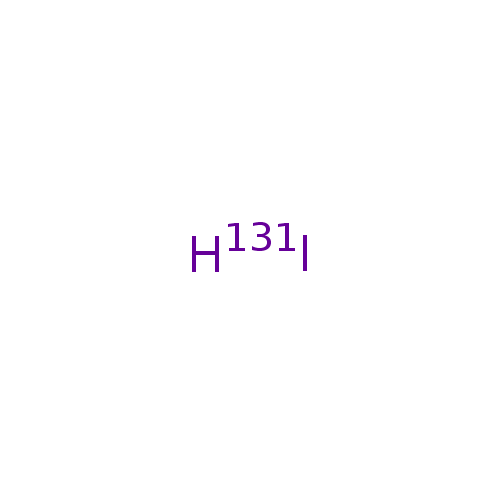
Iodine is a chemical element that has the symbol I and atomic number 53. Chemically, iodine is the second least reactive of the halogens, and the second most electropositive halogen; trailing behind astatine in both of these categories. However, the element does not occur in the free state in nature. As with all other halogens, when freed from its compounds iodine forms diatomic molecules. Iodine naturally occurs in the environment chiefly as a dissolved iodide in seawater, although it is also found in some minerals and soils. Iodine is an essential trace element for life, mainly as constituents of the thyroid hormones, thyroxine (10) and triiodothyronine (9). Iodine-131 is used in nuclear medicine both diagnostically and therapeutically. Examples of its use in radiation therapy include the treatment of thyrotoxicosis and thyroid cancer. Diagnostic tests exploit the mechanism of absorption of iodine by the normal cells of the thyroid gland. Iodine-131 is also used as a radioactive label for radiopharmaceuticals that can be used for imaging and therapy. (5, 6)
belongs to the class of inorganic compounds known as halogen hydrides. These are inorganic compounds in which the heaviest atom bonded to a hydrogen atom is a halogen.
Iodide inhibits adenylate cyclase in thyroid gland follicle cells and decreases the TSH-induced rise in intracellular cAMP. This results in decreased iodination of thyroglobulin and inhibited production and release of T4 and T3, causing hypothyroidism. The ionizing radiation produced by radioiodine causes cellular damage that includes DNA breakage, accurate or inaccurate repair, apoptosis, gene mutations, chromosomal change, and genetic instability. This leads to loss of normal cell and tissue homeostasis, and development of malignancy. Ionizing radiation that does not directly damage DNA can produce reactive oxygen intermediates that directly affect the stability of p53, an important enzyme in cell-cycle regulation, and produce oxidative damage to individual bases in DNA and point mutations by mispairing during DNA replication. (2, 3, 4)
Metabolism
Iodine can enter the body following ingestion, inhalaiton, or dermal exposure. In the body, iodine and iodide accumulates in the thyroid gland, where it is used for producing the thyroid hormones T4 and T3. Iodide in the thyroid gland is incorporated into a protein, thyroglobulin, as covalent complexes with tyrosine residues. The iodination of thyroglobulin is catalyzed by the enzyme thyroid peroxidase. The iodination reactions occur at the follicular cell-lumen interface and consist of the oxidation of iodide to form a reactive intermediate, the formation of monoiodotyrosine and diiodotyrosine residues in thyroglobulin, and the coupling of theiodinated tyrosine residues to form T4 (coupling of two diiodotyrosine residues) or T3 (coupling of a monoiodotyrosine and diiodotyrosine residue) in thyroglobulin. The major pathways of metabolism of iodine that occur outside of the thyroid gland involve the catabolism of T4 and T3, and include deiodination reactions, ether bond cleavage of thyronine, oxidative deamination and decarboxylation of the side chain of thyronine, and conjugation of the phenolic hydroxyl group on thyronine with glucuronic acid and sulfate. Absorbed iodine is excreted primarily in the urine and feces, but is also excreted in breast milk, exhaled air, sweat, and tears. (4)
Iodine-131 is used in nuclear medicine both diagnostically and therapeutically. Examples of its use in radiation therapy include the treatment of thyrotoxicosis and thyroid cancer. Diagnostic tests exploit the mechanism of absorption of iodine by the normal cells of the thyroid gland. Iodine-131 is also used as a radioactive label for radiopharmaceuticals that can be used for imaging and therapy. (6)
Minimum Risk Level
Not Available
Health Effects
Exposure to high levels of nonradioactive and radioactive iodine can damage the thyroid. Damage to the thyroid gland can result in effects in other parts of your body, such as your skin, lung, and reproductive organs. Concentrated iodine is very corrosive and can damage the mucous membrane if swallowed. Radioactive iodine can also cause cancer, especially of the thyroid, where it tends to concentrate. (4, 6, 7)
Symptoms
Ingestion of iodine may cause corrosive effects such as oedema of the glottis, with asphyxia, aspiration pneumonia, pulmonary oedema and shock, as well as vomiting and bloody diarrhea. The CNS, cardiovascular and renal toxicity following acute iodine ingestion appear to be due to the corrosive gastroenteritis and resultant shock. Vomiting, hypotension and circulatory collapse may be noted following severe intoxication. Exposure to high doses of ionizing radiation results in acute radiation syndrome, which can cause skin burns, hair loss, nausea, vomiting, dizziness, disorientation, low blood pressure, headache, fatigue, weakness, fever, birth defects, illness, infection, and death. (2, 8, 7)
Treatment
Sodium thiosulphate, 100 mL orally of a 1% solution, has been recommended as an antidote because it immediately reduces iodine to iodide. Treatment reversing the effects of irradiation is currently not possible. Anaesthetics and antiemetics are administered to counter the symptoms of exposure, as well as antibiotics for countering secondary infections due to the resulting immune system deficiency. (8, 7)