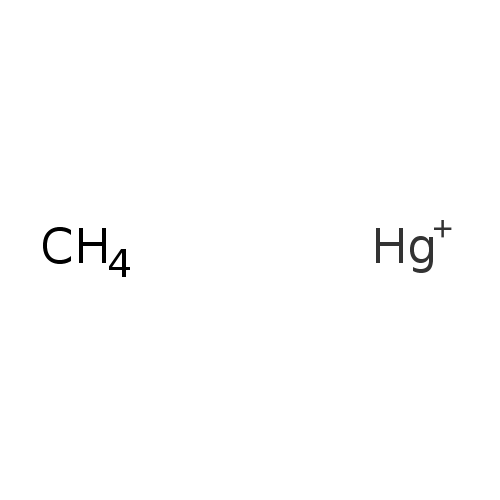
Methylmercury is an organometallic cation. It is formed by the burning of wastes and fossil fuels containing inorganic mercury, as well as by the action of anaerobic organisms on inorganic mercury. It is particularily hazardous due to its ability to bioaccumulate in the environment, particularily in aquatic systems. (12)
belongs to the class of organic compounds known as hydrocarbon derivatives. These are derivatives of hydrocarbons obtained by substituting one or more carbon atoms by an heteroatom. They contain at least one carbon atom and heteroatom.
Methylmercury is neurotoxic. It potently affects the release of neurotransmitter from presynaptic nerve terminals. Methylmercury alters calcium ion concentrations by at least two mechanisms. First, it disrupts regulation of Ca2+ from an intracellular Ca2+ pool and second, it increases the permeability of the plasma membrane to Ca2+. Methylmercury also blocks plasma membrane voltage-dependent Ca2+ and Na+ channels in addition to activating a nonspecific transmembrane cation conductance. Chronic Methylmercury exposure results in ultrastructural changes and accumulation of Methylmercury within mitochondria. In vitro, Methylmercury inhibits several mitochondrial enzymes and depolarizes the mitochondria membrane subsequently reducing ATP production and Ca2+ buffering capacity. Inhibition of protein synthesis is observed after in vivo or in vitro exposures of Methylmercury and may be an early effect of Methylmercury poisoning. Organic mercury exerts developmental effects by binding to tubulin, preventing microtubule assembly and causing mitotic inhibition (6)
Metabolism
Ingested methylmercury is readily and completely absorbed by the gastrointestinal tract. Methylmercury has a half-life in human blood of about 50 days. Organic mercury complexes with free cysteine and the cysteine and sulfhydryl groups on proteins such as haemoglobin. The methylmercuric-cysteinyl complex is recognized by amino acid transporting proteins in the body as methionine, another essential amino acid. Because of this mimicry, it is transported freely throughout the body including across the blood–brain barrier and across the placenta, where it is absorbed by the developing fetus. Also for this reason as well as its strong binding to proteins, methylmercury is not readily eliminated. Because methylmercury is formed in aquatic systems and because it is not readily eliminated from organisms it is biomagnified. Organic mercury is metabolized into inorganic mercury, which is eventually excreted in the urine and faeces. (6)
Methylmercury is a pollutant producted by the burning of fossil fuels and wastes containing inorganic mercury. It bioaccumulates in aquatic systems and exposure can result from ingesting contaminated fish. (12)
Mercury mainly affects the nervous system. Exposure to high levels of metallic, inorganic, or organic mercury can permanently damage the brain, kidneys, and developing fetus. Effects on brain functioning may result in irritability, shyness, tremors, changes in vision or hearing, and memory problems. Acrodynia, a type of mercury poisoning in children, is characterized by pain and pink discoloration of the hands and feet. Mercury poisoning can also cause Hunter-Russell syndrome and Minamata disease. (7)
Symptoms
Chronic Exposure:Common symptoms include peripheral neuropathy, skin discoloration, edema, and desquamation. (1)
Acute Exposure: Symptoms of ingestion within the first few minutes may include pain, profuse vomiting and severe purging and the victim may die within a few hours from peripheral vascular collapse secondary to fluid and electrolyte loss. Primary gastroenteritis may subside spontaneously within a few days but severe hemorrhagic inflammation of the colon (colitis) has occurred as late as 9 days following ingestion. A second phase developing over 1-3 days is characterized by stomatitis (lesions of the mouth parts), membranous colitis and kidney damage (tubular nephritis). This second phase is associated with a slow and prolonged excretion of mercury by salivary glands, the gastrointestinal mucosa and kidneys. Death in this phase usually occurs as a result of kidney failure.
Treatment
Mercury poisoning is treated by immediate decontamination and chelation therapy using DMSA, DMPS, DPCN, or dimercaprol. (2)