Record Information
Version1.0
Creation Date2009-03-06 18:58:04 UTC
Update Date2026-03-26 19:59:12 UTC
Accession NumberCHEM000085
Identification
Common NameCyclotrimethylenetrinitramine
ClassSmall Molecule
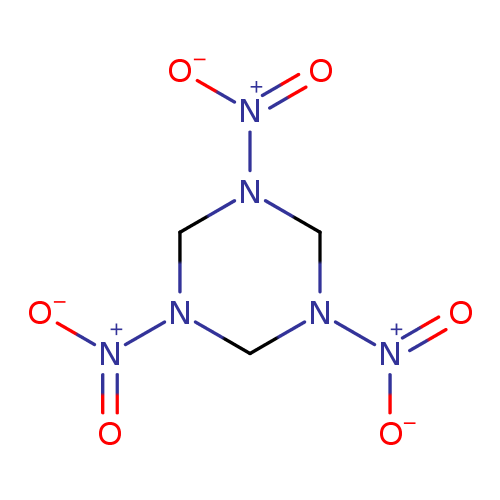
DescriptionCyclotrimethylenetrinitramine is a chemical compound also called RDX, which stands for Royal Demolition Explosive. It is also known as cyclonite or hexogen. The chemical name for RDX is 1,3,5-trinitro-1,3,5-triazine and it is a very explosive white powder that creates fumes when it is burned with other substances. As such, it is used as an explosive and it is also used in combination with other ingredients in explosives. RDX is a synthetic product that does not occur naturally in the environment. (2)
Contaminant Sources
  • HPV EPA Chemicals
  • STOFF IDENT Compounds
  • T3DB toxins
Contaminant Type
  • Amine
  • Explosive Agent
  • Industrial/Workplace Toxin
  • Nitrite
  • Organic Compound
  • Synthetic Compound
Chemical Structure
Thumb
Synonyms
ValueSource
1,3,5-Trinitro-1,3,5-triazacyclohexaneChEBI
1,3,5-Trinitrohexahydro-1,3,5-triazineChEBI
1,3,5-Trinitrohexahydro-S-triazineChEBI
CycloniteChEBI
Hexahydro-1,3,5-trinitro-1,3,5-triazineChEBI
HexogenChEBI
RDXChEBI
Sym-trimethylene trinitramineChEBI
TrimethyleentrinitramineChEBI
TrinitrotrimethylenetriamineChEBI
Cyclotrimethylene trinitramineMeSH
hexahydro-1,3,5-trinitro-S-TriazineMeSH
1,3,5-trinitro-1,3,5-TriazineMeSH
Chemical FormulaC3H6N6O6
Average Molecular Mass222.116 g/mol
Monoisotopic Mass222.035 g/mol
CAS Registry Number121-82-4
IUPAC Name1,3,5-trinitro-1,3,5-triazinane
Traditional Namecyclotrimethylenetrinitramine
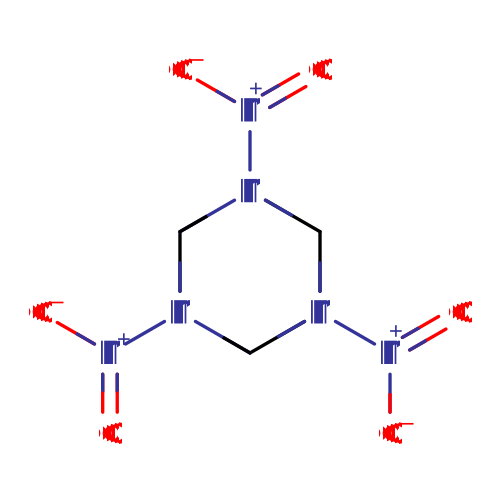
SMILES[O-][N+](=O)N1CN(CN(C1)[N+]([O-])=O)[N+]([O-])=O
InChI IdentifierInChI=1S/C3H6N6O6/c10-7(11)4-1-5(8(12)13)3-6(2-4)9(14)15/h1-3H2
InChI KeyXTFIVUDBNACUBN-UHFFFAOYSA-N
Chemical Taxonomy
Description belongs to the class of organic compounds known as 1,3,5-triazinanes. These are triazinanes having three nitrogen ring atoms at the 1-, 3-, and 5- positions.
KingdomOrganic compounds
Super ClassOrganoheterocyclic compounds
ClassTriazinanes
Sub Class1,3,5-triazinanes
Direct Parent1,3,5-triazinanes
Alternative Parents
Substituents
  • 1,3,5-triazinane
  • Organic nitro compound
  • Azacycle
  • Organic 1,3-dipolar compound
  • Allyl-type 1,3-dipolar organic compound
  • Organic nitrogen compound
  • Organic oxygen compound
  • Organopnictogen compound
  • Organic oxide
  • Hydrocarbon derivative
  • Organonitrogen compound
  • Aliphatic heteromonocyclic compound
Molecular FrameworkAliphatic heteromonocyclic compounds
External Descriptors
Biological Properties
StatusDetected and Not Quantified
OriginExogenous
Cellular Locations
  • Cytoplasm
  • Extracellular
Biofluid LocationsNot Available
Tissue LocationsNot Available
PathwaysNot Available
ApplicationsNot Available
Biological RolesNot Available
Chemical RolesNot Available
Physical Properties
StateSolid
AppearanceWhite powder.
Experimental Properties
PropertyValue
Melting Point205.5°C
Boiling PointNot Available
Solubility0.0597 mg/mL at 25 °C [YALKOWSKY,SH & HE,Y (2003)]
Predicted Properties
PropertyValueSource
Water Solubility1.34 g/LALOGPS
logP1.07ALOGPS
logP-0.48ChemAxon
logS-2.2ALOGPS
Physiological Charge0ChemAxon
Hydrogen Acceptor Count9ChemAxon
Hydrogen Donor Count0ChemAxon
Polar Surface Area147.18 ŲChemAxon
Rotatable Bond Count3ChemAxon
Refractivity43.93 m³·mol⁻¹ChemAxon
Polarizability16.08 ųChemAxon
Number of Rings1ChemAxon
Bioavailability1ChemAxon
Rule of FiveYesChemAxon
Ghose FilterNoChemAxon
Veber's RuleNoChemAxon
MDDR-like RuleNoChemAxon
Spectra
Spectra
Spectrum TypeDescriptionSplash KeyView
Predicted GC-MSPredicted GC-MS Spectrum - GC-MS (Non-derivatized) - 70eV, Positivesplash10-00di-0090000000-3bfc43492d47aef742b1Spectrum
Predicted GC-MSPredicted GC-MS Spectrum - GC-MS (Non-derivatized) - 70eV, PositiveNot AvailableSpectrum
Predicted LC-MS/MSPredicted LC-MS/MS Spectrum - 10V, Positivesplash10-00di-0090000000-16bf5c8406814589961eSpectrum
Predicted LC-MS/MSPredicted LC-MS/MS Spectrum - 20V, Positivesplash10-00di-0290000000-528c091277c138ba31b5Spectrum
Predicted LC-MS/MSPredicted LC-MS/MS Spectrum - 40V, Positivesplash10-06wc-9310000000-ade9f5f10d78c1e4713fSpectrum
Predicted LC-MS/MSPredicted LC-MS/MS Spectrum - 10V, Negativesplash10-00di-2090000000-49d83bfe928d03d90e57Spectrum
Predicted LC-MS/MSPredicted LC-MS/MS Spectrum - 20V, Negativesplash10-05di-9440000000-0c5e5b1c7f10344e7e2dSpectrum
Predicted LC-MS/MSPredicted LC-MS/MS Spectrum - 40V, Negativesplash10-000i-3910000000-98930ca4c173df4a75cfSpectrum
MSMass Spectrum (Electron Ionization)splash10-000w-9100000000-9703866ef7f20ad53fe8Spectrum
Toxicity Profile
Route of ExposureOral (2); inhalation (2) ; dermal (2)
Mechanism of ToxicityRDX can get into the lungs after breathing in the fumes of burning RDX or breathing in the dust from powdered RDX. It can also enter the body after ingestion of contaminated water. It may also pass through the skin into the bloodstream or enter through cuts or breaks in the skin. It also blocks electron transport. (3, 2)
MetabolismThere are no studies available regarding RDX metabolites in humans following inhalation, oral, or dermal exposure. Some studies reported that 4-nitro-2,4-diazabutanal, and nitrite ions are produced through biotransformation of RDX by cytochrome P450. The limited toxicological data show that RDX is absorbed through the gastrointestinal system, lungs, and skin, and is distributed to the cerebrospinal fluid, plasma, urine, and feces. RDX will leaves the body in the breath and urine within a few days. (2, 1)
Toxicity ValuesNot Available
Lethal DoseNot Available
Carcinogenicity (IARC Classification)No indication of carcinogenicity to humans (not listed by IARC).
Uses/SourcesRDX is used as an explosive and is also used in combination with other ingredients in explosives. Exposure may occur by breathing dust containing RDX, contact with the skin, or drinking contaminated water. (2)
Minimum Risk LevelAcute Oral: 0.06 mg/kg/day (Rat) (2) Intermediate Oral: 0.03 mg/kg/day (Rat) (2)
Health EffectsRDX can cause seizures. Inhalation exposure to RDX can lead to gastrointestinal, hematological, hepatic, and renal effects. (2)
SymptomsSymptoms of RDX exposure include epileptiform seizures, insomnia, restlessness, headache, dizziness, nausea, vomiting and irritability. Temporary postconvulsive amnesia, malaise, fatigue, and asthenia can follow the seizures. (4)
TreatmentFollowing oral exposure, symptomatic patients should be given adequate respiratory support during seizures. Monitor liver and renal function tests and urinalysis in patients with significant exposure. Following inhalation exposure, move patient to fresh air. Monitor for respiratory distress. If cough or difficulty breathing develops, evaluate for respiratory tract irritation, bronchitis, or pneumonitis. Administer oxygen and assist ventilation as required. Treat bronchospasm with inhaled beta2 agonist and oral or parenteral corticosteroids. Following eye exposure, irrigate exposed eyes with copious amounts of room temperature water for at least 15 minutes. If irritation, pain, swelling, lacrimation, or photophobia persist, the patient should be seen in a health care facility. Following dermal exposure, remove contaminated clothing and wash exposed area thoroughly with soap and water. A physician may need to examine the area if irritation or pain persists. (5)

Concentrations
Not Available
DrugBank IDNot Available
HMDB IDHMDB0253161
FooDB IDNot Available
Phenol Explorer IDNot Available
KNApSAcK IDNot Available
BiGG IDNot Available
BioCyc IDNot Available
METLIN IDNot Available
PDB IDNot Available
Wikipedia LinkRDX
Chemspider ID8177
ChEBI ID24556
PubChem Compound IDNot Available
Kegg Compound IDNot Available
YMDB IDNot Available
ECMDB IDNot Available
References
Synthesis ReferenceNot Available
MSDSNot Available
General References
1. https://www.ncbi.nlm.nih.gov/pubmed/?term=25142696
2. https://www.ncbi.nlm.nih.gov/pubmed/?term=26247847
3. https://www.ncbi.nlm.nih.gov/pubmed/?term=26552520
4. https://www.ncbi.nlm.nih.gov/pubmed/?term=27010164
5. https://www.ncbi.nlm.nih.gov/pubmed/?term=27285383
6. https://www.ncbi.nlm.nih.gov/pubmed/?term=27301804
7. https://www.ncbi.nlm.nih.gov/pubmed/?term=27387802