Record Information
Version1.0
Creation Date2009-03-06 18:58:02 UTC
Update Date2026-05-14 17:12:34 UTC
Accession NumberCHEM000077
Identification
Common Name2,4,6-Trinitrotoluene
ClassSmall Molecule
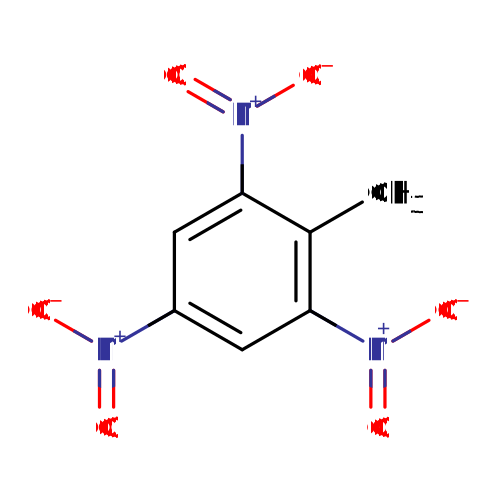
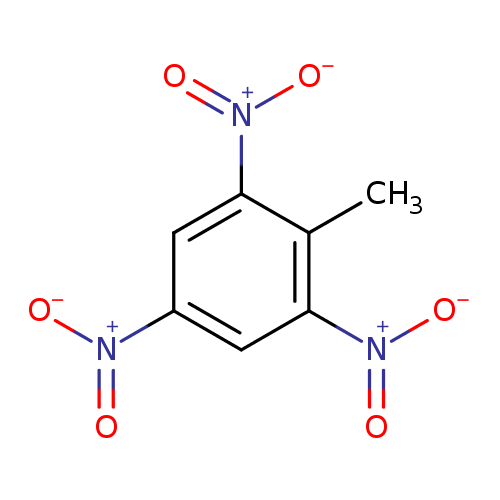
DescriptionTrinitrotoluene (TNT), or more specifically, 2,4,6-trinitrotoluene, is a chemical compound with the formula C6H2(NO2)3CH3. This yellow-coloured solid is a reagent (reactant) in chemistry but is best known as a useful explosive material with convenient handling properties. The explosive yield of TNT is considered the standard measure of strength of bombs and other explosives. In chemistry, TNT is used to generate charge transfer salts. (3)
Contaminant Sources
  • FooDB Chemicals
  • HPV EPA Chemicals
  • IARC Carcinogens Group 3
  • STOFF IDENT Compounds
  • Suspected Compounds
  • T3DB toxins
Contaminant Type
  • Aromatic Hydrocarbon
  • Explosive Agent
  • Food Toxin
  • Human Neurotoxin
  • Indicator and Reagent
  • Industrial/Workplace Toxin
  • Nitrite
  • Organic Compound
  • Synthetic Compound
Chemical Structure
Thumb
Synonyms
ValueSource
1-Methyl-2,4,6-trinitrobenzeneChEBI
2,4,6-TNTChEBI
2,4,6-TrinitrotoluolChEBI
alpha-TNTChEBI
S-TrinitrotolueneChEBI
S-TrinitrotoluolChEBI
Sym-trinitrotoluolChEBI
TNTChEBI
TrinitrotoluenChEBI
TrinitrotolueneChEBI
TrinitrotoluolChEBI
TritolChEBI
TrotylChEBI
a-TNTGenerator
Α-TNTGenerator
2,4,6-TrinitrotolueneKEGG
Chemical FormulaC7H5N3O6
Average Molecular Mass227.131 g/mol
Monoisotopic Mass227.018 g/mol
CAS Registry Number118-96-7
IUPAC Name2-methyl-1,3,5-trinitrobenzene
Traditional Nameα-tnt
SMILESCC1=C(C=C(C=C1[N+]([O-])=O)[N+]([O-])=O)[N+]([O-])=O
InChI IdentifierInChI=1S/C7H5N3O6/c1-4-6(9(13)14)2-5(8(11)12)3-7(4)10(15)16/h2-3H,1H3
InChI KeySPSSULHKWOKEEL-UHFFFAOYSA-N
Chemical Taxonomy
Description belongs to the class of organic compounds known as nitrobenzenes. Nitrobenzenes are compounds containing a nitrobenzene moiety, which consists of a benzene ring with a carbon bearing a nitro group.
KingdomOrganic compounds
Super ClassBenzenoids
ClassBenzene and substituted derivatives
Sub ClassNitrobenzenes
Direct ParentNitrobenzenes
Alternative Parents
Substituents
  • Nitrobenzene
  • Nitrotoluene
  • Nitroaromatic compound
  • Toluene
  • C-nitro compound
  • Organic nitro compound
  • Organic oxoazanium
  • Allyl-type 1,3-dipolar organic compound
  • Organic 1,3-dipolar compound
  • Propargyl-type 1,3-dipolar organic compound
  • Organic nitrogen compound
  • Hydrocarbon derivative
  • Organic oxide
  • Organonitrogen compound
  • Organopnictogen compound
  • Organic oxygen compound
  • Aromatic homomonocyclic compound
Molecular FrameworkAromatic homomonocyclic compounds
External Descriptors
Biological Properties
StatusDetected and Not Quantified
OriginExogenous
Cellular Locations
  • Membrane
Biofluid LocationsNot Available
Tissue LocationsNot Available
PathwaysNot Available
ApplicationsNot Available
Biological RolesNot Available
Chemical Roles
Physical Properties
StateSolid
AppearancePale yellow, odorless solid. Loose "needles" before melt-casting. A solid block after being poured into a casing. (3)
Experimental Properties
PropertyValue
Melting Point80.1°C
Boiling Point240 °C (L131)
Solubility0.115 mg/mL at 23 °C [PHELAN,JM & BARNETT,JL (2001)]
Predicted Properties
PropertyValueSource
Water Solubility0.078 g/LALOGPS
logP1.5ALOGPS
logP2.31ChemAxon
logS-3.5ALOGPS
pKa (Strongest Acidic)16.99ChemAxon
Physiological Charge0ChemAxon
Hydrogen Acceptor Count6ChemAxon
Hydrogen Donor Count0ChemAxon
Polar Surface Area137.46 ŲChemAxon
Rotatable Bond Count3ChemAxon
Refractivity53.07 m³·mol⁻¹ChemAxon
Polarizability17.9 ųChemAxon
Number of Rings1ChemAxon
Bioavailability1ChemAxon
Rule of FiveYesChemAxon
Ghose FilterYesChemAxon
Veber's RuleNoChemAxon
MDDR-like RuleNoChemAxon
Spectra
Spectra
Spectrum TypeDescriptionSplash KeyView
Predicted GC-MSPredicted GC-MS Spectrum - GC-MS (Non-derivatized) - 70eV, Positivesplash10-004i-6190000000-735664b29a5e158ecc6eSpectrum
Predicted GC-MSPredicted GC-MS Spectrum - GC-MS (Non-derivatized) - 70eV, PositiveNot AvailableSpectrum
LC-MS/MSLC-MS/MS Spectrum - APCI-ITFT , negativesplash10-03di-0890000000-f022cff7bafbe3946255Spectrum
Predicted LC-MS/MSPredicted LC-MS/MS Spectrum - 10V, Positivesplash10-004i-0090000000-f6e342b117ed300d424aSpectrum
Predicted LC-MS/MSPredicted LC-MS/MS Spectrum - 20V, Positivesplash10-0uk9-0090000000-92d082746b1341998dfbSpectrum
Predicted LC-MS/MSPredicted LC-MS/MS Spectrum - 40V, Positivesplash10-0v4j-0690000000-bb9a7e5ed2c59b968232Spectrum
Predicted LC-MS/MSPredicted LC-MS/MS Spectrum - 10V, Negativesplash10-004i-0090000000-826ba2a9c274efe75160Spectrum
Predicted LC-MS/MSPredicted LC-MS/MS Spectrum - 20V, Negativesplash10-004i-0090000000-0e8740a26a1b43c5472fSpectrum
Predicted LC-MS/MSPredicted LC-MS/MS Spectrum - 40V, Negativesplash10-00fr-1190000000-714043def040a5a6a26eSpectrum
MSMass Spectrum (Electron Ionization)splash10-03di-9460000000-f13fe3ac3044698c32a4Spectrum
Toxicity Profile
Route of ExposureOral (4) ; inhalation (4) ; dermal (4)
Mechanism of Toxicity2,4,6-Trinitrotoluene is a competitive inhibitor with respect to NADPH and a noncompetitive inhibitor with respect to L-arginine. It binds to the P450 reductase domain of the eNOS and suppresses l-citrulline formation by shunting electrons away from the normal catalytic pathway. The reduction of TNT then produces reactive oxygen species (ROS), such as superoxide (O2.−), and hydrogen peroxide (H2O2). The overproduction of superoxide is associated with oxidative stress-mediated induction of cataracts. The inhibition of the eNOS activity occurs in a concentration-dependent manner. (1, 2)
Metabolism2,4,6-Trinitrotoluene rapidly and completely enters the body through inhalation or ingestion, but more slowly through the skin. Once 2,4,6-trinitrotoluene is in the blood, it travels throughout the body to all of the organs. When it reaches the liver, it breaks down and changes into several different substances, such as 4-aminodinitrotoluene, 2-aminodinitrotoluene and 2,4-diamino-6-nitrotoluene. Most of these substances travel in the blood until they reach the kidneys. Almost all of the 2,4,6-trinitrotoluene that enters the body breaks down and leaves the body in the urine within 24 hours. (5)
Toxicity ValuesNot Available
Lethal DoseNot Available
Carcinogenicity (IARC Classification)3, not classifiable as to its carcinogenicity to humans. (7)
Uses/Sources2,4,6-Trinitrotoluene is an explosive used in military shells, bombs, and grenades, in industrial uses, and in underwater blasting. Exposure may results from drinking contaminated water that has migrated from chemical waste disposal sites, breathing contaminated air, eating contaminated foods such as fruits and vegetables, and/or eating contaminated soil. (5)
Minimum Risk LevelIntermediate Oral: 0.0005 mg/kg/day (6)
Health EffectsExposition to high concentrations of 2,4,6-trinitrotoluene in air can lead to several harmful health effects, including anemia and abnormal liver function. Similar blood and liver effects, as well as spleen enlargement and other harmful effects on the immune system, have been observed in animals that ate or breathed 2,4,6-trinitrotoluene. Other effects in humans include skin irritation after prolonged skin contact, and cataract development after long-term (365 days or longer) exposure. It is not known whether 2,4,6-trinitrotoluene can cause birth defects in humans. However, male animals treated with high doses of 2,4,6-trinitrotoluene have developed serious reproductive system effects. Moreover, the EPA has determined that 2,4,6-trinitrotoluene is a possible human carcinogen. (5)
SymptomsExposure to 2,4,6-trinitrotoluene causes headache, blue lips or finger nails, blue skin, cough, sore throat, laboured breathing, vomiting, abdominal cramps, unconsciousness. Dermal exposure may cause pain and redness at the exposed surface and yellowish staining of the skin. (4)
TreatmentIn some cases, gastric lavage, activated charcoal, and emetics have been suggested as useful in reducing absorption of the general class of nitro compounds to which 2,4,6-trinitrotoluene belongs. (5)
Concentrations
Not Available
DrugBank IDDB01676
HMDB IDHMDB0245483
FooDB IDFDB030299
Phenol Explorer IDNot Available
KNApSAcK IDNot Available
BiGG IDNot Available
BioCyc IDNot Available
METLIN IDNot Available
PDB IDNot Available
Wikipedia LinkTrinitrotoluene
Chemspider ID8073
ChEBI ID46053
PubChem Compound ID8376
Kegg Compound IDC16391
YMDB IDNot Available
ECMDB IDM2MDB004659
References
Synthesis Reference

Hubert E. de Cazenove, Daniel Doyen, Jacques M. Dussidour, Jean-Jacques Gautier, “Process for continuous production of trinitrotoluene.” U.S. Patent US4022844, issued May, 1960.

MSDSNot Available
General References
1. https://www.ncbi.nlm.nih.gov/pubmed/?term=19427119
2. https://www.ncbi.nlm.nih.gov/pubmed/?term=20219247
3. https://www.ncbi.nlm.nih.gov/pubmed/?term=28845964
4. Barupal DK, Fiehn O: Generating the Blood Exposome Database Using a Comprehensive Text Mining and Database Fusion Approach. Environ Health Perspect. 2019 Sep;127(9):97008. doi: 10.1289/EHP4713. Epub 2019 Sep 26.