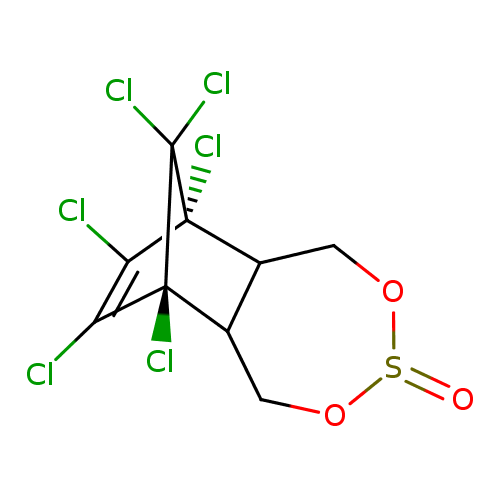
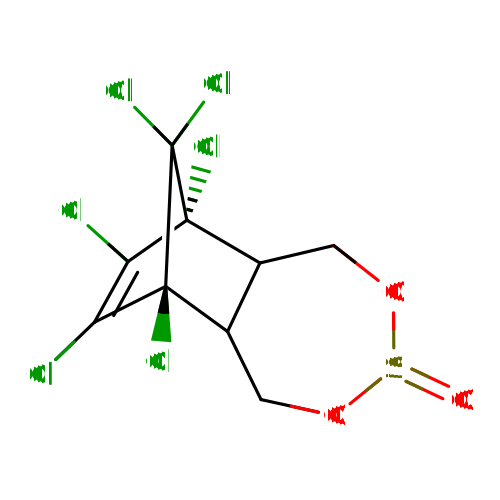
Endosulfan, beta is one of two stereoisomers of endosulfan. Endosulfan is an organochlorine insecticide and acaricide. It is used to control insects on food and non-food crops and as a wood preservative. Due to its toxicity and tendency to bioaccumulate, the use of endosulfan is banned in many areas. (4)
belongs to the class of organic compounds known as sulfite esters. These are organic compounds containing an organic group attached to the sulfite oxoanion, with the formula R[SO3]2-.
Endosulfan antagonizes the action of the neurotransmitter gamma-aminobutyric acid (GABA) acting at the GABA-A receptors, effectively blocking the GABA-induced uptake of chloride ions. Endosulfan also inhibits Na+ K+ ATPase and Ca2+ and Mg2+ ATPase which are essential for the transport of calcium across membranes. This results in the accumulation of intracellular free calcium ions, which promotes release of neurotransmitters from storage vesicles, the subsequent depolarization of adjacent neurons, and the propagation of stimuli throughout the CNS. This results in hyperexcitation and generalized seizures. Endosulfan is also an endocrine disruptor and acts as an agonist at the progesterone receptor and estrogen receptors. (8, 4, 5, 1, 3)
Metabolism
Endosulfan is absorbed by inhalation, oral, and dermal routes of exposure. It accumulates mainly in the liver, kidney, and brain, and is metabolized to polar and nonpolar metabolites by cytochrome P-450 enzymes. Endosulfan and its metabolites, which include sulfate, diol, α-hydroxyether, lactone, and ether derivatives of endosulfan, are excreted in the urine and faeces. (5)
Endosulfan is a neurotoxin and damages the central nervous system, causing effects such as intermittent muscle twitching and myoclonic jerking. Endosulfan can also damage the kidneys, testes, and liver, and may possibly affect the body's ability to fight infection. It is also an endocrine disruptor and causes reproductive and developmental damage. (8, 4, 5)
Symptoms
Symptoms of endosulfan poisoning include hyperactivity, hyperreflexia, tremors, dizziness, headache, convulsions, lack of coordination, staggering, difficulty breathing, nausea and vomiting, diarrhea, and in severe cases, unconsciousness. (8, 4, 5)
Treatment
Treatment is symptomatic, aimed at controlling convulsions, coma, and respiratory depression. If ingested, gastric lavage may be performed, followed by administering activated charcoal powder. (7)